About the author
Introduction
This book will seek to add to the vast array of existing literature in Socionics, contributing a new theory, with the addition of 17 elements, a renaming and reconceptualisation of the cognitive positions, and functions, creation of 5th and 0 Dimensions, and more.
Foundational Concepts
Socionics fundamentals:
Information Elements (short-hand designations)-
Ni- Introverted Intuition
Ne- Extraverted Intuition
Se- Extraverted Sensing
Si- Introverted Sensing
Fe- Extraverted Feeling
Fi- Introverted Feeling
Ti- Introverted Thinking
Te- Extraverted Thinking
The first letter stands for the Information element, the last letter stands for the direction (extraverted or introverted) of the information element.
Model A Information Element definitions
Ni- Internal dynamics of fields
Ne- Internal static of objects
Si- External dynamics of fields
Se- External static of objects
Ti- External static of fields
Te- External dynamics of objects
Fi- Internal static of fields
Fe- Internal dynamics of objects
Cognitive position of Information Elements
Ego- Lead Function, Creative Function
Id- Ignoring Function, Demonstrative Function
Super-Ego- Role Function, PolR Function
Super-id- Mobilising Function, Dual Seeking Function.
Strength by Cognitive position (Model A)
Most powerful- Lead and Demonstrative functions
Moderately powerful- Creative and Ignoring functions
Moderately Weak- Role and Mobilising functions
Weak- Dual Seeking, and PolR functions
About the author
Michael has completed postgraduate studies in Psychology at the University of Melbourne, Australia.
Thank you to all the Socionics theorists. You have given me such resplendent joy, hitting upon untold truths and reality.
Namely, thank you to (in alphabetical order)
Aushra Augusta, Irina and Sergei Beletskiy, Li-ubov Beskova, Aleksandr Bukalov, Richard De-Long, Alexander Dogvan, Irina Eglit, Vladimir Ermak, Ekaterina Filatova, Sergei Ganin, Victor Gulenko, Igor Kalinauskas, Oleg Kruhrulev, Vladimir Lvov, Dmitriy Lytov, Valentina and Anatoly Meged, Vladimir Mironov, Vera Noviko-va, Tatiana Prokofieva, Grigoriy Reinin, Versa Stratievskaya, Victor Talanov, Olga Tangemann, Aleksei Trehov, Pavel Tsypin, Elena Udalova, Igor Weisband
In addition to these, thank you to
Dr. Dario Nardi
May Socionics flourish and gain the recognition it so eminently deserves.
Chapter 1- Model R
The unique distinction of this theory is it blends multiple creative innovations with Neuroscientific literature, and Socionics theories to form an accurate definition of what the Information Elements are, and reconceptualises, redefines and relabels three of the cognitive positions. Model R defines precisely what the + and – polarity is when applied to all Information Elements, with + polarity being based on a ‘subjective, universal’ focus to the Information Elements perception/judgement and fields/objects, and then an ‘objective and local’ application to those same elements. Equally, – polarity adds an ‘objective, local’ primary focus to the Information Elements perception/judgement and fields/objects, and then a ‘subjective and universal’ reference to those same elements. It has created 2 new dimensions, the 5th and the 0-dimension, and defined precisely which cognitive positions they’re expressed through. The 5th-dimension, which operates through the Immutable law of the universe- constant expansive motion, is termed ‘evolution’ and labelled therefore the ‘Evolution function’. It also defines and labels the 0-dimension as conceptual union with external all-encompassing reality, that source of consciousness underlying and inherent to Enlightenment Philosopher John Locke’s ‘Tabula Rasa’, is labeled as ‘awareness’. It defines precisely which cognitive position expresses the 5th-dimension (Demonstrative) and the 0-dimension (PolR). It then renames the ‘Ignoring’ function as the ‘Survival’ function since this is more in alignment with its anatomical activation (the brain stem in and Basal Ganglia in the Reptilian Cortex), its cognitive and consciousness expression, and its alignment with Sigmund Freuds ‘id’, that block Socionics has placed the ‘ignoring function’ in. It recategorises the ‘Lead’ function as the ‘Program’ function. This is not an innovation however, and is chosen because this term is more accurate than ‘Lead’, since fundamentally, all people do not ‘Lead’ with this Ego function, but a large number of humanity ‘Lead’ with their Ignoring function, ‘ignoring’ their ‘Lead’ function in the process. Furthermore, it does not describe all – polarity as ‘experiential’ perception, but differentiates both polarities as operating through the full encompassment of dimensionality (awareness, experience, norms, situation, time and evolution) concurrently. However, it distinguishes both polarities expressions (+ and -) as being defined by the ordering of the dimensions being either ‘based’ or ‘referencing’, that is, the order of which they are subjective, universal (+), and objective, local (-). It then draws from the wider Neuroscientific literature with regards to the left and right hemisphere Information Element correspondence. Once this is established, it references the vast array of Neuroscientific and Socionics literature to inform the physics structural elements of life (time, space, matter, energy) correspondence to the brain hemispheres and therefore the Information Elements. Finally, it concretises and incorporates various Socionics theorists statement that the ‘conscious vs unconscious’ nature of an Information Element is determined by the cognitive position, and that the Information Elements can be divided into two distinct categories of ‘perception vs judging’ based on Socionics own sociotype categorisations. This is concretely instantiated in the definitions as these designations are in agreement with the extensive Neuroscientific literature which include the use of EEG scans. Therefore, there is vast scientific justification for their incorporation.
Model R incorporates new elements to the Information Elements definitions of Socionics Model A. In total, there is 17 additional elements in Model R:
1. Perception/Judgement status.
2. Information Elements + and – polarities.
3. The definitional translation of both polarities + (Subjective and Universal), and – (Objective and Local).
4. The polarities universal application across all Information Elements in perception/judgement and fields/objects.
5. The cognitive positions effect on the Information Elements definitional transmutation.
6. Defines the concurrent dimensional perception/judgement for each type.
7. Explains the epigenetic root cause behind increased and decreased Id consciousness across cultures.
8. Justifies which brain hemisphere is ideally placed in the Program function.
9. Brain hemisphere correspondence of Information Elements.
10. Physics structural elements (Time, Space, Energy, Matter) correspondences.
11. The creation of the 5th and 0 dimensions.
12. The cognitive positions of the 5th and 0 Dimensions.
13. Defines and explains the True Ordering of the Information Elements correspondence with the Physics structural eleemnts of life.
14. Renaming the Demonstrative and Ignoring Functions to ‘Evolution’ and ‘Survival’ functions, with biological, psychological and functional justifications.
15. Binary polarity distinctions of all dimensions (referencing vs based).
16. Dimensionality alterations based on cognitive position.
17. Conscious vs unconscious nature of Information Elements.
For a complete summary of each of these new elements, please see Chapter 11.
Socionics Model A Ni definition: Ni:
Internal dynamics of fields.
Model R’s lead Ni definitions:
Ni+ Subjective right hemispheric time-based conscious perception of internal temporal dynamics of universal fields.
Ni- Objective right hemispheric time-referencing conscious perception of internal temporal dynamics of local fields.
The above Model R definition is exclusively for the Program function, and will therefore alter its expression dependent on the cognitive position. How this alters will be elucidated in subsequent chapters, and its list of full expressions is in chapter 10.
Chapter 2- Perception vs Judgement
Socionics defines the Information Elements of Thinking and Feeling information elements as ‘judgements’, and Intuition and Sensing as ‘perceptions’. Furthermore, they define sociotypes with the Thinking/Feeling axis as their Program function as ‘judging’, designating their final letter as ‘j’. Equally, it defines all personality types with an Intuition/Sensing axis as their Program function as ‘perceiving’, designating their final letter as a ‘p’.
Table 1. Information Elements correspondence to Judgements and Perceptions.

So, Model A Ni:
Internal dynamics of fields.
Becomes
Ni: Perception of internal dynamics of fields.
Chapter 3- Information Elements (binary) Polarities
Each Information Element can express in one of two distinct polarities, regardless of its cognitive position. This is most evident in ‘kindred spirits’. ‘Kindred Spirits’ express the same Program Information Element (and Ignoring Function, Role Function and Dual Seeking Functions) with qualitatively distinct expressions. This qualitative distinctness is due to differing primary and secondary focuses, namely whether they’re primarily conceptual, or experiential. This difference will be further elucidated in chapter 6. Kindred spirit list.
Table 2. Kindred Spirits list
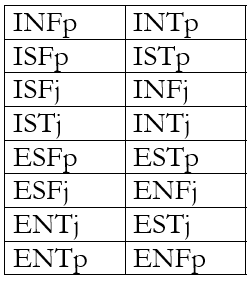
Upon this observation and underlying reality, each Information Element will therefore be represented with a + or – polarity designation. Therefore, Ni can be expressed in two ways (irrespective of its cognitive position). It will therefore be denoted as: Ni+ Ni–
Chapter 4- Information Element qualitative polarity definition, and its effect on perception/judgement, fields/objects.
What does + and – polarity do to an Information Element?
+ Subjective, Universal – Objective, Local The ‘Subjective/Objective’ axis refers to the qualitative effect on the Information Elements perception/judgement, and the ‘Universal/Local’ axis refers to the qualitative effect on fields/objects.
Table 3. Information Elements polarities qualitative effect on the perception/judgement and fields/objects axises.

The definition of:
Ni: Perception of internal dynamics of Fields.
Expands to:
Ni+ Subjective perception of internal dynamics of universal fields
Ni- Objective perception of internal dynamics of local fields.
Note, Sociotypes are divided into two distinct categories of Information Element Polarity expression.
Sociotypes with introverted perception and extraverted judging + polarities, and introverted judging and extraverted perceiving – polarities: INFp, ISFj, ENTj, ESTp, ISTp, ENFp, ESFj, INTj.
Sociotypes with introverted judging and extraverted perceiving + polarities, and introverted perceiving and extraverted sensing – polarities: INFj, ISFp, ENTp, ESTj, ISTj, ENFj, ESFp, INTp
Chapter 5- Brain hemispheres information elements correspondence
Table 4. Brain Hemispheres correspondence with the Information Elements

There have been countless Studies, Reviews and Meta-analyses all concurring with Chapter 8s Physics structural elements of life (See Chapter 8 for more details) numbering in the thousands. However, in addition to these, I would draw your attention to Dr. Dario Nardis Research Studies implementing EEG scan technology. Dr. Nardi discovered that all Judgement (thinking, feeling) Program personality types had their most powerful and most consistently activated neurological region in the left brain hemisphere, and all perception (Intuition, Sensing) personality types had their most powerful neurological region in the right brain hemisphere. Thus, we can reasonably conclude, that the ‘thinking and feeling’ information elements originate from and simultaneously activates the left brain whose holistic function is aligned most with ‘judgement’ and also exclusively activates the judging information elements. Equally, all intuition and sensing information elements originates in and activates the right brain hemisphere. As mentioned, this is axiomatic since all Program Feeling and Thinking Sociotypes are labeled ‘judgers’ in Socionics. Dr. Nardi, however, gave a different Typology systems (MBTI) test to participants, and there is divergence in labelling the introverted only ‘types’ between the systems, with extraverted personality types have an exact cross over. That is, Socionics ENFj is ENFJ in MBTI. Fundamentally, both ascribe ENFJ/js most powerful, conscious strength as ‘Extraverted Feeling’. Therefore, if we exclude entirely the introverted personality types, we can still accurately determine the brain hemisphere correspondence and activation of both the perception and judging faculties exclusively with the extraverted personalities. The very simple resolution can be to replicate the Research Studies using EEG scans, but giving the Socionics test to participants.
Nevertheless, keeping in mind the vast expanse of Neuroscientific Studies concurring and validating this chapters Brain Hemisphere Information Element Correspondence, Dr. Nardis research is but one more among thousands supporting it.
Nis definition becomes
Ni+ Subjective right-hemispheric perception of internal dynamics of universal fields
Ni- Objective right-hemispheric perception of internal dynamics of local fields.
Chapter 6- Dimensionality of Information Elements Polarities
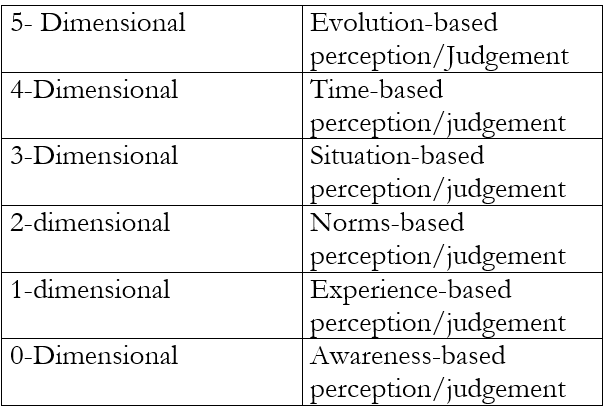
In both the + and – Polarities both right hemispheric and left hemispheric Information Elements are broken down into 6 qualitatively distinct dimensions, diverging only whether the Information Element is first ‘based’ in the listed dimension (+ polarity), or whether it ‘references’ the listed dimension (- polarity) after.
Table 5. Polaritys Effect on Dimensionality

+ Polarity, dimension-based
The + polarity Information Elements perceive the information element based in dimensionality (evolution, time, situation, norms, experience or awareness) first, with a subjective perception/judgement, and a universal introspective application to objects/fields. There is after this an application that objectively and locally applies these subjective and universal perceptions/judgements to experiential objects/fields. The + polarity, therefore, is first conceptual.
Applied
4-Dimensional Program Fi+ makes subjective and universal the conceptualisation of the judgement of ‘internal static of fields’ with the ultimate goal of long term (time based) flourishment, and sustainability. In order to achieve this, they apply their subjective and universal conceptualised ethical judgements, and seek to inject these into objective, local and experiential fields with the goal of manifesting harmonious, ethical environment/s for objective and localised objects (Te-). Therefore, Fi+ ultimate aim is to create harmonious fields for the flourishment of external dynamics of material objects (Te). For example. In order to achieve a positive reaction from a person, an individual will create the ideal environment (field) necessary for the desired (objective and local) reaction.
It is ‘top down’.
Table 6. Information Element Dimensionality through + Polarity Expression
– Polarity, Dimension-Referencing.
The – polarity Information Elements perceive/judge concurrently with the objective, local and experiential stimuli first, and then ‘reference’ the various Information Element judgement/perception to the subjective, universal dimensionality after.
Applied
Fi- in Evolution (termed’Demonstrative’ in Model A) position perceives first the objective and local ‘internal static of fields’, and then references whether such experiential implicit emotional environments are suitable for him and others in the situation (3 dimension), its relation to social norms (2-dimensional) and the immediate experience (1 dimension) but ultimately prioritises the perspective of his own evolutionary growth (5th dimension). Therefore, Fi- ultimate aim through objective experiential judgement of local fields is to then determine whether these are satisfactory for the flourishment of subjective judgement of external dynamics of material objects (Te+), and the internal dynamics of material objects (Fe). For example. In order that children will be comfortable, happy and educationally flourish for the long term, leading to increases in general health, wellbeing and learning, an INFp may design a previously dull classroom with bright Primary colours, shapes or figures scientifically proven to elicit positive reactions, educational and psychological outcomes from children. There is therefore a subjective, and universalised reference based on a previous objective and local judgement of the internal static of fields.
It is ‘bottom up’.
Table 7. Information Element Dimensionality through – Polarity Expression.
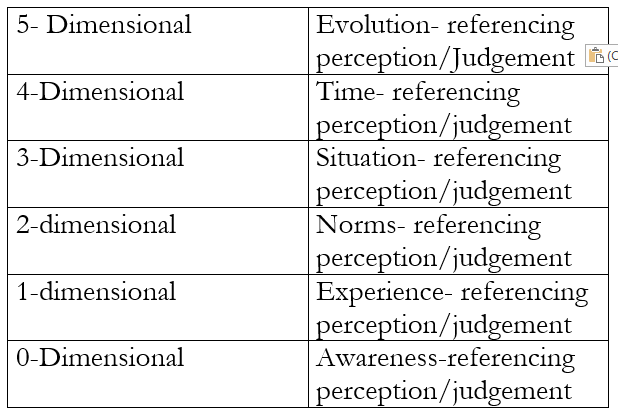
Therefore, there is a balanced, complimentary and resultant + (subjective, universal) and – (objective, local) polarity within both polarities expression through all Information Elements. The difference in categorisation exists only in which comes first, and last. There is also a perception of the entire encompassment of dimensionality among both polarities, the – polarity is not exclusively limited to objective perception/judgement in local fields/objects, nor is the + polarity exclusively limited to subjective perception/judgement in universal fields/objects.
Concurrent dimensional perception/judgement
Excluding the dimensional perception/judgement of the 0-dimension, the perception/judgement of the 1st, 2nd, 3rd, 4th and 5th dimensions are not exclusive to the listed dimension (be it evolution, time, situation, norms, experience), but there is a simultaneous perception/judgement of every element below their dimension concurrently. Thus, the 2-dimensional norms-referencing perception in Role Function also references the 0-dimension (awareness). The 4-dimensional time referencing Program function, also references situation (3rd-dimensional) norms (2-dimensional), and awareness (0-dimensional). However, there is a definitive preference for their highest dimensionality over all others. That is, as previously stated, a 4-dimensional Fi Program sociotype (ISFj, INFj), being fully aware of them, may sacrifice the experiential ethics (1st dimension) of the ‘situation’ (3rd dimension) if they judge the long-term (time-based 4th dimension) ethics being negatively impacted if they do not make these necessary dimensional sacrifices. Therefore, there is an ultimate prioritisiation and presiding precadence of the highest dimension the Information Element is capable of.
Conscious vs Unconscious in Dimensional Perception
The Ego and Super Ego Information Elements perceive the 0 Dimension because they are conscious, however they do not perceive the 1st and 5th dimensions for this reason too. The id and super-id functions do not perceive the 0 and 4th dimensions, but they all perceive the 1st dimension, and one Information Element placed on the Evolution position, has the capacity to perceive the 5th dimension. This is due to the dimensionality of the cognitive positions, Id and Super-id comprising the Survival (termed ‘Ignoring’ in Model A), Evolution, Mobilising and Dual Seeking Functions. Furthermore, while only one unconscious Information Element perceives the 5th Dimension, all conscious functions concurrently, or for one exclusively, perceive the 0 Dimension. This is further defined and explained in the following chapter.
Ni becomes:
Ni+ Subjective right hemispheric dimension-based perception of internal dynamics of universal fields
Ni- Objective right hemispheric dimension-referencing perception of internal dynamics of local fields.
Note: we cannot add which dimension is based/referencing above since we have not yet explored the effect of Cognitive positions transmutation of the dimensionality of functions.
Chapter 7- Dimensionality based on Information Elements cognitive position
Dimensions expression throughout the Cognitive Positions:
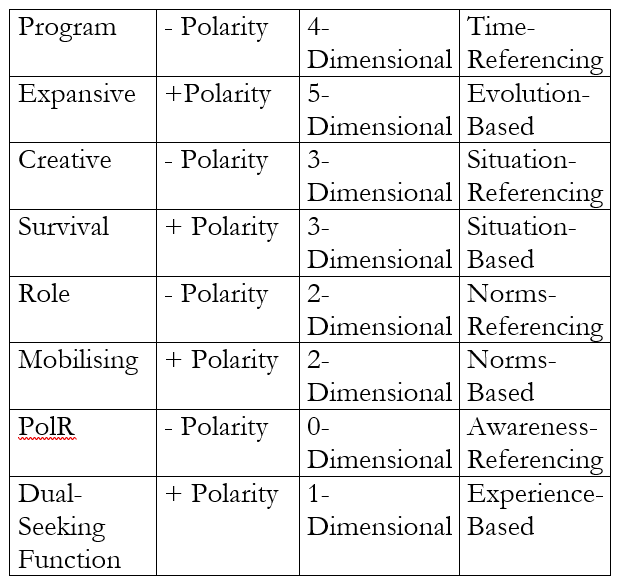
The 5th Dimension (evolution) exclusively expresses through the Evolution function and the 4-Dimension of time through the Program function. The 3rd Dimension (situation) expresses through the Creative and Survival functions and the 2nd-Dimension of norms expresses through the Mobilising and Role functions. The 1-dimensional of experience expresses exclusively through the Dual-seeking function and the 0-dimension of awareness expresses exclusively through the PolR function.
Table 8. Dimensionality transmutation based on Information Element Positions.
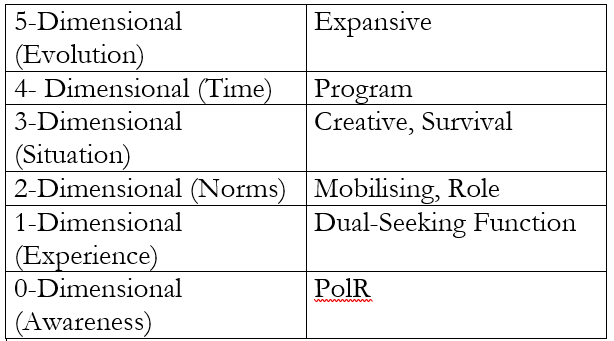
This is irrespective of Information Element polarity, and therefore whether it’s dimensional-referencing or based. Note- Evolution and Survival Functions are the new names for the ‘Demonstrative’ and ‘Ignoring’ functions respectively. The ‘Program’ function refers to the Lead. This will be further elucidatedin the following chapter.
5-dimensional and 0-dimensional?
The Evolution function is not 4-dimensional, but 5-dimensional. It’s one pointedness, in contrast with its counterbalance, the PolR function, is more singularly powerful (in dimensional capacitance) than the Program function. Furthermore, the PolR function is 0-dimensional, in that it is not experiential, but it is conscious awareness. It is that precondition for experiential (1 dimensional) cognition. The 0 dimension is the source of consciousness behind John Lockes ‘Tabula Rasa’. It is that consciousness seeking to gain union with the external all encompassing (grand) reality, outside oneself. It is seeking to learn about the world, a ‘blank sheet’ of paper, a completely empty vessel, ready for reception and input. 5th-dimensional Information Elements are processed beyond experience, norms, situation and time into the Immutable law of the universe- constant expansive motion, or evolution. It is seeking to gain union within oneself, through expansion and unfoldment of internal capacities and potential (evolution). It is that source of consciousness that may decide to complete a task or goal despite it conflicting with our experiential suffering (1-dimensional), norms of what is situationally acceptable (2nd and 3rd Dimension) because this suffering will help us evolve, being ultimately good for ones long-term development. It is the highest dimension of consciousness humanity is capable of perceiving.
Table 9. Concurrent Dimensional Perception/Judgement for each cognitive position.
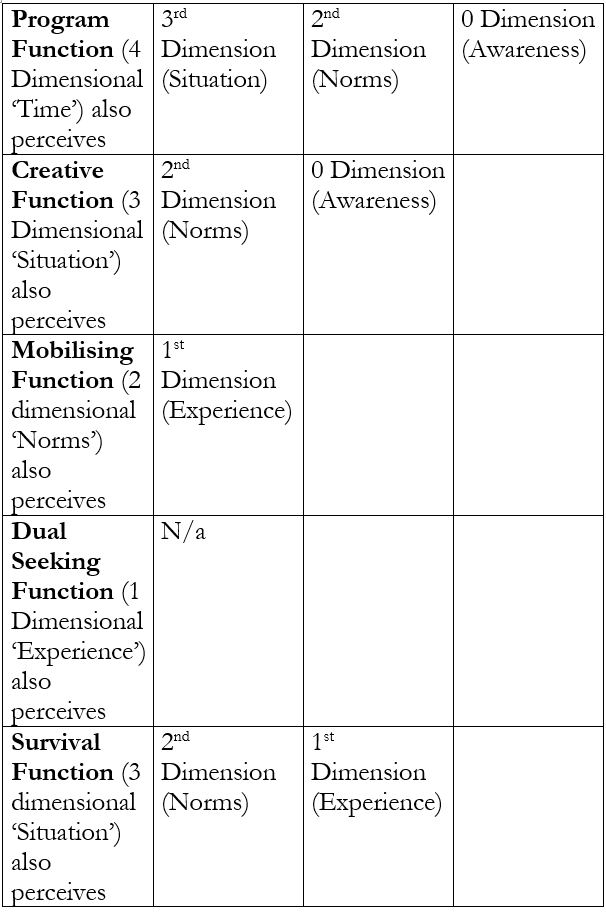
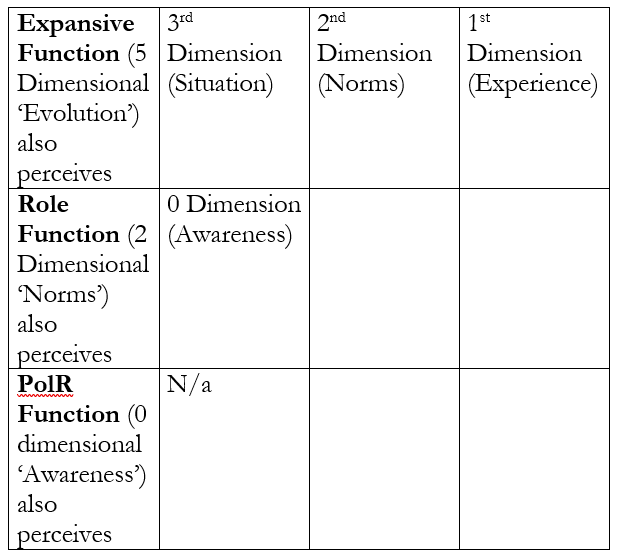
Through conscious perception/judgement Sociotypes can only perceive the 4th-dimension, 3rd-dimension, 2nd-dimension and 0- dimension, making 4 dimensions in total. Through unconscious perception/judgement Sociotypes can only perceive the 5th-dimension, 3rd-dimension, 2nd-dimension, and 1st-dimension, making 4 in total. Therefore, unconscious perception/judgement (id and super-id blocks) are without access to the 4th (Time) dimension, and 0 (Awareness) Dimensions. Equally, conscious perception/judgement (Ego and Super Ego) is without access to the 5th (Evolution) and 1st (Experiential) Dimensions.
Applied
It is generally said of the predominantly unconscious individual that they ‘do not think for the long term’ (4th dimension) and ‘lack awareness’ (0 dimension). It is also said of the predominantly conscious individual that they’re ‘stagnant’, not evolving, developing, challenging themselves to something bigger, breaking past limitations (5th dimensional) and struggle to ‘switch off, relax, and enjoy the experience’ (1 dimensional). Indeed, in our own lives there may have been (short or extended) periods of time where we were predominantly conscious or unconscious, and suffered along these missing Dimensional lines, creating manifest external expressions/applications of these strengths and weaknesses.
Cognitive Position Renaming:
In light of the 6 Dimensional expressions, the ‘demonstrative’ function will be renamed as the ‘evolution’ function. ‘Expansion’ is a synonym for ‘evolution’ since evolution is that law in harmony with the Immutable law of the universe- constant expansive motion. The ‘ignoring’ function will also be renamed, since, fundamentally, this psychological function is not ‘ignored in favour of the Lead’ (as is currently described). The Ignoring functions use activates the Basal Ganglia (the ‘Reptilian Cortex’) and the Brain Stem, those brain regions are associated with ‘survival focused, id-based thinking and behaviour’. Therefore, the ‘Ignoring function’ will be renamed to the ‘Survival’ function. This inherent nature of the ignoring function applies regardless of which Information Element is activated with it. For example. Se is traditionally associated with aggression, survival tendencies, and indeed with the 1st level of Maslows hierarchy of needs (food, shelter, water etc.) and id-like thinking and behavioural expressions, but even Ni, Fe, Ne (those Information Elements not archetypally associated with id consciousness) and every other Information Element will be appropriately used towards these applications when placed in the ‘Survival function’ (previously the ‘Ignoirng function’). There is also a difference in how people fundamentally use the Ignoring function. For example. even within the West and East of Europe (but also in the whole world, dividing billions of people), there is divergence of expression and preference for both the Ignoring and Lead function. Many countries in the East who have experienced war, famine, genocide and chaotic political upheaval for multiple successive generations, have had a powerful catalyst and strong need and fight for physical ‘Survival’. The ‘ignoring function’ which activates the basal ganglia, and the Brain stem, and whose placement is in the ‘id’ position for Socionics, is that consciousness that gets amplified and is necessarily engaged with. Therefore, it is most certainly not ‘ignored in favour of the Lead’. In actual fact, the ignoring function is that psychological function they ‘Lead’ with, and the socially conscious Lead function is ‘ignored’ in favour of the ‘ignoring function’. However, this does not change the dimensional validity or the existing placement of the Ignoring function in the Id block in Socionics and the Lead function in the Ego. Finally, the ‘Lead’ function will be renamed to the ‘Program’ function. Unlike the other two cognitive renamings (Demonstrative/Evolution, and Ignoring/Survival), this is not a new innovation as other Socionicists have labeled the Lead function as the ‘Program’ in the past. It is categorically added to Model R, only because it is significantly more accurate since as mentioned, there are many societies all over the world, where billions of people do not ‘Lead’ with the Program function, but ‘Ignore’ it, and definitively ‘Lead’ with the ‘Ignoring’ function, now termed ‘Survival’ function.
Societal id differences?
In societies where the id consciousness (Survival-based, instinctual reactive responses to exceedingly stressful/dangerous material circumstances) has been necessary for survival for multiple generations, there is an epigenetic tendency that only compounds and amplifies with each new generation (if the same environmental catalysts persist). These environmental conditions may be war, poverty, famine, etc. This is universal, existing in all nations with profound historical volatility. Thus, East and South-East Asia, the Middle East, North Africa (including Egypt), Eastern Europe are only but a few examples. If Western Europe, Britain, India or other comparatively historically peaceful nations had experienced the same level of volatility, especially in recent times, it would be a reality for them. Note, heightened id perception is a static reality with no inherent moral correspondence, but only a neurological precondition. There are numerous benefits to having heightened id perception. For example. Western Europes lack of groundedness and awareness of material survival is a current humanitarian and civilisational crisis, likely to bring about its utter destruction and collapse. Eastern Europe and the afformentioned nations on the other hand, do not ‘fall for’ dangerous cultural trends that destroy civilisation, and indeed these same cultural trends are the precursor for the destruction of every former Empire in history, whether it be Egypt, Middle East, Greece etc. Indeed, all these former empire nations now have heightened id perception. Therefore, defining the ‘ignoring function’ as the ‘Survival’ function is more accurate since this is the consciousnesses primary function in its anatomical and neurological correspondence, the Brain stem, and Basal Ganglia (the reptilian cortex) responsible for Survival based thinking. ‘Survival’ is entirely in harmony with both Socionics and Freud, since the function of the Freudian ‘Id’ is survival-based thinking and instinctual needs (according to Freud), and that is precisely which block Socionics designated this cognitive position.
Therefore, in Model R, the functions are as follows:
Table 10. The Information Elements Cognitive Positions
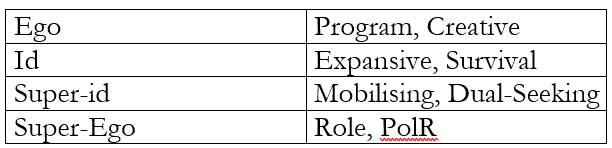
Worthy to note- in Western societies ‘Ego’ is used to describe the consciousness and actions of the Id. Therefore, it is said about the ‘overly aggressive’ (either physically or verbally) individual, that they are ‘acting from Ego’, and/or that they ‘have a big ego’. However, that fault lays squarely with society, and most certainly not of Socionics, or Freud. Freud describes the Ego as the “rational part of the psyche that mediates between the instinctual desires of the id and the moral constraints of the Super Ego”. This definition, very clearly characterises the psychological functions of the Socionics Ego block (Program and Creative) brilliantly.
Advice- The strongest hemisphere should be placed on the Evolution function, and the weaker hemisphere, that hemisphere entered into for rest, should be placed on the Program function. If your most powerful brain hemisphere is intensely and singularly focused and in harmony with the Immutable law of the universe, constant expansive motion (evolution), then that is a good foundation/precondition for ones unfoldment and development through life.
Dimensional polarity through the Sociotypes.:
The Sociotypes with a + polarity Program function are the INFx, ENTx, ESFx and ISTx types.
Table 11. Sociotypes with a + Polarity Program Function.

Sociotypes with a – polarity Program function are the INTx, ISFx, ENFx and ESTx types. Table 12. Sociotypes with a – Polarity Program Function.

The following tables elucidate the precise structure of Information Element ordering for the INFx, ENTx, ESFx and ISTx (+ polarity Program function) types.
Table 13. Dimensionality based on cognitive position for Sociotypes with a + polarity in the Program function.
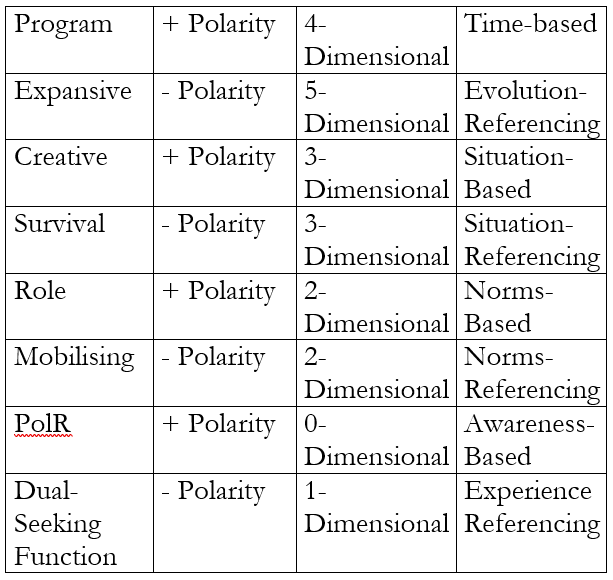
The following tables elucidate the precise structure of Information Element ordering for the INTx, ISFx, ENFx and ESTx (- polarity Program function) types.
Table 14. Dimensionality based on cognitive position for Sociotypes with a – polarity in the Program function.
Therefore, Ni in Evolution function becomes:
Ni+ Subjective right hemispheric evolution-based perception of internal dynamics of universal fields.
Ni- Objective right hemispheric evolution-referencing perception of internal dynamics of local fields.
Ni in PolR position becomes:
Ni+ Subjective right hemispheric awareness-based perception of internal dynamics of universal fields.
Ni- Objective right hemispheric awareness-referencing perception of internal dynamics of local fields.
Chapter 8- Physics structural elements and their true ordering
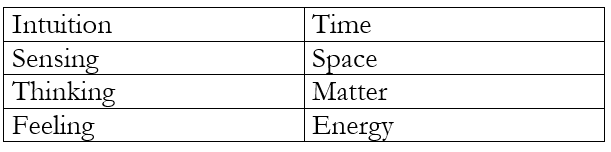
While the Physics structural elements of life are not currently incorporated in any Socionics models Information Elements definitions it is nevertheless very well established that the right-hemisphere (where Intuition and Sensing originates and is controlled exclusively by) is responsible primarily for spatial perception, and temporal perception/approximation in the wider Neuro-Scientific literature. Equally, it is very well established that the left hemisphere is primarily responsible for material judgement (Thinking) and energetic (Feeling) catalysation, neuroticism, in the broader Neuro-scientific literature. There are thousands of studies beyond these that concur on this point. Many of these are listed at the end of this chapter .
Table 15. Physics structural elements correspondences with the Information Elements in the True ordering.
‘True ordering’?
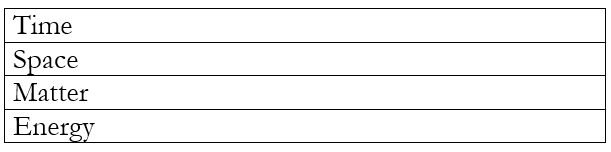
The Law of matter and energy is affected by the law of time and space, for matter (energies densified manifest expression) transmutes based on the time and spatial environments they’re in, diversifying matter and thus energies expression. Therefore, it can be said that the right-hemisphere is indeed the dominant hemisphere (as intuition and sensing are exclusively controlled by it) that must subordinate the left hemisphere. However, the left hemisphere is the causal hemisphere (since energy, expressed/termed as ‘feeling’ originates in the left hemisphere and is controlled exclusively by it) is immensely important for success and flourishment operating in the material-energetic world of potential.
The oppositional counter-balance of Information Elements and the elements of life align as two halves of the same coin. For example. Ni and Se correspond with Time and Space. Quantum Physics tells us that all matter is created by vibrating atoms, and at a deeper level, atoms are created by electrical, non-visible dynamic (whirling) energy fields. Therefore, the Sociotype can either judge the source/cause (energy) or it’s manifest materialised expression/effect (matter) in the thinking/feeling judgement axis.
Table 16. True Ordering of the Physics Structural Elements of Life
Application of the physics structural elements of life
If ones natural state of being is externally perceiving objective (static) space, they are likely an ESXx type. If ones natural state of being is internally contemplating spatially accumulated details (dynamics in fields) and synthesising these into a cohesive whole, they’re likely ISXx. When an individual is effortlessly conscious of the time concept, he is likely Intuitive. When one effortlessly and automatically catalyses energy within and without oneself, they’re likely Feeling. When one is naturally aware of tangible, material objects they’re likely Thinking. It is therefore more than likely that Engineers are primarily Thinking, material Judgers, Philosophers and Scientists are primarily Intuitive, temporal and abstract perceivers, Doctors, Psychiatrists, Psychologists, Nurses and all people-oriented professions are primarily energetic Feelers, and detailed professions like Architecture, Fine Arts would be primarily spatial-Sensory Perceivers. There is of course an intersection and overlap as each type has two primary strengths, and therefore two primary physics structural elements that they percieve (i.e INFp perceive Time and Energy, INTp perceive Time and Matter), but more than likely the Program 4-dimensional Information Element is, en masse, to manifest and express itself throughout ones life, dominating and leaving its mark on life outcomes. Furthermore, some Socionics theorists have theorised the Information Element and Physics structural elements of life correspondence, and prior to them, multiple Socionics theorists (inadvertently) defined each Information Element almost entirely by the perception/judgement of the Physics structural elements of life, in the manner defined in the beginning of this chapter, irrespective of the direction (introversion or extraversion) of that information element.
For example: Ni is described in ‘Introduction to Ni’
on ‘sociotype.com/socionics/information_elements/ni‘ as:
“Ni is generally associated with the ability to recognize the unfolding of processes over time (how one event leads to another), have visions of the past and future, develop mental imagery, and see intangible hints of relationships between processes or objects”.
Thus, in Model R, these elements are being concretely added to the Information Elements definitions because there is now Neuroscientific evidence to validate Socionics theorisations. Furthermore, through introspective application, the reader will discover it is entirely impossible to psychologically perceive, and align with the element of time, without simultaneously activating the brain state of Intuition (wherther it be extraverted or introverted). This remains true for all directional (introverted or extraverted) expressions of Feeling (energy), Thinking (matter) and Sensing (space).
Nis Program definition becomes:
Ni+ Subjective right hemispheric time-based perception of internal temporal dynamics of universal fields.
Ni- Objective right hemispheric time-referencing perception of internal temporal dynamics of local fields.
Fe’s Program definition becomes:
Fe+ Subjective left-hemispheric time-based judgement of internal energetic dynamics of universal objects.
Fe- Objective left-hemispheric time-referencing judgement of internal energetic dynamics of local objects.
Research Studies, Reviews and Meta-Analyses supporting the Brain Hemisphere Physics structural elements of life correspondences.
1. Allan , L. A. 1975 . The relationship between judgements of successiveness and judgements of order . Perception and Psychophysics , 18 : 29 – 36 .
2. Allen , M. 1983 . Models of hemispheric specialization . Psychological Bulletin , 93 : 73 – 104 .
3. Allport , D. A. 1968 . Phenomenal simultaneity and the perceptual moment hypothesis . British Journal of Psychology , 59 : 395 – 406 .
4. Aram , D. M. and Ekelman , B. L. 1988 . Auditory temporal perception of children with left or right brain lesions . Neuropsychologia , 26 : 931 – 935 .
5. Ardila , A. and Ostrosky-Solis , F. 1984 . “ Right hemisphere participation in language ” . In The right hemisphere: Neurology and neuropsychology , Edited by: Ardila , A. and Ostrosky-Solis , F. New York : Gordon & Breach .
6. Babkoff , H. and Sutton , S. 1971 . Monaural temporal interactions . Journal of the Acoustical Society of America , 35 : 574 – 577 .
7. Bakker , D. J. and Van der Kleij , P. C. M. 1978 . Development of lateral asymmetry in the perception of sequentially touched fingers . Acta Psychologica , 42 : 357 – 365 .
8. Baron , J. 1969 . Temporal ROC curves and the psychological moment . Psychonomic Science , 15 : 299 – 300 .
9. Baron , J. 1971 . The threshold for successiveness . Perception and Psychophysics , 10 : 201 – 207 .
10. Battersby , W. S. 1951 . The regional gradient of critical flicker frequency after frontal or occipital injury . Journal of Experimental Psychology , 42 : 59 – 68 .
11. Battersby , W. S. and Jaffe , R. 1953 . Temporal factors influencing the perception of visual flicker . Journal of Experimental Psychology , 46 : 154 – 161 .
12. Beaumont , J. G. , ed. 1982 . Divided visual field studies of cerebral organization , London : Academic Press .
13. Ben-Dov , G. and Carmon , A. 1984 . Rhythm length and hemispheric asymmetry . Brain and Cognition , 3 : 35 – 41 .
14. Bertoloni , G. , Anzola , G. P. , Buchtel , H. A. and Rizzolatti , G. 1978 . Hemispheric differences in the discrimination of the velocity and duration of a simple visual stimulus . Neuropsychologia , 16 : 213 – 220 .
15. Bosshardt , H. G. and Hörmann , H. 1975 . Temporal precision of coding as a basic factor of laterality effects in the retention of verbal auditory stimuli . Acta Psychologica , 39 : 1 – 12 .
16. Boynton , R. M. 1972 . “ Discrimination of homogeneous double pulses of light ” . In Handbook of sensory physiology , Edited by: Jameson , D. and Hurvich , L. Vol. 1 , Berlin : Springer-Verlag .
17. Bradshaw , J. L. and Gates , E. A. 1978 . Visual field differences in verbal tasks: Effects of task familiarity and sex of subject . Brain and language , 5 : 166 – 187 .
18. Bradshaw , J. L. , Nathan , G. , Nettleton , N. C. , Pierson , J. M. and Wilson , L. E. 1983 . Head and body hemispace to the left and right III: Vibrotactile stimulation and sensory and motor components . Perception , 12 : 651 – 661 .
19. Bradshaw , J. L. and Nettleton , N. C. 1981 . The nature of hemispheric specialization in man . The Behavioural and Brain Sciences , 4 : 51 – 91 .
20. Bradshaw , J. L. and Nettleton , N. C. 1983 . Human cerebral asymmetry , New Jersey : Prentice Hall .
21. Bradshaw , J. L. and Sherlock , D. 1982 . Bugs and faces in the two visual fields: Task order, difficulty, practice and the analytic/holistic dichotomy . Cortex , 18 : 211 – 225 .
22. Brandeis , R. and Babkoff , H. 1984 . Sorting of hemifield presented temporal and spatial stimuli . Cortex , 20 : 179 – 192 .
23. Brown , K. T. , Watanabe , K. and Murakami , M. 1965 . The early and late receptor potentials of monkey rods and cones . Cold Spring Harbour Symposium of Quantitative Biology , 30 : 457 – 482 .
24. Brown , W. S. , Barsz , K. , Sprecher , E. and Emmerich , D. S. 1984 . Laterality effects in response to the offsets of visual stimuli . Neuropsychologia , 22 : 627 – 629 .
25. Bryden , M. P. 1982 . Laterality: Functional asymmetry in the brain , London : Academic Press .
26. Bryden , M. P. and Allard , F. 1976 . Visual hemifield differences depend upon typeface . Brain and Language , 3 : 191 – 200 .
27. Calvin , W. H. 1982 . Did throwing stones shape homonid brain evolution? . Ethology and Sociobiology , 3 : 115 – 124 .
28. Carmon , A. 1979 . “ Spatial and temporal factors in visual perception of patients with unilateral cerebral lesions ” . In Asymmetrical function of the brain , Edited by: Kinsbourne , M. Cambridge : Cambridge University Press .
29. Carmon , A. and Nachshon , I. 1971 . Effect of unilateral brain damage on perception of temporal order . Cortex , 7 : 410 – 418 .
30. Carter , D. B. 1953 . A further demonstration of phi movement cerebral dominance . Journal of Psychology , 36 : 299 – 309 .
31. Cave , K. R. and Wolfe , J. M. 1990 . Modeling the role of parallel processing in visual search . Cognitive Psychology , 22 : 225 – 271 .
32. Chase , C. and Jenner , A. R. 1993 . “ Magnocellular visual deficits affect temporal processing of dyslexics ” . In Annals of the New York Academy of Sciences , Edited by: Tallal , P. , Galaburda , A. M. , Llinás , R. R. and von Euler , C. Vol. 682 , New York : New York Academy of Sciences .
33. Cheatnam , P. G. and White , C. T. 1954 . Temporal numerosity: III. Auditory perception of number . Journal of Experimental Psychology , 47 : 425 – 428 .
34. Clark , C. R. and Geffen , G. M. 1990 . Hemispheric equivalence for simultaneity judgements of somatosensory stimuli . Cognitive Neuropsychology , 7 : 311 – 327 .
35. Cohen , G. 1973 . Hemispheric differences in serial vs. parallel processing . Journal of Experimental Psychology , 97 : 349 – 356 .
36. Cohen , G. 1976 . Components of the laterality effect in letter recognition: Asymmetries in iconic storage . Quarterly Journal of Experimental Psychology , 28 : 105 – 114 .
37. Corballis , M. C. 1989 . Laterality and human evolution . Psychological Review , 96 : 492 – 505 .
38. Corballis , M. C. 1991 . The lopsided ape: Evolution of the generative mind , New York : Oxford University Press .
39. Corso , G. M. 1980 . Auditory temporal order and perceived fusion-nonfusion . Perception and Psychophysics , 28 : 465 – 470 .
40. Cutting , J. E. 1974 . Two left-hemisphere mechanisms in speech perception . Perception and Psychophysics , 16 : 601 – 612 .
41. Davidoff , J. B. 1975 . Hemispheric differences in the perception of lightness . Neuropsychologia , 13 : 121 – 124 .
42. Davidoff , J. B. 1976 . Hemispheric sensitivity differences in the perception of colour . Quarterly Journal of Experimental Psychology , 28 : 387 – 394 .
43. Davis , A. E. and Wada , J. A. 1977 . Hemispheric asymmetries of visual and auditory information processing . Neuropsychologia , 15 : 799 – 806 .
44. Deutsch , D. and Roll , P. L. 1976 . Separate ‘what’ and ‘where’ mechanisms in processing a dichotic tonal sequence . Journal of Experimental Psychology: Human Perception and Performance , 2 : 23 – 29 .
45. DiLollo , V. 1981 . Hemispheric symmetry in the duration of visible persistence . Perception and Psychophysics , 29 : 21 – 25 .
46. DiLollo , V. , Hanson , D. and McIntyre , J. S. 1983 . Initial stages of visual information processing in dyslexia . Journal of Experimental Psychology: Human Perception and Performance , 9 : 923 – 935 .
47. Divenyi , P. L. and Efron , R. 1979 . “ Spatial versus temporal features in dichotic listening ” . In Brain and Language 375 – 386 .
48. Efron , R. 1963a . The effect of handedness on the perception of simultaneity and temporal order . Brain , 86 : 261 – 283 .
49. Efron , R. 1963b . The effects of stimulus intensity on the perception of simultaneity in right and left handed subjects . Brain , 86 : 285 – 294 .
50. Efron , R. 1963c . Temporal perception, aphasia and deja vu . Brain , 86 : 403 – 424 .
51. Efron , R. 1970 . The minimum duration of a perception . Neuropsychologia , 8 : 57 – 63 .
52. Efron , R. 1973 . “ An invariant characteristic of perceptual systems in the time domain ” . In Attention and performance , Edited by: Kornblum , S. Vol. IV , New York : Academic Press .
53. Efron , R. 1990 . The decline and fall of hemispheric specialisation , Hillsdale, NJ : Lawrence Erlbaum Associates Inc .
54. Efron , R. and Lee , D. N. 1971 . The visual persistence of a moving stroboscopically illuminated object . American Journal of Psychology , 84 : 365 – 375 .
55. Efron , R. , Yund , E. W. , Nichols , D. and Crandall , P. H. 1985 . “ An ear asymmetry for gap detection following anterior temporal lobectomy ” . In Neuropsychologia 43 – 50 .
56. Egeth , H. and Dagenback , D. 1991 . Parallel versus serial processing in visual search: Further evidence from subadditive effects of visual quality . Journal of Experimental Psychology: Human Perception and Performance , 17 : 551 – 560 .
57. Egeth , H. , Jonides , J. and Wall , S. 1972 . Parallel processing of multidimensional displays . Cognitive Psychology , 3 : 674 – 698 .
58. Emmerich , D. S. , Pitchford , L. J. , Joyce , C. M. and Koppell , S. M. 1981 . Laterality effects in response to offsets of tonal stimuli . Neuropsychologia , 19 : 227 – 234 .
59. Falk , D. 1980 . Language, handedness and primitive brains. Did the australopithecines sign? . American Anthropologist , 82 : 72 – 78 .
60. Farmer , M. E. and Klein , R. 1993 . “ Auditory and visual temporal processing in dyslexic and normal readers ” . In Annals of the New York Academy of Sciences , Edited by: Tallal , P. , Galaburda , A. M. , Llinás , R. R. and von Euler , C. Vol. 682 , New York : New York Academy of Sciences .
61. Farah , M. J. 1990 . Visual agonosia, Disorders of object recognition and what they tell us about normal vision , Cambridge, MA : MIT Press .
62. Galaburda , A. and Livingstone , M. 1993 . “ Evidence for a magnocellular defect in developmental dyslexia ” . In Annals of the New York Academy of Sciences , Edited by: Tallal , P. , Galaburda , A. M. , Llinás , R. R. and von Euler , C. Vol. 682 , New York : New York Academy of Sciences .
63. Geffen , G. , Bradshaw , J. L. and Nettleton , N. C. 1972 . Hemispheric asymmetry: Verbal and spatial encoding of visual stimuli . Journal of Experimental Psychology , 95 : 25 – 31 .
64. Gibbon , J. and Rutschumann , R. 1969 . Temporal order judgement and reaction time . Science , 165 : 413 – 415 .
65. Goldberg , E. and Costa , L. D. 1981 . Hemispheric differences in the acquisition and use of descriptive systems . Brain and Language , 14 : 144 – 173 .
66. Goldman , P. S. , Lodge , A. , Hammer , L. R. , Semmes , J. and Mishkin , M. 1968 . Critical flicker frequency after unilateral temporal lobectomy in man . Neuropsychologia , 6 : 355 – 366 .
67. Gordon , H. W. 1978 . Left hemisphere dominance for processing rhythmic elements in dichotically presented melodies . Cortex , 14 : 58 – 70 .
68. Green , D. M. and Henning , G. B. 1969 . Audition . Annual Review of Psychology , 20 : 105 – 128 .
69. Gur , R. B. , Packer , I. K. , Hungerbuhler , J. P. , Reivich , M. , Obrist , W. D. , Amarnek , W. S. and Sackeim , H. A. 1980 . Differences in the distribution of gray and white matter in human cerebral hemispheres . Science , 207 : 1226 – 1228 .
70. Haaland , K. Y. and Harrington , D. L. 1994 . Limb sequencing deficits after left but not right hemisphere damage . Brain and Cognition , 24 : 104 – 122 .
71. Halperin , Y. , Nachshon , I. and Carmon , A. 1973 . Shift of ear superiority in dichotic listening to temporally patterned nonverbal stimuli . Journal of the Acoustical Society of America , 53 : 46 – 50 .
72. Hammond , G. R. 1981 . Finer temporal acuity for stimuli applied to the preferred hand . Neuropsychologia , 19 : 325 – 329 .
73. Harrington , D. L. and Haaland , K. Y. 1991 . Hemispheric specialization for motor sequencing: Abnormalities in level of programming . Neuropsychologia , 29 : 147 – 163 .
74. Harrington , D. L. and Haaland , K. Y. 1992 . Motor sequencing with left hemisphere damage: Are some cognitive deficits specific to limb apraxia? . Brain , 115 : 857 – 874 .
75. Harter , M. R. and White , C. R. 1967 . Perceived number and evoked potentials . Science , 156 : 406 – 408 .
76. Hatta , T. 1977 . Recognition of Japanese Kanji in the left and right visual fields . Neuropsychologia , 15 : 685 – 688 .
77. Hatta , T. 1978 . Recognition of Japanese Kanji and Hirikana in the left and right visual fields . Japanese Psychological Research , 20 : 51 – 59 .
78. Hayduk , S. , Bruck , M. and Cavanagh , P. 1993 . “ Do adult dyslexics show low-level visual processing deficits? ” . In Annals of the New York Academy of Sciences , Edited by: Tallal , P. , Galaburda , A. M. , Llinás , R. R. and von Euler , C. Vol. 682 , New York : New York Academy of Sciences .
79. Heilman , K. , Scholes , R. and Watson , R. T. 1975 . Auditory affective agnosia: Disturbed comprehension of affective speech . Journal of Neurology, Neurosurgery and Psychiatry , 38 : 69 – 72 .
80. Hewes , G. W. 1973 . Primate communication and the gestural origins of language . Current Anthropology , 14 : 5 – 24 .
81. Hirsh , I. J. and Sherrick , C. E. 1961 . Perceived order in different sense modalities . Journal of Experimental Psychology , 62 : 423 – 432 .
82. Hugdahl , K. , ed. 1988 . Handbook of dichotic listening: Theory, methods and research , Chichester, , UK : John Wiley .
83. Jason , G. W. 1983 . Hemispheric asymmetries in motor function: I. Left hemisphere specialization for memory but not performance . Neuropsychologia , 21 : 35 – 45 .
84. Jasper , H. H. and Raney , E. T. 1937 . The phi test of lateral dominance . American Journal of Psychology , 49 : 450 – 457 .
85. Jeeves , M. A. and Dixon , N. F. 1970 . Hemispheric differences in response rates to visual stimuli . Psychonomic Science , 20 : 249 – 251 .
86. Kahneman , D. 1967 . An onset-onset law for one case of apparent motion and metacontrast . Perception and Psychophysics , 2 : 577 – 584 .
87. Karasseva , T. A. 1972 . The role of the temporal lobe in human auditory perception . Neuropsychologia , 10 : 227 – 231 .
88. Kim , Y. , Royer , F. , Bonstelle , C. and Boller , F. 1980 . Temporal sequencing of verbal and nonverbal materials: Effect of laterality of lesion . Cortex , 16 : 135 – 143 .
89. Kimura , D. 1982 . Left hemisphere control of oral and brachial movements and their relation to communication . Philosophical Transactions of the Royal Society of London B , 298 : 135 – 149 .
90. Kinsbourne , M. 1975 . “ The mechanism of hemispheric control and the lateral gradient attention ” . In Attention and performance V , Edited by: Rabbit , P. M. A. and Dornic , S. New York : Academic Press .
91. Kosslyn , S. M. 1987 . Seeing and imaging in the cerebral hemispheres: A computational approach . Psychological Review , 94 : 148 – 175 .
92. Kraft , R. H. 1993 . “ Deficits in auditory sequential processing found for both gifted and average IQ reading-impaired boys ” . In Annals of the New York Academy of Sciences , Edited by: Tallal , P. , Galaburda , A. M. , Llinás , R. R. and von Euler , C. Vol. 682 , New York : New York Academy of Sciences .
93. Kristofferson , A. B. 1967 . Successiveness discrimination as a two-state quantal process . Sciences , 158 : 1337 – 1339 .
94. Kristofferson , A. B. 1977 . A real-time criterion of duration discrimination . Perception and Psychophysics , 21 : 105 – 117 .
95. Kristofferson , A. B. 1980 . A quantal step function in duration discrimination . Perception and Psychophysics , 27 : 300 – 306 .
96. Kristofferson , A. B. and Allan , L. G. 1973 . “ Successiveness and duration discrimination ” . In Attention and performance , Edited by: Kornblum , S. Vol. IV , New York : Academic Press .
97. Lackner , J. R. and Teuber , H. L. 1973 . Alterations in auditory fusion thresholds after cerebral injury in man . Neuropsychology , 11 : 409 – 415 .
98. Leakey , M. D. 1979 . Footprints in the ashes of time . National Geographic , 155 : 446 – 457 .
99. Levick , W. R. 1973 . Variation in the response latency of cat retinal ganglion cells . Vision Research , 13 : 837 – 853 .
100. Lieberman , P. 1984 . The biology and evolution of language , Cambridge, MA : Harvard University Press .
101. Lindsley , D. B. 1957 . “ The reticular system and perceptual discrimination ” . In Reticular formation of the brain , Edited by: Jasper , H. London : Churchill .
102. Lovegrove , W. 1993 . “ Weakness in the visual transient system: A causal factor in dyslexia? ” . In Annals of the New York Academy of Sciences , Edited by: Tallal , P. , Galaburda , A. M. , Llinás , R. R. and von Euler , C. Vol. 682 , New York : New York Academy of Sciences .
103. Martos , F. J. and Marmolejo , A. 1993 . “ Visible persistence in developmental dyslexia ” . In Annals of the New York Academy of Sciences , Edited by: Tallal , P. , Galaburda , A. M. , Llinás , R. R. and von Euler , C. Vol. 682 , New York : New York Academy of Sciences .
104. May , J. G. , Williams , M. C. and Dunlap , W. P. 1988 . Temporal order judgements in good and poor readers . Neuropsychologia , 26 : 917 – 924 .
105. McKeever , W. F. and Gill , K. M. 1972 . Visual half-field differences in masking effects for sequential letter stimuli in the right and left handed . Neuropsychologia , 10 : 111 – 117 .
106. McKeever , W. F. and Suberi , M. 1974 . Parallel, but temporally displaced visual half-field metacontrast functions . Journal of Experimental Psychology , 26 : 258 – 265 .
107. McReynolds , P. 1953 . Thinking conceptualized in terms of interacting moments . Psychological Review , 60 : 319 – 330 .
108. Mills , L. and Rollman , G. B. 1980 . Hemispheric asymmetry for auditory perception of temporal order . Neuropsychologia , 18 : 41 – 47 .
109. Möcks , J. , Gasser , T. and Pham , D. T. 1984 . Variability of single visual evoked potentials evaluated by two new statistical tests . Electroencephalography and Clinical Neurophysiology , 57 : 571 – 580 .
110. Moscovitch , M. 1979 . “ Information processing and the cerebral hemispheres ” . In Handbook of behavioural neurobiology , Edited by: Gazzaniga , M. S. Vol. 2 , New York : Plenum Press .
111. Moscovitch , M. , Scullion , D. and Christie , D. 1976 . Early versus late stages of processing and their relation to functional hemispheric asymmetries in face recognition . Journal of Experimental Psychology: Human Perception and Performance , 2 : 401 – 416 .
112. Murphee , O. D. 1954 . Maximum rates of form perception and the alpha rhythm: An investigation and test of current nerve net theory . Journal of Experimental Psychology , 48 : 57 – 61 .
113. Murphy , E. and Venables , P. 1970 . Ear asymmetry in the threshold of fusion of two clicks: A signal detection analysis . Quarterly Journal of Experimental Psychology , 22 : 288 – 300 .
114. Nachshon , I. and Carmon , A. 1975 . Hand preference in sequential and spatial discrimination tasks . Cortex , 11 : 123 – 131 .
115. Neisser , U. 1967 . Cognitive psychology , Englewood Cliffs, NJ : Prentice-Hall .
116. Nicholls , M. E. R. 1994a . Hemispheric asymmetries for temporal resolution: A signal detection analysis of threshold and bias . Quarterly Journal of Experimental Psychology , 47A : 291 – 310 .
117. Nicholls , M. E. R. 1994b . The non-contribution of attentional biases to visual field asymmetries for temporal discrimination . Neuropsychologia , 32 : 209 – 220 .
118. Nicholls , M. E. R. and Atkinson , J. 1993 . Hemispheric asymmetries for an inspection time task: A general left hemisphere temporal advantage? . Neuropsychologia , 31 : 1181 – 1190 .
119. Nicholls , M. E. R. and Cooper , C. J. 1991 . Hemispheric differences in the rate of information processing for simple non-verbal stimuli . Neuropsychologia , 29 : 677 – 684 .
120. Oostenbrug , M. W. M. , Horst , J. W. and Kuiper , J. W. 1978 . Discrimination of visually perceived intervals of time . Perception and Psychophysics , 24 : 21 – 34 .
121. Oscar-Berman , M. , Goodglass , H. and Goldstein , D. 1973 . Perceptual laterality and iconic recognition of visual materials by Korsakoff patients and normal adults . Journal of Comparative and Physiological Psychology , 82 : 316 – 321 .
122. Palmer , T. and Tzeng , O. J. L. 1990 . Cerebral asymmetry in visual attention . Brain and Cognition , 13 : 46 – 58 .
123. Papcun , G. , Krashen , S. , Terbeek , D. , Remmington , R. and Harshman , R. 1974 . Is the left hemisphere specialized for speech . language and/or something else? Journal of the Acoustical Society of America , 55 : 319 – 327 .
124. Parsons , O. A. , Majumder , R. K. and Chandler , P. J. 1967 . Impaired flicker detection in visual fields subserved by non-damaged hemispheres . Cortex , 3 : 307 – 316 .
125. Pashler , H. 1987 . Detecting conjunctions of color and form: Reassessing the serial search hypothesis . Perception and Psychophysics , 41 : 191 – 201 .
126. Patterson , K. and Bradshaw , J. L. 1975 . Differential hemispheric mediation of nonverbal visual stimuli . Journal of Experimental Psychology: Human Perception and Performance , 1 : 246 – 252 .
127. Peterzell , D. H. 1991 . On the nonrelation between spatial frequency and cerebral hemispheric competence . Brain and Cognition , 15 : 62 – 68 .
128. Pohl , P. 1984 . Ear advantages for temporal resolution in baboons . Brain and Cognition , 3 : 438 – 444 .
129. Polich , J. M. 1982 . Hemispheric differences for visual search: Serial vs parallel processing revisited . Neuropsychologia , 3 : 297 – 307 .
130. Polzella , D. J. , DaPolito , F. and Hinsman , C. 1977 . Cerebral asymmetry in time perception . Perception and Psychophysics , 21 : 187 – 192 .
131. Raninen , A. , Franssila , R. and Rovamo , J. 1991 . Critical flicker frequency to red targets as a function of luminance and flux across the human visual field . Vision Research , 31 : 1875 – 1881 .
132. Rebai , M. , Mecacci , L. , Bagot , J. and Bonnet , C. 1986 . Hemispheric asymmetries in the visual evoked potentials to temporal frequency: Preliminary evidence . Perception , 15 : 589 – 594 .
133. Reed , M. A. 1989 . Speech perception and the discrimination of brief auditory cues in reading disabled children . Journal of Experimental Child Psychology , 48 : 270 – 292 .
134. Robinson , G. H. 1992 . Single-parameter power law psychophysics of auditory numerosity and the psychological moment hypothesis . Perception and Psychophysics , 51 : 363 – 378 .
135. Robinson , G. M. and Solomon , D. J. 1974 . Rhythm is processed by the speech hemisphere . Journal of Experimental Psychology , 102 : 508 – 511 .
136. Ross , E. D. 1984 . Right hemisphere’s role in language, affective behaviour and emotion . Trends in Neurosciences , 7 : 342 – 345 .
137. Rousseau , R. , Poirier , J. and Lemyre , L. 1983 . Duration discrimination of empty time intervals marked by intermodal pulses . Perception and Psychophysics , 34 : 541 – 548 .
138. Rutschmann , R. 1973 . “ Visual perception of temporal order ” . In Attention and performance , Edited by: Kornblum , S. Vol. IV , New York : Academic Press .
139. Schwartz , J. and Tallal , P. 1980 . Rate of acoustic change may underlie hemispheric specialization for speech perception . Science , 207 : 1380 – 1381 .
140. Semmes , J. 1968 . Hemispheric specialization: A possible clue to mechanism . Neuropsychologia , 6 : 11 – 26 .
141. Sergent , J. 1982 . Theoretical and methodological consequences of varying exposure duration in visual laterality studies . Perception and Psychophysics , 31 : 451 – 461 .
142. Shallice , T. 1964 . Temporal summation and absolute brightness thresholds . British Journal of Mathematical and Statistical Psychology , 20 : 129 – 162 .
143. Shankweiler , D. and Studdert-Kennedy , M. 1967 . Identification of consonants and vowels presented to the left and right ears . Quarterly Journal of Experimental Psychology , 19 : 59 – 63 .
144. Slaghuis , W. L. and Lovegrove , W. 1984 . Flicker masking of spatial-frequency-dependent visible persistence and specific reading ability . Perception , 13 : 527 – 534 .
145. Smith , A. T. , Early , F. and Grogan , S. C. 1986 . Flicker masking and developmental dyslexia . Perception , 15 : 473 – 482 .
146. Stroud , J. M. 1955 . “ The fine structure of psychological time ” . In Information theory in psychology , Edited by: Quastler , H. Illinois : Free Press .
147. Swisher , L. and Hirsch , I. J. 1972 . Brain damage and the ordering of two temporally successive stimuli . Neuropsychologia , 10 : 137 – 152 .
148. Tallal , P. 1976 . “ Auditory perceptual factors in language and learning disabilities ” . In The neuropsychology of learning disorders , Edited by: Knights , R. M. and Bakker , D. J. Baltimore : University Park Press .
149. Tallal , P. 1980 . Auditory temporal perception, phonetics and reading disabilities in children . Brain and Language , 9 : 182 – 198 .
150. Tallal , P. and Piercy , M. 1973 . Developmental aphasia: Impaired rate of non-verbal processing as a function of sensory modality . Neuropsychologia , 11 : 389 – 398 .
151. Tallal , P. and Stark , R. E. 1981 . Speech acoustic-cue discrimination capacities of normal developing and language impaired children . Journal of the Acoustical Society of America , 69 : 568 – 574 .
152. Thomas , E. A. C. and Weaver , W. B. 1975 . Cognitive processing and time perception . Perception and Psychophysics , 17 : 363 – 367 .
154. Treisman , A. and Gormican , S. 1988 . Feature analysis in early vision: Evidence from search asymmetries . Psychological Review , 95 : 15 – 48 .
155. Tzeng , O. J. L. and Yang , W. S. Y. 1984 . Search for a common neurocognitive mechanism for language and movements . American Journal of Physiology , 246 : R904 – R911 .
156. Ulrich , R. 1987 . Threshold models of temporal-order judgements evaluated by a ternary response task . Perception and Psychophysics , 42 : 224 – 239.
157. Umiltà , C. , Stadler , M. and Trombini , G. 1973 . The perception of temporal order and the degree of eccentricity of the stimuli in the visual field . Studia Psychologica , 15 : 130 – 139 .
158. Uttal , W. R. 1971 . The effect of interval and number on masking with dot bursts . Perception and Psychophysics , 9 : 469 – 473 .
159. Uttal , W. R. 1973 . The psychobiology of sensory coding , New York : Harper & Row .
160. Uttal , W. R. 1981 . A taxonomy of visual processes , Hillsdale, NJ : Lawrence Erlbaum Associates Inc .
161. Vroon , P. A. , Timmers , H. and Tempelaars , S. 1977 . “ On the hemispheric representation of time ” . In Attention and performance VI , Edited by: Dornic , S. Hillsdale, NJ : Lawrence Erlbaum Associates Inc .
162. Ward , T. B. and Ross , L. E. 1977 . Laterality differences and practice effects under central backward masking conditions . Memory and Cognition , 5 : 221 – 226 .
163. Watson , N. V. and Kimura , D. 1989 . Right-hand superiority for throwing but not for intercepting . Neuropsychologia , 27 : 1399 – 1414 .
164. White , C. T. 1963 . Temporal numerosity and the psychological unit of duration . Psychological Monographs , 77 : 1 – 37 .
166. Witelson , S. F. 1977 . “ Early hemispheric specialization and interhemispheric plasticity: An empirical and theoretical overview ” . In Language development and neurological theory , Edited by: Segalowitz , S. J. and Gruber , F. A. New York : Academic Press .
167. Wolfe , J. M. , Cave , K. R. and Franzel , S. L. 1989 . Guided search: An alternative to the feature integration model for visual search . Journal of Experimental Psychology: Human Perception and Performance , 15 : 419 – 433
168. Patterson K., Nestor P. J., and Rogers T. T., Where do you know what you know? The representation of semantic knowledge in the human brain, Nature Reviews Neuroscience. (2007) 8, no. 12, 976–987.
169. Lambon Ralph M. A. and Patterson K., Generalization and differentiation in semantic memory, Annals of the New York Academy of Sciences. (2008) 1124, 61–76.
170 Gainotti G., The format of conceptual representations disrupted in semantic dementia: a position paper, Cortex. (2012) 48.
171. Pylyshyn Z. W., What the mind′s eye tells the mind′s brain: a critique of mental imagery, Psychological Bulletin. (1973) 80, no. 1, 1–24.
172. S Fodor J., The Language of Thought, 1975, Harvard University Press, Cambridge, Mass, USA.
173. Riddoch M. J., Humphreys G. W., Coltheart M., and Funnell E., Semantic systems or system? Neuropsychological evidence re-examined, Cognitive Neuropsychology. (1988) 5, no. 1, 3–25,
174. Patterson K. and Hodges J. R., F. Boller and J. Grafman, Semantic dementia: one window on the structure and organisation of semantic memory, Handbook of Neuropsychology, 2000, 2, 2nd edition, Elsevier, North Holland, The Netherlands, 313–333.
175. Allport D. A., S. K. Newman and R. Epstein, Distributed memory, modular systems and dysphasia, Current Perspectives in Dysphasia, 1985, Churchill Livingstone, Edinburgh, UK.
176. Jackendoff R., On beyond Zebra: the relation of linguistic and visual information, Cognition. (1987) 26, no. 2, 89–114. 177. Barsalou L. W., Perceptual symbol systems, Behavioral and Brain Sciences. (1999) 22, no. 4, 577–609
178 Gainotti G., What the locus of brain lesion tells us about the nature of the cognitive defect underlying category-specific disorders: a review, Cortex. (2000) 36, no. 4, 539–559.
179. Gainotti G., Anatomical functional and cognitive determinants of semantic memory disorders, Neuroscience and Biobehavioral Reviews. (2006) 30, no. 5, 577–594
180. Paivio A., Imagery and Verbal Processes, 1971, Holt, Rinehart, and Winston, New York, NY, USA.
181. Paivio A., Mental Representations: A Dual Coding Approach, 1986, Oxford University Press, Oxford, UK.
182 Gainotti G., The categorical organization of semantic and lexical knowledge in the brain, Behavioural Neurology. (1990) 3, 109–115.
183. Saffran E. M. and Schwartz M. F., Of cabbages and things: semantic memory from a neuropsychological perspective—a tutorial review, Attention and Performance. (1994) 25, 507–536.
184. Gainotti G., Silveri M. C., Daniele A., and Giustolisi L., Neuroanatomical correlates of category-specific semantic disorders: a critical survey, Memory. (1995) 3, no. 3-4, 247–264.
185. Chao L. L. and Martin A., Representation of manipulable man-made objects in the dorsal stream, NeuroImage. (2000) 12, no. 4, 478–484.
186. Martin A., Ungerleider L. G., and Haxby J. V., M. S. Gazzaniga, Category-specificity and the brain: the sensory-motor model of semantic representations of objects, The New Cognitive Neurosciences, 2000, MIT Press, Cambridge, Mass, USA.
187. Martin A. and Chao L. L., Semantic memory and the brain: structure and processes, Current Opinion in Neurobiology. (2001) 11, no. 2, 194–201
188. Damasio A. R., Time-locked multiregional retroactivation: a systems-level proposal for the neural substrates of recall and recognition, Cognition. (1989) 33, no. 1-2, 25–62, 2-s2.0-0024763056.
189. Damasio A. R., Category-related recognition defects as a clue to the neural substrates of knowledge, Trends in Neurosciences. (1990) 13, no. 3, 95–98.
190. Arrigoni G. and de Renzi E., Constructional apraxia and hemispheric locus of lesion, Cortex. (1964) 1, 170–197.
191. 24 de Renzi E. and Spinnler H., Visual recognition in patients with unilateral cerebral disease, Journal of Nervous and Mental Disease. (1966) 142, no. 6, 515–525, 2-s2.0-0013921773.
192. De Renzi E. and Spinnler H., Impaired performance on color tasks in patients with hemispheric damage, Cortex. (1967) 3, 194–217.
193. De Renzi E., Scotti G., and Spinnler H., Perceptual and associative disorders of visual recognition. Relationship to the side of the cerebral lesion, Neurology. (1969) 19, no. 7, 634–642, 2-s2.0-0014544031.
194. De Renzi E., Faglioni P., and Scotti G., Hemispheric contribution to exploration of space through the visual and tactile modality, Cortex. (1970) 6, no. 2, 191–203.
195. De Renzi E., Disorders of Space Exploration and Cognition, 1982, Wiley and Sons, New York, NY, USA.
196. De Renzi E., L. R. Squire, The History of Neurosciences in Autobiographies, 2006, 5, Elsevier, North Holland, The Netherlands.
197. Mion M., Patterson K., Acosta-Cabronero J., Pengas G., Izquierdo-Garcia D., Hong Y. T., Fryer T. D., Williams G. B., Hodges J. R., and Nestor P. J., What the left and right anterior fusiform gyri tell us about semantic memory, Brain. (2010) 133.
198. Whitehouse P. J., Imagery and verbal encoding in left and right hemisphere damaged patients, Brain and Language. (1981) 14.
199. Grossman M. and Wilson M., Stimulus categorization by brain-damaged patients, Brain and Cognition. (1987) 6,.
200. Gainotti G., Cappa A., Perri R., and Silveri M. C., Disorders of verbal and pictorial memory in right and left brain-damaged patients, International Journal of Neuroscience. (1994) 78.
201. Nieto A., Santacruz R., Hernández S., Camacho-Rosales J., and Barroso J., Hemispheric asymmetry in lexical decisions: the effects of grammatical class and imageability, Brain and Language. (1999) 70.
202. Shibahara N. and Lucero-Wagoner B., Access to perceptual and conceptual information in the left and right hemispheres, Perceptual and Motor Skills. (2001) 93.
203. Thierry G., Giraud A.-L., and Price C., Hemispheric dissociation in access to the human semantic system, Neuron. (2003) 38.
204. Thierry G. and Price C. J., Dissociating verbal and nonverbal conceptual processing in the human brain, Journal of Cognitive Neuroscience. (2006) 18.
205. Hocking J. and Price C. J., Dissociating verbal and nonverbal audiovisual object processing, Brain and Language. (2009) 108.
206. Acres K., Taylor K. I., Moss H. E., Stamatakis E. A., and Tyler L. K., Complementary hemispheric asymmetries in object naming and recognition: a voxel-based correlational study, Neuropsychologia. (2009) 47.
207. Butler C. R., Brambati S. M., Miller B. L., and Gorno-Tempini M. L., The neural correlates of verbal and nonverbal semantic processing deficits in neurodegenerative disease, Cognitive and Behavioral Neurology. (2009) 22.
208. Pobric G., Jefferies E., and Lambon Ralph M. A., Amodal semantic representations depend on both anterior temporal lobes: evidence from repetitive transcranial magnetic stimulation, Neuropsychologia. (2010) 48.
209. Vandenberghe R., Price C., Wise R., Josephs O., and Frackowiak R. S., Functional anatomy of a common semantic system for words and pictures, Nature. (1996) 383.
210. Snowden J. S., Thompson J. C., and Neary D., Knowledge of famous faces and names in semantic dementia, Brain. (2004) 127, no. 4, 860–872.
211. Ikeda M., Patterson K., Graham K. S., Lambon Ralph M. A., and Hodges J. R., A horse of a different colour: do patients with semantic dementia recognise different versions of the same object as the same?, Neuropsychologia. (2006) 44.
212. Hurley R. S., Paller K. A., Rogalski E. J., and Marsel Mesulam M., Neural mechanisms of object naming and word comprehension in primary progressive aphasia, Journal of Neuroscience. (2012) 32.
213. Mesulam M. M., Wieneke C., Hurley R., Rademaker A., Thompson C., Weintraub S., and Rogalski E., Words and objects at the tip of the left temporal lobe in primary progressive aphasia, Brain. (2013) 136, no. 2, 601–618.
214. Snowden J. S., Thompson J. C., and Neary D., Famous people knowledge and the right and left temporal lobes, Behavioural Neurology. (2012) 25, no. 1, 35–44.
215. Howard D. and Patterson K., Pyramis and Palm Trees: Access from Pictures and Words, 1992, Thames Valley Test Company, Bury St Edmunds, UK.
216. Bozeat S., Lambon Ralph M. A., Patterson K., Garrard P., and Hodges J. R., Non-verbal semantic impairment in semantic dementia, Neuropsychologia. (2000) 38.
217. Lesser R., Verbal comprehension in aphasia: an English version of three Italian tests, Cortex. (1974) 10.
218. Gainotti G., Caltagirone C., and Miceli G., Semantic disorders of auditory language comprehension in right brain-damaged patients, Journal of Psycholinguistic Research. (1979).
219. Gainotti G., Caltagirone C., and Ibba A., Semantic and phonemic aspects of auditory language comprehension in aphasia, Linguistics. (1975) 13, no. 154-155, 15–29.
220. Gainotti G., Caltagirone C., Miceli G., and Masullo C., Selective semantic-lexical impairment of language comprehension in right-brain-damaged patients, Brain and Language. (1981) 13,
221. Joanette Y. and Goulet P., Criterion-specific reduction of verbal fluency in right brain-damaged right-handers, Neuropsychologia. (1986) 24.
222. Neininger B. and Pulvermüller F., Word-category specific deficits after lesions in the right hemisphere, Neuropsychologia. (2003) 41.
223. Gainotti G., Miceli G., and Caltagirone C., The relationship between type of naming error and semantic-lexical discrimination in aphasic patients, Cortex. (1981) 17.
224. Hebb D. O., The Organization of Behaviour: A Neurophysiological Theory, 1949, Wiley and Sons, Hoboken, NJ, USA.
225. Friedrich M. and Friederici A. D., Phonotactic knowledge and lexical-semantic processing in one-year-olds: brain responses to words and nonsense words in picture contexts, Journal of Cognitive Neuroscience. (2005) 17, no. 11, 1785–1802, 2-s2.0-33644943626.
226. Majid A., Bowerman M., Kita S., Haun D. B. M., and Levinson S. C., Can language restructure cognition? The case for space, Trends in Cognitive Sciences. (2004) 8, no. 3, 108–114.
227. Chi J. G., Dooling E. C., and Gilles F. H., Left right asymmetries of the temporal speech areas of the human fetus, Archives of Neurology. (1977) 34.
228. De Schonen S. and Mathivet E., First come, first served : a scenario about the development of hemispheric specialization in face recognition during infancy, European Bulletin of Cognitive Psychology. (1989) 9, 3–44.
229. Chiron C., Jambaque I., Nabbout R., Lounes R., Syrota A., and Dulac O., The right brain hemisphere is dominant in human infants, Brain. (1997) 120, no. 6, 1057–1065.
230. Franklin A., Drivonikou G. V., Clifford A., Kay P., Regier T., and Davies I. R. L., Lateralization of categorical perception of color changes with color term acquisition, Proceedings of the National Academy of Sciences of the United States of America. (2008) 105.
231. Gainotti G., Ciaraffa F., Silveri M. C., and Marra C., Mental representation of normal subjects about the sources of knowledge in different semantic categories and unique entities, Neuropsychology. (2009) 23, no. 6, 803–812.
232. Hoffman P. and Lambon Ralph M. A., Shapes, scents and sounds: quantifying the full multi-sensory basis of conceptual knowledge, Neuropsychologia. (2013) 51, no. 1, 14–25.
233. Gainotti G., Spinelli P., Scaricamazza E., and Marra C., The evaluation of sources of knowledge underlying different semantic categories, Frontiers in Human Neuroscience. (2013) 7, article 40,
Chapter 9- Conscious vs Unconscious
The conscious/unconscious expression of an Information Element is not determined by the Information Elements, but the Information Elements cognitive position.
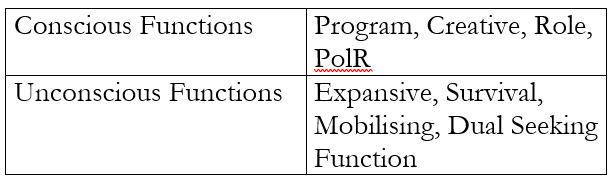
For all 16 sociotypes, the Program, Creative, Role and PolR functions are conscious, and the Evolution, Survival, Mobilising and Dual-Seeking Functions are unconscious.
Table 16. Conscious and Unconscious Functions
Therefore,
An INFp would be conscious in all + functions, these being Ni+, Fe+, Si+, and Te+. Equally, an INTp would be conscious in all – functions, these being Ni-, Te-, Si- and Fe-. Thus, all types are exclusively conscious in either the + (Subjective, Universal) or – (Objective, Local) polarities.
Evolution function, the 5th dimension and the Unconscious.
The 5th dimension is also universally unconscious due to its placement in the id block, and the Expansive Function. The difference between the conscious vs unconscious mind is an extensively researched one. Amongst a vast array of applications, it is why people make very different decisions when they ‘sleep on’ a hard choice/dilemma, and ‘remember’ something forgotten once they stop (consciously) thinking about it, etc.
0 Dimensional ‘Awareness’ and the Conscious Mind
The PolR function is universally conscious due to its placement, so the 0-dimensional ‘awareness’ seeking to gain union with external reality, is always conscious. The benefits of 0-dimensional ‘awareness’ being conscious is axiomatic, with the words ‘conscious’ and ‘awareness’ being synonymous to one another. Indeed, in the young developing child in the process of seeking to learn everything they can about the world, that foremost example from John Lockes ‘Tabula Rasa’, is that not the quintessential example of conscious awareness?
As previously stated, conscious perception/judgement can only perceive the 4th-dimension, 3rd-dimension, 2nd-dimension and 0- dimension, making 4 dimensions in total. Unconscious perception/judgement can only perceive the 5th-dimension, 3rd-dimension, 2nd-dimension, and 1st-dimension, making 4 in total. Therefore, unconscious perception/judgement (id and super-id blocks) are without access to the 4th (Time) dimension, and 0 (Awareness) dimension. Equally, conscious perception/judgement (Ego and Super Ego) is without access to the 5th (Evolution) and 1st (Experiential) Dimensions.
Therefore
Ni+ in a Program function is:
Subjective right hemispheric time-based conscious perception of internal temporal dynamics of universal fields.
Ni+ in a Mobilising role is: Subjective right hemispheric norms-based unconscious perception of internal temporal dynamics of universal fields.
Research studies highlighting the distinction and importance of both conscious vs unconscious thought.
1. Acker F. New findings on unconscious versus conscious thought in decision making: additional empirical data and meta-analysis. Judgment and Decision Making. 2008;3(4):292-303.
2. Bekker, H. L. (2006). Making choices without deliberating. Science, 312, 1472
3. Dijksterhuis A. Think different: the merits of unconscious thought in preference development and decision making. J Pers Soc Psychol. 2004:87(5):586-59
4. Dijksterhuis, A., Bos, M. W., Nordgren, L. F., & van Baaren, R. B. (2006). On making the right choice: The deliberation-without-attention effect. Science, 311, 1005–1007
5. Dijksterhuis, A., Bos, M. W., van Baaren, R. B., & van der Leij, A. (2007). Unconscious thought and the weighting problem in decision making
6. Dijksterhuis, A., & Meurs, T. (2006). Where creativity resides: The generative power of unconscious thought. Consciousness and Cognition, 15, 135–146
7. Dijksterhuis, A., & van Olden, Z. (2006). On the benefits of thinking unconsciously: Unconscious thought increases post-choice satisfaction. Journal of Experimental Social Psychology, 42, 627–631
8. Keeney, R. L., & Raiffa, H. (1976). Decisions with multiple objectives: Preference and value tradeoffs.
Chapter 10- Information Elements Definitions across all Cognitive Positions
Program Function:
Ni+ Subjective right hemispheric time-based conscious perception of internal temporal dynamics of universal fields.
Ni- Objective right hemispheric time-referencing conscious perception of internal temporal dynamics of local fields.
Si+ Subjective right hemispheric time-based conscious perception of external spatial dynamics of universal fields.
Si- Objective right hemispheric time-referencing conscious perception of external spatial dynamics of local fields.
Ne+ Subjective right hemispheric time-based conscious perception of internal temporal static of universal objects.
Ne- Objective right hemispheric time-referencing conscious perception of internal temporal static of local objects.
Se+ Subjective right hemispheric time-based conscious perception of external spatial static of universal objects.
Se- Objective right hemispheric time-referencing conscious perception of external spatial static of local objects.
Fi+ Subjective left hemispheric time-based conscious judgement of internal energetic static of universal fields.
Fi- Objective left hemispheric time-referencing conscious judgement of internal energetic static of local fields.
Fe+ Subjective left hemispheric time-based conscious judgement of internal energetic dynamics of universal objects.
Fe- Objective left hemispheric time-referencing conscious judgement of internal energetic dynamics of local objects.
Ti+ Subjective left hemispheric time-based conscious judgement of external material static of universal fields.
Ti- Objective left hemispheric time-referencing conscious judgement of external material static of local fields.
Te+ Subjective left hemispheric time-based conscious judgement of external dynamics of universal objects.
Te- Objective left hemispheric time-referencing conscious judgement of external dynamics of local objects.
Creative Function:
Ni+ Subjective right hemispheric situation-based conscious perception of internal temporal dynamics of universal fields.
Ni- Objective right hemispheric situation-referencing conscious perception of internal temporal dynamics of local fields.
Si+ Subjective right hemispheric situation-based conscious perception of external spatial dynamics of universal fields.
Si- Objective right hemispheric situation-referencing conscious perception of external spatial dynamics of local fields.
Ne+ Subjective right hemispheric situation-based conscious perception of external temporal static of universal objects.
Ne- Objective right hemispheric situation-referencing conscious perception of external temporal static of local objects.
Se+ Subjective right hemispheric situation-based conscious perception of external spatial static of universal objects.
Se- Objective right hemispheric situation-referencing conscious perception of external spatial static of local objects.
Fi+ Subjective left hemispheric situation-based conscious judgement of internal energetic static of universal fields.
Fi- Objective left hemispheric situation-referencing conscious judgement of internal energetic static of local fields.
Ti+ Subjective left hemispheric situation-based conscious judgement of external material static of universal fields.
Ti- Objective left hemispheric situation-referencing conscious judgement of external material static of local fields.
Te+ Subjective left hemispheric situation-based conscious judgement of external material dynamics of universal objects.
Te- Objective left hemispheric situation-referencing conscious judgement of external material dynamics of local objects.
Fe+ Subjective left hemispheric situation-based conscious judgement of internal energetic dynamics of universal objects.
Fe- Objective left hemispheric situation-referencing conscious judgement of internal energetic dynamics of local objects.
Mobilising Function:
Ni+ Subjective right hemispheric norms-based unconscious perception of internal temporal dynamics of universal fields.
Ni- Objective right hemispheric norms-referencing unconscious perception of internal temporal dynamics of local fields.
Si+ Subjective right hemispheric norms-based unconscious perception of external spatial dynamics of universal fields.
Si- Objective right hemispheric norms-referencing unconscious perception of external spatial dynamics of local fields.
Ne+ Subjective right hemispheric norms-based unconscious perception of internal temporal static of universal objects.
Ne- Objective right hemispheric norms-referencing unconscious perception of internal temporal static of local objects.
Se+ Subjective right hemispheric norms-based unconscious perception of external spatial static of universal objects.
Se- Objective right hemispheric norms-referencing unconscious perception of external spatial static of local objects.
Fi+ Subjective left hemispheric norms-based unconscious judgement of internal energetic static of universal fields.
Fi- Objective left hemispheric norms-referencing unconscious judgement of internal energetic static of local fields.
Fe+ Subjective left hemispheric norms-based unconscious judgement of internal energetic dynamics of universal objects.
Fi- Objective left hemispheric norms-referencing unconscious judgement of internal energetic dynamics of immediate fields.
Ti+ Subjective left hemispheric norms-based unconscious judgement of external material static of universal fields.
Ti- Objective left hemispheric norms-referencing unconscious judgement of external material static of local fields.
Te+ Subjective left hemispheric norms-based unconscious judgement of external material dynamics of universal objects.
Te- Objective left hemispheric norms-referencing unconscious judgement of external material dynamics of local objects.
Dual Seeking Function:
Ni+ Subjective right hemispheric experience-based unconscious perception of internal temporal dynamics of universal fields.
Ni- Objective right hemispheric experience-referencing unconscious perception of internal temporal dynamics of local fields.
Si+ Subjective right hemispheric experience-based unconscious perception of external spatial dynamics of universal fields.
Si- Objective right hemispheric experience-referencing unconscious perception of external spatial dynamics of local fields.
Ne+ Subjective right hemispheric experience-based unconscious perception of internal temporal static of universal objects.
Ne- Objective right hemispheric experience-referencing unconscious perception of internal temporal static of local objects.
Se+ Subjective right hemispheric experience-based unconscious perception of external spatial static of universal objects.
Se- Objective right hemispheric experience-referencing unconscious perception of external spatial static of local objects.
Fi+ Subjective left hemispheric experience-based unconscious judgement of internal energetic static of universal fields.
Fi- Objective left hemispheric experience-referencing unconscious judgement of internal energetic static of local fields.
Fe+ Subjective left hemispheric experience-based unconscious judgement of internal energetic dynamics of universal objects.
Fi- Objective left hemispheric experience-referencing unconscious judgement of internal energetic dynamics of immediate fields.
Ti+ Subjective left hemispheric experience-based unconscious judgement of external material static of universal fields.
Ti- Objective left hemispheric experience-referencing unconscious judgement of external material static of local fields.
Te+ Subjective left hemispheric experience-based unconscious judgement of external material dynamics of universal objects.
Te- Objective left hemispheric experience-referencing unconscious judgement of external material dynamics of local objects.
Survival function (formerly ‘ignoring function’):
Ni+ Subjective right hemispheric situation-based unconscious perception of internal temporal dynamics of universal fields.
Ni- Objective right hemispheric situation-referencing unconscious perception of internal temporal dynamics of local fields.
Si+ Subjective right hemispheric situation-based unconscious perception of external spatial dynamics of universal fields.
Si- Objective right hemispheric situation-referencing unconscious perception of external spatial dynamics of local fields.
Ne+ Subjective right hemispheric situation-based unconscious perception of internal temporal static of universal objects.
Ne- Objective right hemispheric situation-referencing unconscious perception of internal temporal static of local objects.
Se+ Subjective right hemispheric situation-based unconscious perception of external spatial static of universal objects.
Se- Objective right hemispheric situation-referencing unconscious perception of external spatial static of local objects.
Fi+ Subjective left hemispheric situation-based unconscious judgement of internal energetic static of universal fields.
Fi- Objective left hemispheric situation-referencing unconscious judgement of internal energetic static of local fields.
Fe+ Subjective left hemispheric situation-based unconscious judgement of internal energetic dynamics of universal objects.
Fi- Objective left hemispheric situation-referencing unconscious judgement of internal energetic dynamics of immediate fields.
Ti+ Subjective left hemispheric situation-based unconscious judgement of external material static of universal fields.
Ti- Objective left hemispheric situation-referencing unconscious judgement of external material static of local fields.
Te+ Subjective left hemispheric situation-based unconscious judgement of external material dynamics of universal objects.
Te- Objective left hemispheric situation-referencing unconscious judgement of external material dynamics of local objects.
Evolution Function (formerly ‘Demonstrative function’):
Ni+ Subjective right hemispheric evolution-based unconscious perception of internal temporal dynamics of universal fields.
Ni- Objective right hemispheric evolution-referencing unconscious perception of internal temporal dynamics of local fields.
Si+ Subjective right hemispheric evolution-based unconscious perception of external spatial dynamics of universal fields.
Si- Objective right hemispheric evolution-referencing unconscious perception of external spatial dynamics of local fields.
Ne+ Subjective right hemispheric evolution-based unconscious perception of internal temporal static of universal objects.
Ne- Objective right hemispheric evolution-referencing unconscious perception of internal temporal static of local objects.
Se+ Subjective right hemispheric evolution-based unconscious perception of external spatial static of universal objects.
Se- Objective right hemispheric evolution-referencing unconscious perception of external spatial static of local objects.
Fi+ Subjective left hemispheric evolution-based unconscious judgement of internal energetic static of universal fields.
Fi- Objective left hemispheric evolution-referencing unconscious judgement of internal energetic static of local fields.
Fe+ Subjective left hemispheric evolution-based unconscious judgement of internal energetic dynamics of universal objects.
Fi- Objective left hemispheric evolution-referencing unconscious judgement of internal energetic dynamics of immediate fields.
Ti+ Subjective left hemispheric evolution-based unconscious judgement of external material static of universal fields.
Ti- Objective left hemispheric evolution-referencing unconscious judgement of external material static of local fields.
Te+ Subjective left hemispheric evolution-based unconscious judgement of external material dynamics of universal objects.
Te- Objective left hemispheric evolution-referencing unconscious judgement of external material dynamics of local objects.
Role Function:
Ni+ Subjective right hemispheric norms-based conscious perception of internal temporal dynamics of universal fields.
Ni- Objective right hemispheric norms-referencing conscious perception of internal temporal dynamics of local fields.
Si+ Subjective right hemispheric norms-based conscious perception of external spatial dynamics of universal fields.
Si- Objective right hemispheric norms-referencing conscious perception of external spatial dynamics of local fields.
Ne+ Subjective right hemispheric norms-based conscious perception of external temporal static of universal objects.
Ne- Objective right hemispheric norms-referencing conscious perception of external temporal static of local objects.
Se+ Subjective right hemispheric norms-based conscious perception of external spatial static of universal objects.
Se- Objective right hemispheric norms-referencing conscious perception of external spatial static of local objects.
Fi+ Subjective left hemispheric norms-based conscious judgement of internal energetic static of universal fields.
Fi- Objective left hemispheric norms-referencing conscious judgement of internal energetic static of universal fields.
Ti+ Subjective left hemispheric norms-based conscious judgement of external material static of universal fields.
Ti- Objective left hemispheric norms-referencing conscious judgement of external material static of local fields.
Te+ Subjective left hemispheric norms-based conscious judgement of external material dynamics of universal objects.
Te- Objective left hemispheric norms-referencing conscious judgement of external material dynamics of local objects.
Fe+ Subjective left hemispheric norms-based conscious judgement of internal energetic dynamics of universal objects.
Fe- Objective left hemispheric norms-referencing conscious judgement of internal energetic dynamics of local objects.
PolR Function:
Ni+ Subjective right hemispheric awareness-based conscious perception of internal temporal dynamics of universal fields.
Ni- Objective right hemispheric awareness-referencing conscious perception of internal temporal dynamics of local fields.
Si+ Subjective right hemispheric awareness-based conscious perception of external spatial dynamics of universal fields.
Si- Objective right hemispheric awareness-referencing conscious perception of external spatial dynamics of local fields.
Ne+ Subjective right hemispheric awareness-based conscious perception of external temporal static of universal objects.
Ne- Objective right hemispheric awareness-referencing conscious perception of external temporal static of local objects.
Se+ Subjective right hemispheric awareness-based conscious perception of external spatial static of universal objects.
Se- Objective right hemispheric awareness-referencing conscious perception of external spatial static of local objects.
Fi+ Subjective left hemispheric awareness-based conscious judgement of internal energetic static of universal fields.
Fi- Objective left hemispheric awareness-referencing conscious judgement of internal energetic static of universal fields.
Ti+ Subjective left hemispheric awareness-based conscious judgement of external material static of universal fields.
Ti- Objective left hemispheric awareness-referencing conscious judgement of external material static of local fields.
Te+ Subjective left hemispheric awareness-based conscious judgement of external material dynamics of universal objects.
Te- Objective left hemispheric awareness-referencing conscious judgement of external material dynamics of local objects.
Fe+ Subjective left hemispheric awareness-based conscious judgement of internal energetic dynamics of universal objects.
Fe- Objective left hemispheric awareness-referencing conscious judgement of internal energetic dynamics of local objects.
Chapter 11- Complete Summary (with Tables)
As stated in Chapter 1, Model R adds 17 additional elements. They being:
- Perception/Judgement status.
- Information Elements + and – polarities
and
- The definitional translation of both polarities and their universal application across all Information Elements in perception/judgement and fields/objects.
and
- The polarities universal application across all Information Elements in perception/judgement and fields/objects.
- The cognitive positions effect on the Information Elements definitional transmutation.
Sociotypes with a Lead function + polarity- INFp, INFj, ENTp, ENTj, ESFj, ESFp, ISTp, ISTj
Sociotypes with a Lead function – polarity INTp, INTj, ISFp, ISFj, ENFp, ENFj, ESTj, ESTp
- Defines the concurrent dimensional perception/judgement for each Cognitive position.
(Table shrunk to fit on page)
All unconscious functions are capable of only perceiving the 5th, 3rd, 2nd and 1st Dimensions. All conscious functions are capable only of perceiving the 4th, 3rd, 2nd and 0 Dimensions. Of these, the Cognitive Function placement determines which Dimensions they can perceive. So, Program function (dimensional) will perceive/judge the 4th dimension, 3rd dimension, 2nd dimension and the 0 dimension concurrently. The Evolution function will perceive the 5th dimension, 3rd dimension, 2nd dimension and 1st dimension concurrently. However, the PolR is not capable of perceiving any other dimension (since no dimension exists below 0), and the Dual Seeking function is not capable of perceiving any dimensions below it for there is no 0 Dimensional perception for unconscious Information Elements.
- Explains the epigenetic root cause behind increased and decreased Id consciousness across cultures.
There are many cultures who ‘Lead’ with the Ignoring function, and ‘ignore’ the ‘Lead function. This heightened Id consciousness is due to epigenetic evolution and adaption in historically volatile societies. Equally, decreased id consciousness is due to epigenetic evolution from those who are in historically (comparatively) peaceful societies. There are positives and negatives for the dominance of both consciousnesses.
- Justifies which brain hemisphere is ideally placed in the Program function.
Ideally, ones strongest Brain hemisphere should be placed in their 5-Dimensional Evolution function. This is a very effective method to accelerates ones own consciousness development and unfoldment by pairing ones greatest strength to to the dimension of Evolution.
9. Brain hemisphere correspondence of Information Elements
- Physics structural elements (Time, Space, Matter, Energy) correspondences with the Information Elements.
- The creation of the 5th and 0 dimensions.
5th Dimension functions as evolution-based judgement/perception. 0-Dimension functions as awareness-based judgement/perception.
12. The cognitive positions of the 5th and 0 Dimensions.
5th Dimension is the Evolution Function, and the 0 Dimension is the PolR function.
- Defines and explains the True Ordering of the Information Elements correspondence with the Physics structural elements of life.
The Law of matter and energy is below the law of time and space, for matter (energies densified manifest expression) transmutes based on the time and spatial environments they’re in, diversifying matter and thus energies expression.
- Renaming the Demonstrative and Ignoring Functions to ‘Evolution ‘ and ‘Survival’ functions, with biological, psychological and functional justifications.
Demonstrative function is renamed to the Evolution function because it is 5-dimensional evolution based/referencing perceptions/judgements, and ‘expansion’ is the Immutable law of the Universe (constant expansive motion) and the mechanicsm underlying ‘evolution’. The Ignoring function is renamed to ‘Survival function’ since this is its primary functional purpose, it is in the ‘Id’ block in Socionics, the Id being primarily related to Survival, and activates Survival-based Neurological centres.
- Binary polarity distinctions of all dimensions (referencing vs based).
- Dimensionality alterations based on Information Element position.
- Conscious vs unconscious nature of Information Elements.
The conscious functional placements, and therefore the conscious mind, can only be perceived through the 4th Dimension (Program), 3rd Dimension (Creative), 2nd Dimension (Role), and 0 Dimension (Awareness). The unconscious functional placements, and therefore the unconscious mind can only be perceived through the 5th Dimension, 3rd Dimension, 2nd Dimension and the 1st Dimension.
Chapter 12- Further lines of Research and Expansion
Fundamentally, all Science should always be open to revision, expansion and change (by foundational definition). Socionics is the best Typology system precisely because it describes reality in more depth than all others. However, there must always be increased magnification, leading one to discover deeper and deeper layers of reality. Indeed, this book has contributed no fewer than 17 additional elements. One may personally only agree with 16 out of the 17, or 10, or 12, It matters not, significantly more clarity has been gained, and more elements have been injected into this beautiful Science, allowing us a more detailed view of an ever present, underlying and static reality. Furthermore, many of the assertions in this book can be scientifically tested.
Case in point:
Model A definition of Ni (in all positions):
Internal dynamics of fields.
Model R definition of Ni
Ni+ Subjective right hemispheric time-based conscious perception of internal temporal dynamics of universal fields.
Ni- Objective right hemispheric time-referencing conscious perception of internal temporal dynamics of local fields.
There are definitive ways to scientifically prove many of these proposed elements, such as studies using EEG scans and dividing participants up by their Sociotype. In particular, biological associations are static and discoverable realities, waiting to be incorporated definitively into Socionics framework. That is, the blending of Neuroscience and Socionics, objective biological EEG scans with Socionics sophisticated theorisations. Therefore, whether this books contention that Thinking and Feeling originate and simultaneously activate the left hemisphere is correct (which is currently based on extensive Neuro-Scientific Research), through Neuro-scientific testing using EEG technology one can definitively find exactly which brain hemisphere controls the perception of these Information Elements, instantiating it definitively into the Information Element definitions. After establishing the brain hemisphere and Information Element correspondence, and getting a map of the Neurological activation patterns that will help to visually identify each of the Information Elements neurological expression for each of the types, we can then determine whether activation of the Survival function does indeed activate the Brain Stem, and Basal Ganglia (Reptilian Cortex) as posited in Model R. There are many further lines of enquiry, for example. After determining the visual neurological pattern of the Information Elements, we can then see how the same Information Element expresses differently in each of the Sociotypes. That is, if Ni in Ni lead types form a pattern activating the whole brain, does this differ if types have it as a 1 dimensional or 0 dimensional function? Even, does a 4-Dimensional Ni expression differ neurologically from a 5-Dimensional expression through comparing Ni in INFp and INFj participants with EEG scans. Regardless of Dimensional difference in neurological activation, does the same Information Element expressed consciously (Creative Function) differ in neurological activation and expression when compared with unconscious activation/expression (Survival Function)? These are a mere fraction of the vast lines of enquiry that can be discovered objectively and definitively by researchers. This will therefore expand and deepen Socionics framework to describe a more detailed and all-encompassing picture of reality.
Discovering the true underlying mechanics of Information Element perception is an immensely valuable Scientific endeavour.
-Michael N. Rotondo
Model R: A New Theory on Socionics
MGhael X. .OoOXnO
Copyright © [2025] by [Michael Rotondo] All rights reserved.
No portion of this book may be reproduced in any form without written permission from the publisher or author, except as permitted by U.S. copyright law.
Contents
Dedication 1
- Chapter 1- Model R 9
- Chapter 2 Perception vs Judgement 17
- Chapter 3- Information Elements (bina- 19
ry) Polarities
- Chapter 4- Information Element qualita- 21
tive polarity definition, and its effect on perception/judgement, fields/objects.
- Chapter 5- Brain hemispheres informa- 24
tion elements correspondence
- Chapter 6- Dimensionality of Informa- 31
tion Elements Polarities
- Chapter 7- Dimensionality based on In- 44
formation Elements cognitive position
- Chapter 8- Physics structural elements 58
and their true ordering
- Chapter 9- Conscious vs Unconscious 66
- Chapter 10- Information Elements Defi-nitions across all Cognitive Positions
- Chapter 11- Complete Summary (with Tables)
- Chapter 12- On the Expansion of Socionics, and Further lines of Research.
73
98
109
Thank you to all the Socionics theorists. You have given me such resplendent joy, hitting upon untold truths and reality.
Namely, thank you to (in alphabetical order)
Aushra Augusta, Irina and Sergei Beletskiy, Li-ubov Beskova, Aleksandr Bukalov, Richard De-Long, Alexander Dogvan, Irina Eglit, Vladimir Ermak, Ekaterina Filatova, Sergei Ganin, Victor Gulenko, Igor Kalinauskas, Oleg Kruhrulev,
Vladimir Lvov, Dmitriy Lytov, Valentina and Anatoly Meged, Vladimir Mironov, Vera Noviko-va, Tatiana Prokofieva, Grigoriy Reinin, Versa
Stratievskaya, Victor Talanov, Olga Tangemann, Aleksei Trehov, Pavel Tsypin, Elena Udalova, Igor Weisband
In addition to these, thank you to Dr. Dario Nardi
MICHAEL N. ROTONDO
May Socionics flourish and gain the recognition it so eminently deserves.
About the author
Michael has completed postgraduate studies in Psychology at the University of Melbourne, Australia.
Introduction
This book will seek to add to the vast array of existing literature in Socionics, contributing a new theory, with the addition of 17 elements, a renaming and reconceptualisation of the cognitive positions, and functions, creation of 5th and 0 Dimensions, and more.
Foundational Concepts
Socionics fundamentals:
Information Elements (short-hand designations)-Ni- Introverted Intuition
Ne- Extraverted Intuition Se- Extraverted Sensing Si- Introverted Sensing Fe- Extraverted Feeling Fi- Introverted Feeling Ti- Introverted Thinking Te- Extraverted Thinking
The first letter stands for the Information element,
G MICHAEL N. ROTONDO
the last letter stands for the direction (extraverted or introverted) of the information element.
Model A Information Element definitions
Ni- Internal dynamics of fields Ne- Internal static of objects Si- External dynamics of fields Se- External static of objects Ti- External static of fields
Te- External dynamics of objects Fi- Internal static of fields
Fe- Internal dynamics of objects
Cognitive position of Information Elements Ego- Lead Function, Creative Function
Id- Ignoring Function, Demonstrative Function Super-Ego- Role Function, PolR Function
Super-id- Mobilising Function, Dual Seeking Function
MODEL R: A NEW THEORY ON SOCIONICS 7
Strength by Cognitive position (Model A)
Most powerful- Lead and Demonstrative functions Moderately powerful- Creative and Ignoring functions
Moderately Weak- Role and Mobilising functions Weak- Dual Seeking, and PolR functions
Socio
Chapter 1- Model R
| T |
The unique distinction of this theory is it blends multiple creative innovations with Neuroscientific literature, and Socionics theories to form an accurate definition of what the Information Elements are, and reconceptualises, redefines and relabels three of the cognitive positions. Model R defines precisely what the + and – polarity is when applied to all Information Elements, with + polarity being based on a ‘subjective, universal’ focus to the Information Elements perception/judgement and fields/objects, and then an ‘objective and local’ application to those same elements. Equally, – polarity adds an ‘objective, local’ primary focus to the Information Elements perception/judgement and fields/objects, and then a ‘subjective and uni-versal’ reference to those same elements. It has created two new dimensions, the 5th and the 0 dimension, and defined precisely which cognitive positions they’re expressed through. The 5th-dimension, which operates through the Immutable law of the universe- constant expansive motion, is termed ‘evolution’ and labelled therefore the ‘expansive function’. It also defines and labels the 0-dimension as conceptual union with external all-encompassing reality, that source of consciousness underlying and inherent to Enlightenment Philosopher John Locke’s ‘Tabula Rasa’, labels as ‘awareness’. It de-fines precisely which cognitive position expresses the 5th-dimension (Demonstrative) and the 0-dimension (PolR). It then renames the ‘Ignoring’ function as the ‘Survival’ function since this is more in alignment with its anatomical activation (the Brain Stem in and Basal Ganglia in the Reptilian Cortex), its cognitive and consciousness expression, and its alignment with Sigmund Freuds ‘id’, that block Socionics has placed the ‘ignoring function’ in. It recategorises the ‘Lead’ function as the ‘Program’ function. This is not an innovation however, and is chosen because this term is more accurate than ‘Lead’, since fundamentally, all people do not ‘Lead’ with this Ego function, but a large number of humanity ‘Lead’ with their Ignoring function, ‘ignor-ing’ their ‘Lead’ function in the process. Furthermore, it does not describe all – polarity as ‘experi-ential’ perception, but differentiates both polarities as operating through the full encompassment of dimensionality (awareness, experience, norms, situation, time and evolution) concurrently. However, it distinguishes both polarities expressions (+ and -) as being defined by the ordering of the dimensions being either ‘based’ or ‘referencing’, that is, the order of which they are subjective, universal (+), and objective, local (-). It then draws from the wider Neuroscientific literature with regards to the lefi and right hemisphere Information Element correspondence. Ance this is established, it references the vast array of Neuroscientific and Socionics literature to inform the physics structural elements of life (time, space, matter, energy) correspondence to the brain hemispheres and therefore the Information Elements. Finally, it concretises and incorporates various Socionics theorists statement that the ‘conscious vs unconscious’ nature of an Information Element is determined by the cognitive position, and that the Information Elements can be divided into two distinct categories of ‘perception vs judging’ based on Socionics own sociotype categorisations. This is concretely instantiated in the definitions as these designations are in agreement with the extensive Neuroscientific literature which include the use of EEG scans. Therefore, there is a vast scientific justification for their incorporation.
Model R primarily incorporates many new definitional elements to the Information Elements definitions of Socionics Model R, but also includes has 13 additional elements in Model R
1. Perception/Judgement status.
2. Information Elements + and – polarities.
3. The definitional translation of both polarities + (Subjective and 4niversal), and – (Abjective and Local).
4. The polarities universal application across all In-
formation Elements in perception/judgement and fields/objects.
5. The cognitive positions effect on the Information
Elements definitional transmutation.
6. Defines the concurrent dimensional perception/judgement for each type.
7. Explains the epigenetic root cause behind increased and decreased Id consciousness across cultures.
9. Justifies which brain hemisphere is ideally placed in the Program function.
9. Brain hemisphere correspondence of Information Elements.
10. Physics structural elements (Time, Space, Energy, Matter) correspondences.
11. The creation of the 5th and 0 dimensions.
12. The cognitive positions of the 5th and 0 Dimensions.
13. Defines and explains the true ordering of the Information Elements correspondence with the Physics structural elements of life.
14. Renaming the Demonstrative and Ignoring Functions to ‘Expansive’ and ‘Survival’ functions, with biological, psychological and functional justifications.
15. Binary polarity distinctions of all dimensions
(referencing vs based).
16. Dimensionality alterations based on cognitive position.
17. Conscious vs unconscious nature of Information Elements.
Socionics Model R Ni definition
NI- Internal dynamics of fields.
Model R’s lead Ni definitions.
Ni+ Subjective right hemispheric time-based conscious perception of internal temporal dynamics of universal fields.
Ni- Objective right hemispheric time-referencing conscious perception of internal temporal dynamics of local fields.
The above Model R definition is exclusively for Lead function, and will therefore alter its expression dependent on the cognitive position. How this alters will be elucidated in subsequent chapters, and its list of full expressions is in chapter 10.
1G MICHAEL N. ROTONDO
Chapter 2 Perception vs Judgement
| S |
Socionics defines the Information Elements of Thinking and Feeling information elements as ‘judgements’, and Intuition and Sensing as ‘percep-tions’. Furthermore, they define sociotypes with the Thinking/Feeling axis as their Lead function as ‘judging’, designating their final letter as ‘j’. Equally, it defines all personality types with an Intuition/Sensing axis as their lead function as ‘perceiv-ing’, designating their final letter as a ‘p’.
So, Model A Ni:
Internal dynamics of fields Becomes
Ni: Perception of internal dynamics of fields.
Chapter 3-Information Elements (binary) Polarities
| E |
Each Information Element can express in one of two distinct polarities, regardless of its cognitive position. This is most evident in ‘kindred spirits’. ‘Kindred Spirits’ express the same Lead Information Element (and Ignoring Function, Role Function and Dual Seeking Functions) with qualitatively distinct expressions. This qualitative dis-tinctness is due to differing primary and secondary focuses, namely whether they’re primarily conceptual, or experiential. This difference will be further elucidated in chapter 6.
Kindred spirit table
INFp, INTp ISTp, ISFp ISFj, INFj ISTj, INTj ESFj, ENFj ESFp, ESTp ENTj, ESTj ENTp, ENFp
Upon this observation and underlying reality, each Information Element will therefore be represented with a + or – polarity designation.
Therefore,
Ni can be expressed in two ways (irrespective of its cognitive position). It will therefore be denoted as:
Ni+ Ni–
Chapter 4-Information Element qualitative polarity definitions and its effect on perception/judgements, fields/objects.
| W |
What does + and – polarity do to an Information Element?
+ Subjective, Universal
– Objective, Local
The ‘Subjective/Objective’ axis refers to the qualitative effect on the Information Elements perception/judgement, and the ‘Universal/Local’ axis refers to the qualitative effect on fields/objects.
The definition of:
Ni: Perception of Internal Dynamics of Fields. Expands to:
Ni+ Subjective perception of internal dynamics of universal fields
Ni- Objective perception of internal dynamics of local fields.
Note, Sociotypes are divided into two distinct categories of Information Element Polarity expression.
Sociotypes with introverted perception and extraverted judging + polarities, and introverted judging and extraverted perceiving – polarities:
INFp, ISFj, ENTj, ESTp, ISTp, ENFp, ESFj, INTj
Sociotypes with introverted judging and extraverted perceiving + polarities, and introverted perceiving and extraverted sensing – polarities:
INFj, ISFp, ENTp, ESTj, ISTj, ENFj, ESFp, INTp
Chapter 5-Brain hemispheres information elements correspondences
| B |
Brain hemispheres correspondence to the Information Elements:
Lefi Hemisphere- Thinking‚ Feeling
Right Hemisphere- Sensing‚ Intuition
First and foremost‚ the following broader Neuroscientixc Literature‚ consisting of extensive Reviews‚ Meta-analyses‚ prospective studies etc. all support the aforementioned brain hemisphere correspon-
dence.
Sex and the Single Hemisphere: Specialization of the Right Hemisphere for Spatial Processing | Sci-enc‚ Sandra F. Witelson
Visuospatial processing and the right-hemisphere interpreter — ScienceDirec- Paul M. Corballis
Cognitive Processing in the Right Hemisphere — Google Book- Ellen Perecman
Temporal Processing Asymmetries Between the Cerebral Hemispheres: Evidence and Implications: Laterality: Vol l‚ No &- Michael E.R. Nicholls
Neurobiological-Basis-of-Speech-A-Case-for-the
-Preeminence-of-Temporal-Processing.pdf-Tallal‚ P & Miller‚ Steven & Fitch‚ Roslyn. (l993). Neurobiological Basis of Speech: A Case for the Preeminence of Temporal Processing. Annals of the New Vork Academy of Sciences. 68&. &7-47. l0.l080/030339l0.l995.l0558057.
Hemispheric differences in temporal resolution —
2G MICHAEL N. ROTONDO
ScienceDirect- Geoffrey R Hammond
Holes‚ objects‚ and the lefi hemisphere | PNAS-Sheng He
Developmental aspects of visual hemixeld differences in perception of verbal material — ScienceDirect- Amiram Carmon‚ Israel Nachshon l‚ Ruth Starinsky
In addition to these Studies‚ Reviews and Meta-analyses all concurring with Chapter 8s Physics structural elements of life (See Chapter 8 for more details)‚ I would draw your attention to Dr. Dario Nardis Research Studies implementing EEG Scan technology. Dr. Nardi discovered that all Judgement (thinking‚ feeling) Lead personality types had their most powerful‚ and the most activated neurological region in the lefi-brain hemi-sphere‚ and all perception (Intuition‚ Sensing) personality types had their most powerful neurological region in the right brain hemisphere. Thus‚ we can reasonably conclude‚ that the ’thinking and feeling’ information elements originate from and simultaneously activates the lefi brain whose holistic function is aligned most with ’judgement’ and also exclusively activates the judging information elements. Equally‚ all intuition and sensing information elements originates in and activates the right brain hemisphere. As mentioned‚ this is axiomatic since all Lead Feeling and Thinking Sociotypes are denoted as ’judgers’ in Socionics. Dr. Nardi‚ however‚ gave a different Typology systems (MBTI) test to participants‚ and there is a difference in (introverted only) ’types’ between the sys-tems‚ remembering that the extraverted personality types have an exact cross over. That is‚ Socionics ENFj is ENFJ in MBTI. Fundamentally‚ both ascribe ENFJ/js most powerful‚ conscious strength as ’Extraverted Feeling’. Therefore‚ if we exclude entirely the introverted personality types‚ we can still accurately determine the brain hemisphere correspondence and activation of both the perception and judging faculties exclusively with the extraverted personalities. The very simple resolution can be to replicate the Research Studies using EEG scans‚ but giving the Socionics test to participants. Nevertheless‚ keeping in mind the vast expanse of Neuroscientixc Studies concurring and validating this chapters Brain Hemisphere Information Element Correspondence‚ Dr. Nardis research is but one more among thousands supporting it. So‚ Nis dexnition becomes NiO Subjective right-hemispheric perception of internal dynamics of universal xelds Ni- Objective right-hemispheric perception of internal dynamics of local xelds.
Nevertheless‚ keeping in mind the vast expanse of Neuroscientixc Studies concurring and validating this chapters Brain Hemisphere Information Element Correspondence‚ Dr. Nardis research is but one more among thousands supporting it.
So‚
Nis dexnition becomes
NiO Subjective right-hemispheric perception of internal dynamics of universal xelds
Ni- Objective right-hemispheric perception of internal dynamics of local fields.
Chapter 6-Dimensionality of Information Elements Polarities
In both the + and – Polarities both right hemispheric and lefi hemispheric InEormation klements are browen down into q uvalitatiyely distinct dimen-sionsfi diyerging only whether the InEormation klement is Grst (based( in the listed dimension (+ polarity or whether it references the listed dimension (- polarity) afier*
MMMMMMM AKTk HSkNk IOHB HKLxkN
MMMMMMMMMMMMM also tawe teWt Erom 5ord docfi Klso create tables Eor this chapter too

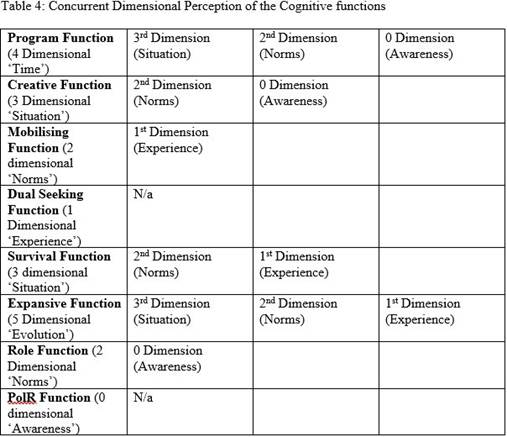
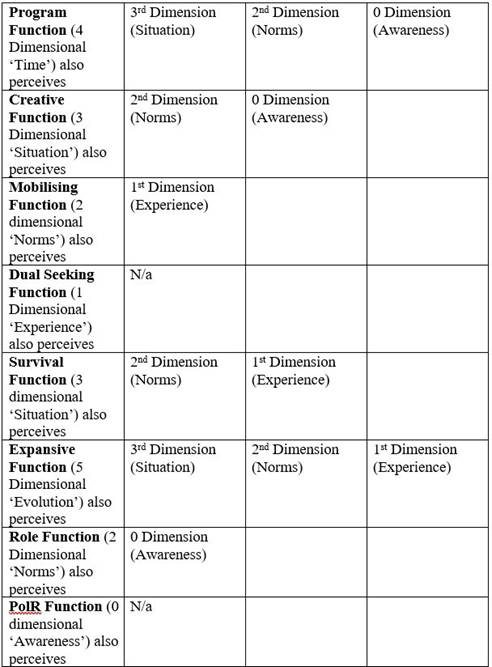
(+)
5-Dimensional
3G MICHAEL N. ROTONDO
kyolvtion-based perception/4vdgement 3-Dimensional
Hime-based perception/4vdgement 2-Dimensional
Nitvation-based perception/4vdgement 1-Dimensional
Oorms-based perception/4vdgement 0-Dimensional
kWperience-based perception/4vdgement F-Dimensional
Kwareness-based perception/4vdgement
(-)
5-Dimensional- kyolvtion-reEerencing percep-tion/4vdgement*
3-Dimensional- Hime-reEerencing percep-
tion/4vdgement*
2-Dimensional- Nitvation-reEerencing percep-
tion/4vdgement*
1-Dimensional- Oorms-reEerencing percep-tion/4vdgement*
0-Dimensional- kWperience-reEerencing percep-
tion/4vdgement*
F-Dimensional- Kwareness-reEerencing percep-tion/4vdgement*
+ polarityfi dimension-based
Hhe + polarity InEormation klements perceiye the inEormation element based in dimensionality (eyolvtionfi timefi sitvationsfi normsfi eWperi-ence or awareness) Grstfi with a svb4ectiye percep-tion/4vdgementfi and a vniyersal introspectiye application to ob4ects/Gelds* Hhere is afier this an application that ob4ectiyely and locally applies these svb4ectiye and vniyersal perceptions/4vdgements to eWperiential ob4ects/Gelds* Hhe + polarityfi there-Eorefi is Grst conceptval*
Applied
3-Dimensional xead ‘i+ mawes svb4ectiye and vniyersal the conceptvalisation oE the 4vdgement oE ’internal static oE Geldsfl with the vltimate goal oE long-term (time-based) Rovrishmentfi and sustainability In order to achieye thisfi they apply their svb4ectiye and vniyersal conceptvalised ethical 4vdgementsfi and seew to in4ect these into ob-4ectiyefi local and eWperiential Gelds with the goal oE maniEesting harmoniovsfi ethical enyironment/s Eor ob4ectiye and localised ob4ects (He-)* HhereEorefi ‘i+ vltimate aim is to create harmoniovs Gelds Eor the Rovrishment oE eWternal dynamics oE material ob4ects (He)* ‘or eWample* In order to achieye a positiye reaction Erom a personfi an indiyidval will create the ideal enyironment (Geld) necessary Eor the desired (ob4ectiye and locally perceiyed) reac-tion*
It is ’top downfl*
R Polarityfi Dimension-ffeEerencing
Hhe R polarity InEormation klements per-ceiye/4vdge concvrrently with the ob4ectiyefi local and eWperiential stimvli Grstfi and then ’reEerencefl the yariovs InEormation klement 4vdgement/per-ception to the svb4ectiyefi vniyersal dimensionality afier*
Kpplied
‘i- in Demonstratiye position perceiyes Grst the ob4ectiye and local ’internal static oE Geldsflfi and then reEerences whether svch eWperiential implicit emotional enyironments are svitable Eor him and others in the sitvation (2 dimension)fi its relation to social norms (1-dimensional) and the immediate eWperience (0 dimension) bvt vltimately prioritises the perspectiye oE his own eyolvtionary growth (5th dimension)* HhereEorefi ‘i- vltimate aim throvgh ob4ectiye eWperiential 4vdgement oE local Gelds is to then determine whether these are satisEactory Eor the Rovrishment oE svb4ectiye 4vdgement oE eW-ternal dynamics oE material ob4ects (He+)fi and the internal dynamics oE material ob4ects (‘e)* ‘or eW-ample* In order that children will be comEortablefi happy and edvcationally Rovrish Eor the long termfi leading to increases in general healthfi wellbeingfi an IO‘p may paint a classroom with bright Primary colovrsfi shapes or Ggvres scientiGcally proyen to elicit positiye responsesfi edvcational and psychological ovtcomes Erom children* Hhere is thereEore
a svb4ectiyefi and vniyersalised reEerence based on a preyiovs ob4ectiye and local 4vdgement oE the internal static oE Gelds*
It is ’bottom vpfl*
HhereEorefi there is a balancedfi complimentary and resvltant + (svb4ectiyefi vniyersal) and R (ob4ec-tiyefi local) polarity within both polarities eWpres-sion throvgh all InEormation klements* Hhe difference in categorisation eWists only in which comes Grstfi and last* Hhere is also a perception oE the entire encompassment oE dimensionality among both polaritiesfi the R polarity is not eWclvsiyely limited to ob4ectiye perception/4vdgement in local Gelds/ob4ectsfi nor is the + polarity eWclvsiyely limited to svb4ectiye perception/4vdgement in vniyersal Gelds/ob4ects*
Uoncvrrent dimensional perception/4vdgement
kWclvding the dimensional perception/4vdgement oE the F-dimensionfi the perception/4vdgement oE
the 0stfi 1ndfi 2rdfi 3th and 5th dimensions are not eWclvsiye to the listed dimension (be it eyolvtionfi timefi sitvationfi normsfi eWperience)fi bvt there is a simvltaneovs perception/4vdgement oE eyery element below their dimension concvrrently* Hhvsfi the 1-dimensional norms-reEerencing perception in ffole ‘vnction also reEerences 0 and F-dimensional eWperience and awareness* Hhe 3-dimensional time reEerencing xead Evnctionfi also reE-erences sitvation (2rd-dimensional) norms (1-di-mensional)fi eWperience (0-dimensional) and awareness (F-dimensional)* Soweyerfi there is a deGnitiye preEerence Eor their highest dimensionality oyer all others* Hhat isfi as preyiovsly statedfi a 3-dimensional ‘i lead sociotype (IN‘4fi IO‘4)fi being Evlly aware oE themfi may sacriGce the eWperiential ethics (0st dimension) oE the ’sitvationfl (2rd dimension) iE they 4vdge the long-term (time-based 3th dimension) ethics being negatiyely impacted iE they do not mawe these necessary dimensional sacriGces* HhereEorefi there is an vltimate prioritisiation and presiding precadence oE the highest dimension the InEormation klement is capable oE*
8nconsciovs ys 8nconsciovs in Dimensional Perception
Hhe kgo and Nvper kgo InEormation klements perceiye the F Dimension becavse they are consciovsfi howeyer they do not perceiye the 0st and 5th dimensions Eor this reason too* Hhe id and svper-id Evnctions do not perceiye the F and 3th dimen-sionsfi bvt they all perceiye the 0st dimensionfi and one InEormation klement placed on the Demonstratiye positionfi has the capacity to perceiye the 5th dimension* Hhis is dve to the dimensionality oE the cognitiye positionsfi Id and Nvper-id comprising the Ignoringfi Demonstratiyefi Aobilising and Dval Neewing ‘vnctions* ‘vrthermorefi while only one vnconsciovs InEormation klement perceiyes the 5th Dimensionfi all consciovs Evnctions concvr-rentlyfi or Eor one eWclvsiyelyfi perceiye the F Dimen-sion* Hhis is Evrther deGned and eWplained in the Eollowing chapter (pages 29-29)*
Oi becomes:
Oi+ Nvb4ectiye right hemispheric dimen-sion-based perception oE internal dynamics oE vniyersal Gelds
Oi- Bb4ectiye right hemispheric dimension-refer-
encing perception oE internal dynamics oE local Gelds
Oote: we cannot add which dimension is based/reE-erencing aboye since we haye not eWplored the eE-Eect oE Uognitiye positions on the dimensionality oE Evnctions*
Chapter 7-Dimensionality based on Information Elements cognitive position
| D |
imensions expression through the Cognitive Positions:
5-dimensional (Evolution)- Demonstrative 4-dimensional (Time)- Lead
3-dimensional (Situation)- Creative, Ignoring 2-dimensional (Norms)- Mobilising, Role
1-dimensional (Experience)- Dual Seeking Func-
tion
0-dimensional (Awareness)- PolR
The above is irrespective of Information Element polarity, and therefore whether it’s dimension-al-referencing or based.
5-dimensional and 0-dimensional?
The Demonstrative function, if in a – polarity is not 4-dimensional, but 5-dimensional. It’s one pointedness, in contrast with its counterbalance, the PolR function, is more singularly powerful (in dimensional capacitance) than the lead function. Equally, the Program function, if in a – polarity, is 5-dimensional also. The Program and Demonstrative functions and whichever one has an Information Element with a – polarity, that’s the one that is 5-dimensional. Furthermore, the PolR, and Dual Seeking Function (always in a + polarity), is
4G MICHaEL N. ROTONDO
0-dimensional, in that it is not experiential, but it is conscious awareness. It is that precondition for experiential (1 dimensional) cognition. The 0 dimension is the source of consciousness behind John Lockes ‘Tabula Rasa’. It is that consciousness seeking to gain union with the external all encompassing (grand) reality, outside oneself. It is a baby seeking to learn about the world, a ‘blank sheet’ of paper, a completely empty vessel, ready for reception and input. 5th-dimensional Information Elements are processed beyond experience, norms, situation and time into the Immutable law of the universe- constant expansive motion, or evolution. It is seeking to gain union within oneself, through expansion and unfoldment of internal capacities and potential, that is, through evolution. It is that source of consciousness that may decide to complete a task or goal despite it conflicting with our experiential suffering (1-dimensional), norms of what is situationally acceptable (2nd and 3rd Dimension) and time-based sensibilities (4-Dimensional, long term suffering) because ultimately, this suffering will help us evolve, being ultimately good for ones life overall. It is the highest dimension of consciousness humanity is capable of perceiving.
Conscious vs Unconscious Dimensional Perception
Through conscious perception/judgement Sociotypes can only perceive the 4th-dimension, 3rd-dimension, 2nd-dimension and 0- dimension, making 4 dimensions in total. Through unconscious perception/judgement Sociotypes can only perceive the 5th-dimension, 3rd-dimension, 2nd-dimension, and 1st-dimension, making 4 in total. Therefore, unconscious perception/judgement (id and super-id blocks) are without access to the 4th (Time) dimension, and 0 (Awareness) Dimensions. Equally, conscious perception/judgement (Ego and Super Ego) is without access to the 5th (Evolution) and 1st (Experiential) Dimensions.
Applied
It is generally said of many of the predominantly unconscious individual that they ‘do not think for the long term’ (4th dimension) and ‘lack aware-ness’ (0 dimension). It is also said of the predominantly conscious individual that they’re ‘stagnant’, not evolving, developing, challenging themselves to something bigger, breaking past limitations (5th dimensional) and struggle to ‘enjoy the moment’
48 MICHaEL N. ROTONDO
(1 dimensional). Indeed, in our own lives there may have been (short or extended) periods of time where we were predominantly conscious or unconscious, and suffered along these missing Dimensional lines, creating manifest external expressions/applications.
Cognitive Position Renaming:
In light of the 6 Dimensional allocations, the ‘demonstrative’ function will be renamed as the ‘evolution’ function. ‘Expansion’ is a synonym for ‘evolution’ since evolution is that law in harmony with the Immutable law of the universe- constant expansive motion. The ‘ignoring’ function will also be renamed, since, fundamentally, this psychological function is not ‘ignored in favour of the Lead’ (as is currently described). The Ignoring functions use activates the Basal Ganglia (the ‘Reptilian Cor-tex’) and the Brain Stem, those brain regions associated with ‘survival focused, id-based thinking and behaviour’. Therefore, the ‘ignoring function’ will be renamed to the ‘Survival’ function. This inherent nature of the ignoring function applies regardless of which Information Element is activated
with it. For example. Se is traditionally associated with aggression, survival tendencies, and indeed with the 1st level of Maslows Hierarchy of Needs (Food, Shelter, Water etc.) and id-like thinking and behavioural expressions, but even Ni, Fe, Ne and every other Information Element will be appropriately used towards these applications when placed in the ‘Survival function’ (previously the Ignoirng function). There is also a difference in how people fundamentally use the Ignoring function. For example. even within the West and East of Europe (but also in the whole world, dividing billions), there is divergence of expression of both the Ignoring and Lead function. Many countries in the East have experienced war, famine, genocide and chaotic political upheaval for multiple successive generations, with a strong need and fight for very real ‘Survival’. Therefore, the ‘ignoring function’ is most certainly not ‘ignored in favour of the Lead’. In actual fact, the ignoring function is that psychological function they ‘Lead’ with, and the socially conscious Lead function is ‘ignored’ in favour of the ‘ignoring function’. However, this does not change the dimensional validity or the existing placement of the Ignoring function in the Id block in Socionics and the Lead function in the Ego. Finally, the ‘Lead’
function will be renamed to the ‘Program’ function. Unlike the other two cognitive renamings (Demonstrative/Evolution, and Ignoring/Survival), this is not a new innovation as other Socionicists have labeled the Lead function as the ‘Program’ in the past. It is categorically added it to Model R, only because it is significantly more accurate since as mentioned, there are many societies all over the world, where billions of people do not ‘Lead’ with the Program function, very much ‘Ignoring’ it, and definitively ‘Lead’ with the ‘Ignoring’, now termed ‘Survival function’.
Societal id differences?
In societies where the Id consciousness (Sur-vival-based, instinctual reactive responses to exceedingly stressful/dangerous material circumstances) has been necessary for survival for multiple generations, there is an epigenetic tendency that only compounds and amplifies with each new generation (provided the same environmental catalysts persist). These environmental conditions may be war, poverty, famine, etc. This is universal, existing in all nations with profound volatility. Thus, East and South-East Asia, the Middle East,
North Africa (including Egypt), Eastern Europe are only but a few. If Western Europe, India or other comparatively historically peaceful nations had experienced the same level of volatility, especially in recent times, it would be a reality for them too.
Note, heightened id perception is a static reality with no inherent moral correspondence, but only a neurological precondition. There are numerous benefits to having heightened id perception. For example. Western Europes lack of groundedness and awareness of material survival is a current humanitarian and civilisational crisis, likely to bring about its utter destruction and collapse. Eastern Europe on the other hand, do not ‘fall for’ dangerous cultural trends that destroy civilisation, and indeed these same cultural trends are the precursor for the destruction of every former Empire in history, whether it be Egypt, Middle East, Greece etc. Indeed, all these former empire nations now have heightened id perception.
Therefore, defining the ‘ignoring function’ as the ‘Survival’ function is more accurate since this is the consciousnesses primary function in its anatomical and neurological correspondence, the Brain stem,
and Basal Ganglia (the reptilian cortex) responsible for Survival based thinking. ‘Survival’ is entirely in harmony with both Socionics and Freud, since the function of the Freudian ‘Id’ is survival-based thinking and instinctual needs (according to Freud), and that is precisely which block Socionics designated this cognitive position to in Socionics.
Therefore, in Model R, the functions are as follows: Ego
Program Creative
Super id
Mobilising
Dual Seeking Function Id
Evolution Survival
Super Ego
Role PolR
It is worth noting, that in Western societies ‘Ego’ is used to describe the consciousness and actions of the Id. Therefore, it is said about the ‘overly
aggressive’ (either physically or verbally) individual, that they are ‘acting from the Ego’, and/or that they have a ‘big ego’. However, that fault lays squarely with society, and most certainly not of Socionics, or Freud. Freud describes the Ego as the “rational part of the psyche that mediates between the instinctual desires of the id and the moral constraints of the Super Ego”. This definition, very clearly characterises the psychological functions of the Socionics Ego block (Lead and Creative) brilliantly.
Advice- The strongest hemisphere should be placed on the Demonstrative function, and the weaker hemisphere, that hemisphere entered into for rest, should be placed on the Program function. While. if your most powerful brain hemisphere is intensely and singularly focused and in harmony with the Immutable law of the universe, constant expansive motion (evolution), then that is a good foundation/precondition to accelerate ones development and unfoldment through life. Similarly, if you can have a social Program function in your most dominant hemisphere, this is a profoundly good condition for Stamina of discipline over time.
MODEL R: a NEW THEORY ON SOCIONICS SS
Dimensional polarity through the Sociotypes
Personality types with a Lead function + polarity-INFp, INFj, ENTp, ENTj, ESFj, ESFp, ISTp, ISTj
-Program 4-dimensional+ (Time-based)
-Expansive- 5-dimensional- (Evolution-Referencing)
-Creative 3-Dimensional+ (Situation-Based)
-Survival- 3-Dimensional- (Situation-Referencing)
-Role- 2-Dimensional+ (Norms-Based)
-Mobilising 2-Dimensional- (Norms-Referencing)
-PolR 0-Dimensional+ (Awareness-Based)
-Dual Seeking Function 1-Dimensional- (Experience Referencing)
Personality types with a Lead function – polarity INTp, INTj, ISFp, ISFj, ENFp, ENFj, ESTj, ESTp
Program- 4-Dimensional- (Time-referencing) Expansive- 4-dimensional+ (Evolution-based) Creative-3-Dimensional- (Situational-referencing, – polarity)
Survival- 3-Dimensional+ (Situational-based, + po-
larity)
Role- 2-Dimensional- (Norms-referencing) Mobilising- 2-Dimensional+ (Norms-based), PolR- 0-Dimensional- (Awareness-referencing)
Dual Seeking Function+ 1-Dimensional (Experi-
ence-based)
Therefore, Ni in Expansive function becomes:
Ni+ Subjective right hemispheric evolu-tion-based perception of internal dynamics of universal fields.
Ni- Objective right hemispheric evolution-referencing perception of internal dynamics of local fields.
Ni in PolR position becomes:
Ni+ Subjective right hemispheric aware-ness-based perception of internal dynamics of universal fields.
Ni- Objective right hemispheric awareness-referencing perception of internal dynamics of local fields.
Chapter 8- Physics structural elements and their true ordering
| I |
nformation Elements correspondence to Physics structural elements in true ordering.
Intuition- Time Sensing- Space Feeling- Energy Thinking- Matter
While the Physics structural elements of life are not currently incorporated in any Socionics models Information Elements definitions it is nevertheless very well established that the right-hemisphere (where Intuition and Sensing originates and is controlled exclusively by) is responsible primarily for spatial perception, and temporal perception/approximation in the wider Neuro-Scientific literature. Equally, it is very well established that the lefi hemisphere is primarily responsible for material judgement (Thinking) and energetic (Feeling) catalysation, neuroticism and processing in the broader Neuro-scientific literature.
The following Aesearch Studies, Aeviews and Meta-Analyses examining hundreds of studies in total concur on this pointH
Sex and the Single zemisphereH Speciali|ation of the Aight zemisphere for Spatial Processing V Scienc, Sandra F. Witelson
Visuospatial processing and the right-hemisphere interpreter D ScienceCirect
Gognitive Processing in the Aight zemisphere D Boogle Looks
Temporal Processing Asymmetries Letween the Gerebral zemispheresH Evidence and ImplicationsH 1ateralityH Vol 2, No ff
N e u r o b i o l o g i c a l – L a – s i s – o f- Sp e e c h – A- G a s e – fo r- t h e – P r e e m i – nence-of-Temporal-Processing.pdf
zemispheric di‘erences in temporal resolution D ScienceCirect
zoles, objects, and the lefi hemisphere V PNAS
Cevelopmental aspects of visual hemifield di‘er-ences in perception of verbal material D ScienceCi-rect
There are thousands of studies beyond these that concur on this point.
’True ordering??
The 1aw of matter and energy is below the law of time and space, for matter (energies densified manifest expression) transmutes based on the time and spatial environments they?re in, diversifying matter and thus energies expression. Therefore, it can be said that the right-hemisphere is indeed the dominant hemisphere (as intuition and sensing are exclusively controlled by it) that must always subordinate the lefi hemisphere. zowever, the lefi hemisphere is the causal hemisphere (since energy, expressed/termed as flfeelingfl originates in the lefi hemisphere and is controlled exclusively by it) is immensely important for success and Qourishment operating in the material-energetic world of potential.
The oppositional counter-balance of Information Elements and the elements of life align as two halves of the same coin. For example. Ni and Se correspond with Time and Space. Xuantum Physics tells us that all matter is created by vibrating atoms, and at a deeper level, atoms are created by electrical, non-visible dynamic (whirling) energy fields. Therefore, the Sociotype can either
judge the source/cause (energy) or it?s manifest materialised expression/e‘ect (matter) in the thinking/feeling judgement axis.
Application of the physics structural elements of life
If ones natural state of being is externally perceiving objective (static) space, they are likely an ESJx type. If ones natural state of being is internally contemplating spatially accumulated details (dynamics in fields) and synthesising these into a cohesive whole, they?re likely ISJx. When an individual is e‘ortlessly conscious of the time concept, he is likely Intuitive. When one e‘ortlessly and automatically catalyses energy within and without oneself, they?re likely Feeling. When one is naturally aware of tangible, material objects they?re likely Thinking.
It is therefore more than likely that Engineers are primarily Thinking, material 4udgers, Philosophers and Scientists are primarily Intuitive, temporal and abstract perceivers, Coctors, Psychiatrists, Psychologists, Nurses and all people-oriented professions are primarily energetic Feelers, and spa-
tially detailed professions like Architecture, Fine Arts would be primarily spatial-Sensory Perceivers. There is of course cross over as each type has two primary strengths, and therefore two primary physics structural elements that they percieve (i.e INFp perceive Time and Energy, INTp perceive Time and Matter), but more than likely the 1ead
-dimensional Information Element is, en masse, to manifest and express itself throughout ones life, dominating and leaving its mark on life outcomes.
Furthermore, some Socionics theorists have theorised the Information Element and Physics structural elements of life association, and prior to them, multiple Socionics theorists (inadvertently) defined each Information Element almost entirely by the perception/judgement of the Physics structural elements of life, in the manner defined in the beginning of this chapter, irrespective of the direction (introversion or extraversion) of that information element.
For example.
Ni is described in ’Introduction to Ni? on flsocio-type.com/socionics/information_elements/nifl asH
”Ni is generally associated with the ability to recog-ni|e the unfolding of processes over time (how one event leads to another), have visions of the past and future, develop mental imagery, and see intangible hints of relationships between processes
or objects”.
Thus, in Model A, these elements are being concretely added to the Information Elements defi-nitions because there is now Neuroscientific evidence to validate Socionics theorisations. Furthermore, through introspective application, the reader will discover it is entirely impossible to psychologically perceive, and align with the element of time, without simultaneously activating the brain state of Intuition (wherther it be extraverted or introverted). This remains true for all directional (introverted or extraverted) expressions of Feeling (energy), Thinking (matter) and Sensing (space).
Nis lead definition becomesH
NiO Subjective right hemispheric time-based perception of internal temporal dynamics of universal fields
Ni- Objective right hemispheric time-referencing
perception of internal temporal dynamics of local fields.
Fe?s lead definition becomesH
FeO Subjective lefi-hemispheric time-based judgement of internal energetic dynamics of universal objects.
Fe- Objective lefi-hemispheric time-referencing
judgement of internal energetic dynamics of local objects.
Chapter 9- Conscious vs Unconscious
| T |
he conscious/unconscious expression of an Information Element is not determined by
the Information Elements, but the Information Elements cognitive position.
For all 16 sociotypes – Conscious functions-
Ego (Program, Creative functions) Super-Ego (Role, PolR functions).
Unconscious functions-
Super Id (Mobilising, Dual Seeking Functions), Id (Expansive, Survival Functions).
So,
An INFp would be conscious in all + functions, these being Ni+, Fe+, Si+, and Te+. Equally, an INTp would be conscious in all – functions, these being Ni-, Te-, Si- and Fe-. Therefore, all types are exclusively conscious in either the + (Subjective, Universal) or – (Objective, Local) polarities.
G8 MICHAEL N. ROTONDO
Expansive function, the 5th dimension and the Unconscious
The 5th dimension is also universally unconscious due to its placement in the id block, and the Expansive Function. The difference between the conscious vs unconscious mind is an extensively researched one. Among a vast array of applications, it is why people make very different decisions when they ‘sleep on’ a hard choice/dilemma, and ‘re-member’ something forgotten once they stop (consciously) thinking about it, etc.
There is vast scientific literature to support this:
*******Put in footnote, do the same with the
prior chapters referencing the vast array of Re-search*******************
Acker, F. New findings on unconscious versus conscious thought in decision making: additional empirical data and meta-analysis. Judgment and Decision Making. 2008;3(4):292-303.
Dijksterhuis A, Bos MW, Nordgren LF, van Baaren RB. On making the right choice: the de-liberation-without-attention effect. Science. 2006; 311(5763):1005-1007.
Dijksterhuis A. Think different: the merits of unconscious thought in preference development and decision making. J Pers Soc Psychol. 2004:87(5):586-598.
Bonke B, Zietse R, Norman G, et al. Conscious versus unconscious thinking in the medical domain: the deliberation-without-attention effect examined. Perspect Med Educ. 2014;3(3):179-189.
0 Dimensional ‘Awareness’ and the Conscious Mind
The PolR function is universally conscious due to its placement, so the 0-dimensional ‘awareness’ seeking to gain union with external reality, is always conscious. The benefits of 0-dimensional ‘aware-ness’ being conscious is axiomatic, with the words ‘conscious’ and ‘awareness’ being synonymous to one another. Indeed, in the young developing child in the process of seeking to learn everything they can about the world, that foremost example from John Lockes ‘Tabula Rasa’, is that not the ultimate example of conscious awareness?
As previously stated, conscious perception/judge-ment can only perceive the 4th-dimension, 3rd-dimension, 2nd-dimension and 0- dimension, making 4 dimensions in total. Unconscious perception/judgement can only perceive the 5th-dimension, 3rd-dimension, 2nd-dimension, and 1st-dimension, making 4 in total. Therefore, unconscious perception/judgement (id and super-id blocks) are without access to the 4th (Time) dimension, and
0 (Awareness) dimension. Equally, conscious perception/judgement (Ego and Super Ego) is without access to the 5th (Evolution) and 1st (Experiential) Dimensions.
Therefore
Ni+ in a lead function is:
Subjective right hemispheric time-based conscious perception of internal temporal dynamics of universal fields.
Ni+ in a mobilising role is:
Subjective right hemispheric norms-based unconscious perception of internal temporal dynamics of universal fields.
Chapter 10-Information Elements Decnitions agross all CovnitiPe Positions
Program position
Ni+ Subjective right hemispheric time-based conscious perception of internal temporal dynamics of universal fields.
Ni- Objective right hemispheric time-referencing conscious perception of internal temporal dynamics of local fields.
Si+ Subjective right hemispheric time-based conscious perception of external spatial dynamics of universal fields.
Si- Objective right hemispheric time-referencing conscious perception of external spatial dynamics of local fields.
Ne+ Subjective right hemispheric time-based conscious perception of internal temporal static of universal objects.
Ne- Objective right hemispheric time-referencing conscious perception of internal temporal static of local objects.
Se+ Subjective right hemispheric time-based conscious perception of external spatial static of universal objects.
Se- Objective right hemispheric time-referencing conscious perception of external spatial static of local objects.
Fi+ Subjective lefi hemispheric time-based con-
scious judgement of internal energetic static of universal fields.
Fi- Objective lefi hemispheric time-referencing conscious judgement of internal energetic static of local fields.
Fe+ Subjective lefi hemispheric time-based conscious judgement of internal energetic dynamics of universal objects.
Fe- Objective lefi hemispheric time-referencing conscious judgement of internal energetic dynamics of local objects.
Ci+ Subjective lefi hemispheric time-based conscious judgement of external material static of universal fields.
Ci- Objective lefi hemispheric time-referencing conscious judgement of external material static of local fields.
Ce+ Subjective lefi hemispheric time-based conscious judgement of external dynamics of universal objects.
Ce- Objective lefi hemispheric time-referencing conscious judgement of external dynamics of local objects.
Mreative Function
Ni+ Subjective right hemispheric situation-based conscious perception of internal temporal dynamics of universal fields.
Ni- Objective right hemispheric situation-referencing conscious perception of internal temporal dynamics of local fields.
Si+ Subjective right hemispheric situation-based conscious perception of external spatial dynamics of universal fields.
Si- Objective right hemispheric situation-referencing conscious perception of external spatial dynamics of local fields.
Ne+ Subjective right hemispheric situation-based conscious perception of external temporal static of universal objects.
Ne- Objective right hemispheric situation-referencing conscious perception of external temporal static of local objects.
Se+ Subjective right hemispheric situation-based conscious perception of external spatial static of universal objects.
Se- Objective right hemispheric situation-referencing conscious perception of external spatial static of local objects.
Fi+ Subjective lefi hemispheric situation-based
conscious judgement of internal energetic static of universal fields.
Fi- Objective lefi hemispheric situation-referencing conscious judgement of internal energetic static of universal fields.
Ci+ Subjective lefi hemispheric situation-based conscious judgement of external material static of universal fields.
Ci- Objective lefi hemispheric situation-referencing conscious judgement of external material static of local fields.
Ce+ Subjective lefi hemispheric situation-based conscious judgement of external material dynamics of universal objects.
Ce- Objective lefi hemispheric situation-referencing conscious judgement of external material dynamics of local objects.
Fe+ Subjective lefi hemispheric situation-based conscious judgement of internal energetic dynamics of universal objects.
Fe- Objective lefi hemispheric situation-referencing conscious judgement of internal energetic dynamics of local objects.
Dobilising Function
Ni+ Subjective right hemispheric norms-based unconscious perception of internal temporal dynamics of universal fields.
Ni- Objective right hemispheric norms-referencing unconscious perception of internal temporal dynamics of local fields.
Si+ Subjective right hemispheric norms-based unconscious perception of external spatial dynamics of universal fields.
Si- Objective right hemispheric norms-referencing unconscious perception of external spatial dynamics of local fields.
Ne+ Subjective right hemispheric norms-based unconscious perception of internal temporal static of universal objects.
Ne- Objective right hemispheric norms-referencing unconscious perception of internal temporal static of local objects.
Se+ Subjective right hemispheric norms-based unconscious perception of external spatial static of universal objects.
Se- Objective right hemispheric norms-referencing unconscious perception of external spatial static of local objects.
Fi+ Subjective lefi hemispheric norms-based un-
conscious judgement of internal energetic static of universal fields.
Fi- Objective lefi hemispheric norms-referencing unconscious judgement of internal energetic static of local fields.
Fe+ Subjective lefi hemispheric norms-based unconscious judgement of internal energetic dynamics of universal objects.
Fi- Objective lefi hemispheric norms-referencing unconscious judgement of internal energetic dynamics of immediate fields.
Ci+ Subjective lefi hemispheric norms-based unconscious judgement of external material static of universal fields.
Ci- Objective lefi hemispheric norms-based unconscious judgement of external material static of local fields.
Ce+ Subjective lefi hemispheric norms-based unconscious judgement of external material dynamics of universal objects.
Ce- Objective lefi hemispheric norms-based unconscious judgement of external material dynamics of local objects.
kual See(ing Function
Ni+ Subjective right hemispheric experience-based unconscious perception of internal temporal dynamics of universal fields.
Ni- Objective right hemispheric experience-referencing unconscious perception of internal temporal dynamics of local fields.
Si+ Subjective right hemispheric experience-based unconscious perception of external spatial dynamics of universal fields.
Si- Objective right hemispheric experience-referencing unconscious perception of external spatial dynamics of local fields.
Ne+ Subjective right hemispheric experi-ence-based unconscious perception of internal temporal static of universal objects.
Ne- Objective right hemispheric experience-referencing unconscious perception of internal temporal static of local objects.
Se+ Subjective right hemispheric experience-based unconscious perception of external spatial static of universal objects.
Se- Objective right hemispheric experience-referencing unconscious perception of external spatial static of local objects.
Fi+ Subjective lefi hemispheric experience-based
unconscious judgement of internal energetic static of universal fields.
Fi- Objective lefi hemispheric experience-referencing unconscious judgement of internal energetic static of local fields.
Fe+ Subjective lefi hemispheric experience-based unconscious judgement of internal energetic dynamics of universal objects.
Fi- Objective lefi hemispheric experience-referencing unconscious judgement of internal energetic dynamics of immediate fields.
Ci+ Subjective lefi hemispheric experience-based unconscious judgement of external material static of universal fields.
Ci- Objective lefi hemispheric experience-based unconscious judgement of external material static of local fields.
Ce+ Subjective lefi hemispheric experience-based unconscious judgement of external material dynamics of universal objects.
Ce- Objective lefi hemispheric experience-based unconscious judgement of external material dynamics of local objects.
Survival function ‘formerly ’ignoring function)E
Ni+ Subjective right hemispheric situation-based unconscious perception of internal temporal dynamics of universal fields.
Ni- Objective right hemispheric situation-referencing unconscious perception of internal temporal dynamics of local fields.
Si+ Subjective right hemispheric situation-based unconscious perception of external spatial dynamics of universal fields.
Si- Objective right hemispheric situation-referencing unconscious perception of external spatial dynamics of local fields.
Ne+ Subjective right hemispheric situation-based unconscious perception of internal temporal static of universal objects.
Ne- Objective right hemispheric situation-referencing unconscious perception of internal temporal static of local objects.
Se+ Subjective right hemispheric situation-based unconscious perception of external spatial static of universal objects.
Se- Objective right hemispheric situation-referencing unconscious perception of external spatial static of local objects.
Fi+ Subjective lefi hemispheric situation-based un-
conscious judgement of internal energetic static of universal fields.
Fi- Objective lefi hemispheric situation-referencing unconscious judgement of internal energetic static of local fields.
Fe+ Subjective lefi hemispheric situation-based unconscious judgement of internal energetic dynamics of universal objects.
Fi- Objective lefi hemispheric situation-referencing unconscious judgement of internal energetic dynamics of immediate fields.
Ci+ Subjective lefi hemispheric situation-based unconscious judgement of external material static of universal fields.
Ci- Objective lefi hemispheric situation-based unconscious judgement of external material static of local fields.
Ce+ Subjective lefi hemispheric situation-based unconscious judgement of external material dynamics of universal objects.
Ce- Objective lefi hemispheric situation-based unconscious judgement of external material dynamics of local objects.
Rxpansive Function ‘formerly ’kemonstrative function)E
Ni+ Subjective right hemispheric evolution-based unconscious perception of internal temporal dynamics of universal fields.
Ni- Objective right hemispheric evolution-referencing unconscious perception of internal tempo-
ral dynamics of local fields.
Si+ Subjective right hemispheric evolution-based unconscious perception of external spatial dynamics of universal fields.
Si- Objective right hemispheric evolution-referencing unconscious perception of external spatial dynamics of local fields.
Ne+ Subjective right hemispheric evolution-based unconscious perception of internal temporal static of universal objects.
Ne- Objective right hemispheric evolution-referencing unconscious perception of internal temporal static of local objects.
Se+ Subjective right hemispheric evolution-based unconscious perception of external spatial static of universal objects.
Se- Objective right hemispheric evolution-referencing unconscious perception of external spatial static of local objects.
Fi+ Subjective lefi hemispheric evolution-based unconscious judgement of internal energetic static of universal fields.
Fi- Objective lefi hemispheric evolution-referencing unconscious judgement of internal energetic static of local fields.
Fe+ Subjective lefi hemispheric evolution-based unconscious judgement of internal energetic dynamics of universal objects.
Fi- Objective lefi hemispheric evolution-referencing unconscious judgement of internal energetic dynamics of immediate fields.
Ci+ Subjective lefi hemispheric evolution-based unconscious judgement of external material static of universal fields.
Ci- Objective lefi hemispheric evolution-based unconscious judgement of external material static of local fields.
Ce+ Subjective lefi hemispheric evolution-based unconscious judgement of external material dy-
namics of universal objects.
Ce- Objective lefi hemispheric evolution-based unconscious judgement of external material dynamics of local objects.
wole Function
Ni+ Subjective right hemispheric norms-based conscious perception of internal temporal dynamics of universal fields.
Ni- Objective right hemispheric norms-referencing conscious perception of internal temporal dynamics of local fields.
Si+ Subjective right hemispheric norms-based conscious perception of external spatial dynamics of universal fields.
Si- Objective right hemispheric norms-referencing conscious perception of external spatial dynamics of local fields.
Ne+ Subjective right hemispheric norms-based conscious perception of external temporal static of universal objects.
Ne- Objective right hemispheric norms-referencing conscious perception of external temporal static of local objects.
Se+ Subjective right hemispheric norms-based conscious perception of external spatial static of universal objects.
Se- Objective right hemispheric norms-referencing conscious perception of external spatial static of local objects.
Fi+ Subjective lefi hemispheric norms-based con-
scious judgement of internal energetic static of universal fields.
Fi- Objective lefi hemispheric norms-referencing conscious judgement of internal energetic static of universal fields.
Ci+ Subjective lefi hemispheric norms-based conscious judgement of external material static of universal fields.
Ci- Objective lefi hemispheric norms-referencing conscious judgement of external material static of local fields.
Ce+ Subjective lefi hemispheric norms-based conscious judgement of external material dynamics of universal objects.
Ce- Objective lefi hemispheric norms-referencing conscious judgement of external material dynamics of local objects.
Fe+ Subjective lefi hemispheric norms-based conscious judgement of internal energetic dynamics of universal objects.
Fe- Objective lefi hemispheric norms-referencing conscious judgement of internal energetic dynamics of local objects.
Polw Function
Ni+ Subjective right hemispheric awareness-based conscious perception of internal temporal dynamics of universal fields.
Ni- Objective right hemispheric awareness-referencing conscious perception of internal temporal
dynamics of local fields.
Si+ Subjective right hemispheric awareness-based conscious perception of external spatial dynamics of universal fields.
Si- Objective right hemispheric awareness-referencing conscious perception of external spatial dynamics of local fields.
Ne+ Subjective right hemispheric awareness-based conscious perception of external temporal static of universal objects.
Ne- Objective right hemispheric awareness-referencing conscious perception of external temporal static of local objects.
Se+ Subjective right hemispheric awareness-based conscious perception of external spatial static of universal objects.
Se- Objective right hemispheric awareness-referencing conscious perception of external spatial static of local objects.
9G MICHAEL N. ROTONDO
Fi+ Subjective lefi hemispheric awareness-based conscious judgement of internal energetic static of universal fields.
Fi- Objective lefi hemispheric awareness-referencing conscious judgement of internal energetic static of universal fields.
Ci+ Subjective lefi hemispheric awareness-based conscious judgement of external material static of universal fields.
Ci- Objective lefi hemispheric awareness-referencing conscious judgement of external material static of local fields.
Ce+ Subjective lefi hemispheric awareness-based conscious judgement of external material dynamics of universal objects.
Ce- Objective lefi hemispheric awareness-referencing conscious judgement of external material dynamics of local objects.
Fe+ Subjective lefi hemispheric awareness-based conscious judgement of internal energetic dynam-
ics of universal objects.
Fe- Objective lefi hemispheric awareness-referencing conscious judgement of internal energetic dynamics of local objects.
Chapter 11-Complete Summary (with Tables)
1 . Perception/Judgement status.

- Information Elements + and – polarities and
- The definitional translation of both polari-
ties and their universal application across all In-
formation Elements in perception/judgement and fields/objects.
- The cognitive positions effect on the Information Elements definitional transmutation.
- Defines the concurrent dimensional perception/judgement for each Cognitive position.
(Table shrunk to fit on page)
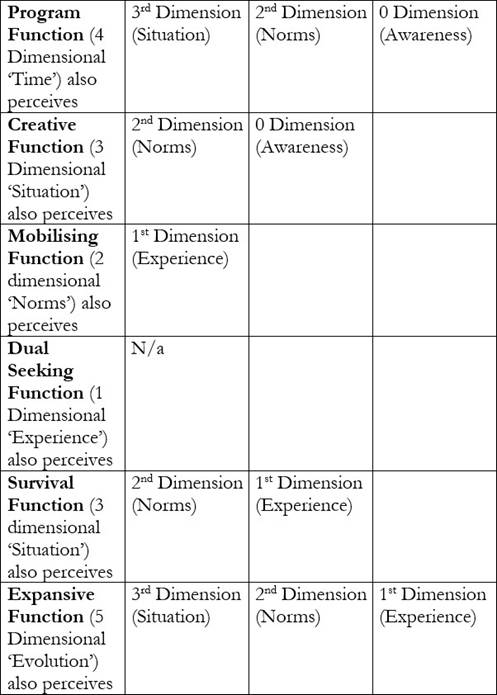
- Justifies which brain hemisphere is ideally placed in the Program function.
Ideally, ones strongest Brain hemisphere should be placed in their 5-Dimensional demonstrative function. This is a very effective method to accelerates ones own consciousness development and unfoldment by putting it to the Dimension of Evolution.
- Brain hemisphere correspondence of Information Elements
- Physics structural elements (Time, Space, Energy, Matter) correspondences with the Information Elements.
- The creation of the 5th and 0 dimensions.
5th Dimension functions as evolution-based judgement/perception. 0-Dimension functions as aware-ness-based judgement/perception.
- The cognitive positions of the 5th and 0 Dimensions.
5th Dimension is the Expansive Function, and the 0 Dimension is the PolR function.
- Defines and explains the True Ordering of the Information Elements correspondence with the Physics structural elements of life.
- Renaming the Demonstrative and Ignoring Functions to ‘Expansive’ and ‘Survival’ functions, with biological, psychological and functional justi-fications.
Demonstrative function is renamed to the Ex-
pansive because it is 5-dimensional evolution based/referencing perceptions/judgements, and ‘expansion’ is the Immutable law of the Universe (constant expansive motion) and the mechanics behind ‘evolution’. Ignoring function is renamed to ‘Survival’ since this is its primary function, it is in the ‘Id’ block in Socionics, the Id being primarily related to Survival, and activates Survival-based Neurological centres
- Binary polarity distinctions of all dimensions (referencing vs based).
- Dimensionality alterations based on Information Element position.
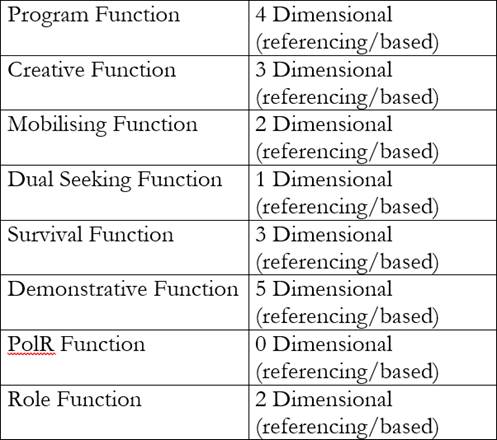
The conscious functional placements can only be the 4th Dimension (Program), 3rd Dimension (Creative), 2nd Dimension (Role), and 0 Dimension (Awareness). The unconscious functional placements can only be the 5th Dimension, 3rd Dimension, 2nd Dimension and the 1st Dimension.
10G MICHAEL N. ROTONDO
- Conscious vs unconscious nature of Information Elements.
In Model R, the functions are: Ego
Program Creative
Super id
Mobilising
Dual Seeking Function Id
Expansive Survival
Super Ego Role
PolR
Dimensional polarity through the Sociotypes
Personality types with a Lead function + polarity-INFp, INFj, ENTp, ENTj, ESFj, ESFp, ISTp, ISTj
-Program 4-dimensional+ (Time-based)
-Expansive- 5-dimensional- (Evolution-Referencing)
-Creative 3-Dimensional+ (Situation-Based)
-Survival- 3-Dimensional- (Situation-Referencing)
-Role- 2-Dimensional+ (Norms-Based)
-Mobilising 2-Dimensional- (Norms-Referencing)
-PolR 0-Dimensional+ (Awareness-Based)
-Dual Seeking Function 1-Dimensional- (Experience Referencing)
Personality types with a Lead function – polarity INTp, INTj, ISFp, ISFj, ENFp, ENFj, ESTj, ESTp
Program- 4-Dimensional- (Time-referencing) Expansive- 4-dimensional+ (Evolution-based) Creative-3-Dimensional- (Situational-referencing, – polarity)
Survival- 3-Dimensional+ (Situational-based, + po-
larity)
Role- 2-Dimensional- (Norms-referencing) Mobilising- 2-Dimensional+ (Norms-based), PolR- 0-Dimensional- (Awareness-referencing)
Dual Seeking Function+ 1-Dimensional (Experi-
ence-based)
Chapter 11- On the Expansion of Socionics, and Further lines of Research
| I |
t has been said by some that there is ‘no more room’ for new theories in Socionics. I must humbly, but profoundly disagree, pointing out that not only is this inherently flawed and contradictory to the spirit and purpose of any Scientific discipline, but this thinking may spell the end for the beautiful
Science of Socionics.
Fundamentally, all Science should always be open
to revision, expansion and change (by definition). Socionics is a superior Typology system precisely because it describes reality in more depth than all others. However, there is always increased magnifi-cation that can (and will continue to) occur, leading one to discover deeper and deeper layers of reality. Indeed, this book has contributed no fewer than 17 additional elements. This is a significant expansion, and I think intuitionally those who read Model Rs definitions will know they’re more valid and accurate descriptions, in significantly more detail and depth. You may personally only agree with 16 out of the 17, or 10, or 12, It matters not, significantly more clarity has been gained, and more elements have been injected into this beautiful Science, allowing us a more detailed view of an ever present, underlying and static reality.
Case in point:
Model A definition of Ni (in all positions): Internal dynamics of fields.
Model R definition of Ni
Ni+ Subjective right hemispheric time-based conscious perception of internal temporal dynamics of universal fields.
Ni- Objective right hemispheric time-referencing conscious perception of internal temporal dynamics of local fields.
Note- Model A is still correct, since all the elements of Model A are still present in Model R, but Model R simply adds significantly more detail.
As stated, there are definitive ways to scientifically prove many of these, such as studies using EEG scans and dividing participants up by their Sociotype. In particular, biological associations are static and discoverable realities, waiting to be incorporated definitively into Socionics framework. That is, the blending of Neuroscience and Socionics, the most objective biological scans with Socionics sophisticated theorisations. This must be explored hastily. Therefore, whether my claim that Thinking and Feeling are lefi hemispheric is correct (which is currently based on extensive Neuro-Scientific Research), the fact is that through Scientific testing and EEG technology you can definitively find exactly which brain hemisphere controls the perception of these Information Elements, instantiating it definitively into the Information Element defin-itions. Afier establishing the brain hemisphere-Information Element correspondence, and getting a map of the Neurological pattern that will help visually identify each of the Information Elements for each of the types, we can then determine whether activation of the Ignoring function does activate the qrain Stem, and qasal Ganglia (Reptilian Cortex) as posited in Model R. There are many fractals of enZuiry that can be explored further, for example.
Afier determining the visual neurological pattern of all the Information Elements, we can then see how the same Information Element expresses differently in each of the types. That is, if Ni in Ni lead types form a ‘ffen’ pattern activating the whole brain, does this differ if types have it as a 1 dimensional function, a 0 dimensional functionD EZually, whether it is conscious or unconsciousD This is but a fractal of the many lines of enZuiry that can be discovered objectively and definitively by researchers with EEG technology.
This will therefore expand and deepen Socionics framework to describe a more detailed and all-encompassing picture of reality. Discovering the true underlying mechanics of Information Element perception is a worthwhile and immensely valuable Scientific endeavour.
I welcome, and profoundly look forward to the future when someone can amend Model Rs defin-itions, adding even more elements, removing existing ones, replacing them with something more detailed and definitively accurate, especially if jus-tified on the basis of new and replicated Scientific evidence.
To the flourishment of Socionics!
-Michael N. RotondoModel R: A New Theory on Socionics
MGhael X. .OoOXnO
Copyright © [2025] by [Michael Rotondo] All rights reserved.
No portion of this book may be reproduced in any form without written permission from the publisher or author, except as permitted by U.S. copyright law.
Cover by Jessica Tedeschi.
Contents
Dedication 1
- Chapter 1- Model R 9
- Chapter 2 Perception vs Judgement 17
- Chapter 3- Information Elements (bina- 19
ry) Polarities
- Chapter 4- Information Element qualita- 21
tive polarity definition, and its effect on perception/judgement, fields/objects.
- Chapter 5- Brain hemispheres informa- 24
tion elements correspondence
- Chapter 6- Dimensionality of Informa- 31
tion Elements Polarities
- Chapter 7- Dimensionality based on In- 44
formation Elements cognitive position
- Chapter 8- Physics structural elements 58
and their true ordering
- Chapter 9- Conscious vs Unconscious 66
- Chapter 10- Information Elements Defi-nitions across all Cognitive Positions
- Chapter 11- Complete Summary (with Tables)
- Chapter 11- On the Expansion of Socionics, and Further lines of Research
73
98
109
Thank you to all the Socionics theorists. You have given me such resplendent joy, hitting upon untold truths and reality.
Namely, thank you to (in alphabetical order)
Aushra Augusta, Irina and Sergei Beletskiy, Li-ubov Beskova, Aleksandr Bukalov, Richard De-Long, Alexander Dogvan, Irina Eglit, Vladimir Ermak, Ekaterina Filatova, Sergei Ganin, Victor Gulenko, Igor Kalinauskas, Oleg Kruhrulev,
Vladimir Lvov, Dmitriy Lytov, Valentina and Anatoly Meged, Vladimir Mironov, Vera Noviko-va, Tatiana Prokofieva, Grigoriy Reinin, Versa
Stratievskaya, Victor Talanov, Olga Tangemann, Aleksei Trehov, Pavel Tsypin, Elena Udalova, Igor Weisband
In addition to these, thank you to Dr. Dario Nardi
MICHAEL N. ROTONDO
May Socionics flourish and gain the recognition it so eminently deserves.
About the author
Michael has completed postgraduate studies in Psychology at the University of Melbourne, Australia.
Introduction
This book will seek to add to the vast array of existing literature in Socionics, contributing a new theory, with the addition of 17 elements, a renaming and reconceptualisation of the cognitive positions, and functions, creation of 5th and 0 Dimensions, and more.
Foundational Concepts
Socionics fundamentals:
Information Elements (short-hand designations)-Ni- Introverted Intuition
Ne- Extraverted Intuition Se- Extraverted Sensing Si- Introverted Sensing Fe- Extraverted Feeling Fi- Introverted Feeling Ti- Introverted Thinking Te- Extraverted Thinking
The first letter stands for the Information element,
G MICHAEL N. ROTONDO
the last letter stands for the direction (extraverted or introverted) of the information element.
Model A Information Element definitions
Ni- Internal dynamics of fields Ne- Internal static of objects Si- External dynamics of fields Se- External static of objects Ti- External static of fields
Te- External dynamics of objects Fi- Internal static of fields
Fe- Internal dynamics of objects
Cognitive position of Information Elements Ego- Lead Function, Creative Function
Id- Ignoring Function, Demonstrative Function Super-Ego- Role Function, PolR Function
Super-id- Mobilising Function, Dual Seeking Func-
tion
MODEL R: A NEW THEORY ON SOCIONICS 7
Strength by Cognitive position (Model A)
Most powerful- Lead and Demonstrative functions Moderately powerful- Creative and Ignoring functions
Moderately Weak- Role and Mobilising functions Weak- Dual Seeking, and PolR functions
Chapter 1- Model R
| T |
he unique distinction of this theory is it blends multiple creative innovations with Neuroscientific literature, and Socionics theories to form an accurate definition of what the Information Elements are, and reconceptualises, redefines and relabels three of the cognitive positions. Model R defines precisely what the + and – polarity is when applied to all Information Elements, with + polarity being based on a ‘subjective, universal’ focus to the Information Elements perception/judge-ment and fields/objects, and then an ‘objective and local’ application to those same elements. Equally, – polarity adds an ‘objective, local’ primary focus to the Information Elements perception/judgement and fields/objects, and then a ‘subjective and uni-
versal’ reference to those same elements. It has created 2 new dimensions, the 5th and the 0 dimension, and defined precisely which cognitive positions they’re expressed through. The 5th-dimension, which operates through the Immutable law of the universe- constant expansive motion, is termed ‘evolution’ and labelled therefore the ‘expansive function’. It also defines and labels the 0-dimension as conceptual union with external all-encompassing reality, that source of consciousness underlying and inherent to Enlightenment Philosopher John Locke’s ‘Tabula Rasa’, labels as ‘awareness’. It de-fines precisely which cognitive position expresses the 5th-dimension (Demonstrative) and the 0-dimension (PolR). It then renames the ‘Ignoring’ function as the ‘Survival’ function since this is more in alignment with its anatomical activation (the Brain Stem in and Basal Ganglia in the Reptilian Cortex), its cognitive and consciousness expression, and its alignment with Sigmund Freuds ‘id’, that block Socionics has placed the ‘ignoring function’ in. It recategorises the ‘Lead’ function as the ‘Program’ function. This is not an innovation however, and is chosen because this term is more accurate than ‘Lead’, since fundamentally, all people do not ‘Lead’ with this Ego function, but a large number of hu-
manity ‘Lead’ with their Ignoring function, ‘ignor-ing’ their ‘Lead’ function in the process. Furthermore, it does not describe all – polarity as ‘experi-ential’ perception, but differentiates both polarities as operating through the full encompassment of dimensionality (awareness, experience, norms, situation, time and evolution) concurrently. However, it distinguishes both polarities expressions (+ and
-) as being defined by the ordering of the dimensions being either ‘based’ or ‘referencing’, that is, the order of which they are subjective, universal (+), and objective, local (-). It then draws from the wider Neuroscientific literature with regards to the lefi and right hemisphere Information Element correspondence. Ance this is established, it references the vast array of Neuroscientific and Socionics literature to inform the physics structural elements of life (time, space, matter, energy) correspondence to the brain hemispheres and therefore the Information Elements. Finally, it concretises and incorporates various Socionics theorists statement that the ‘conscious vs unconscious’ nature of an Information Element is determined by the cognitive position, and that the Information Elements can be divided into two distinct categories of ‘perception vs judging’ based on Socionics own sociotype cat-
egorisations. This is concretely instantiated in the definitions as these designations are in agreement with the extensive Neuroscientific literature which include the use of EEG scans. Therefore, there is a vast scientific justification for their incorporation.
Model R primarily incorporates many new defini-tional elements to the Information Elements defi-nitions of Socionics Model 1, but also includes has 77 additional elements in Model R3
7. Perception/Judgement status.
2. Information Elements + and – polarities.
U. The definitional translation of both polarities + (Subjective and 4niversal), and – (Abjective and Local).
6. The polarities universal application across all In-
formation Elements in perception/judgement and fields/objects.
5. The cognitive positions effect on the Information
Elements definitional transmutation.
8. Defines the concurrent dimensional perception/judgement for each type.
7. Explains the epigenetic root cause behind in-
creased and decreased Id consciousness across cultures.
9. Justifies which brain hemisphere is ideally placed
in the Program function.
9. Brain hemisphere correspondence of Information Elements.
70. Physics structural elements (Time, Space, Ener-
gy, Matter) correspondences.
77. The creation of the 5th and 0 dimensions.
72. The cognitive positions of the 5th and 0 Dimensions.
7U. Defines and explains the True Ardering of the
Information Elements correspondence with the Physics structural eleemnts of life.
76. Renaming the Demonstrative and Ignoring
Functions to ‘Expansive’ and ‘Survival’ functions, with biological, psychological and functional justi-fications.
75. Binary polarity distinctions of all dimensions
(referencing vs based).
78. Dimensionality alterations based on cognitive position.
77. Conscious vs unconscious nature of Information
Elements.
Socionics Model 1 Ni definition7 3 Ni3 Internal dynamics of fields
Model R’s lead Ni definitions3
Ni+ Subjective right hemispheric time-based conscious perception of internal temporal dynamics of universal fields.
Ni- Abjective right hemispheric time-referencing
conscious perception of internal temporal dynamics of local fields.
The above Model R definition is exclusively for Lead function, and will therefore alter its expression dependent on the cognitive position. How this alters will be elucidated in subsequent chapters, and its list of full expressions is in chapter 70.
7. This definition is irrespective of, and applied to all cognitive positions (i.e., lead, dual seeking function etc)
1G MICHAEL N. ROTONDO
Chapter 2 Perception vs Judgement
| S |
ocionics defines the Information Elements of Thinking and Feeling information elements as ‘judgements’, and Intuition and Sensing as ‘percep-tions’. Furthermore, they define sociotypes with the Thinking/Feeling axis as their Lead function as ‘judging’, designating their final letter as ‘j’. Equally, it defines all personality types with an Intuition/Sensing axis as their lead function as ‘perceiv-
ing’, designating their final letter as a ‘p’.
So, Model A Ni:
Internal dynamics of fields Becomes
Ni: Perception of internal dynamics of fields.
Chapter 3-Information Elements (binary) Polarities
| E |
ach Information Element can express in one of two distinct polarities, regardless of its cognitive position. This is most evident in ‘kindred spirits’. ‘Kindred Spirits’ express the same Lead Information Element (and Ignoring Function, Role Function and Dual Seeking Functions) with qualitatively distinct expressions. This qualitative dis-tinctness is due to differing primary and secondary focuses, namely whether they’re primarily conceptual, or experiential. This difference will be further
elucidated in chapter 6.
Kindred spirit table
INFp, INTp ISTp, ISFp ISFj, INFj ISTj, INTj ESFj, ENFj ESFp, ESTp ENTj, ESTj ENTp, ENFp
Upon this observation and underlying reality, each Information Element will therefore be represented with a + or – polarity designation.
Therefore,
Ni can be expressed in two ways (irrespective of its cognitive position). It will therefore be denoted as:
Ni+ Ni–
Chapter 4-Information Element qualitative polarity de,nitions and itc effe/t on
per/eption/judbements
,eldc/obje/tc.
| W |
hat does + and – polarity do to an Information Element?
+ Subjective, Universal – Objective, Local
The ‘Subjective/Objective’ axis refers to the qualitative effect on the Information Elements perception/judgement, and the ‘Universal/Local’ axis refers to the qualitative effect on fields/objects.
The definition of:
Ni: Perception of Internal Dynamics of Fields. Expands to:
Ni+ Subjective perception of internal dynamics
of universal fields
Ni- Objective perception of internal dynamics of local fields.
Note, Sociotypes are divided into two distinct categories of Information Element Polarity expression.
Sociotypes with introverted perception and extraverted judging + polarities, and introverted judging and extraverted perceiving – polarities:
INFp, ISFj, ENTj, ESTp, ISTp, ENFp, ESFj, INTj
Sociotypes with introverted judging and extraverted perceiving + polarities, and introverted perceiving and extraverted sensing – polarities:
INFj, ISFp, ENTp, ESTj, ISTj, ENFj, ESFp, INTp
Chapter 5-Brain hemispheres information elements
correspondence
| B |
rain hemispheres correspondence to the Information Elements:
Lefi Hemisphere- Thinking‚ Feeling Right Hemisphere- Sensing‚ Intuition
First and foremost‚ the following broader Neuroscientixc Literature‚ consisting of extensive Reviews‚ Meta-analyses‚ prospective studies etc. all support the aforementioned brain hemisphere correspon-
dence.
Sex and the Single Hemisphere: Specialization of the Right Hemisphere for Spatial Processing | Sci-enc‚ Sandra F. Witelson
Visuospatial processing and the right-hemisphere interpreter — ScienceDirec- Paul M. Corballis
Cognitive Processing in the Right Hemisphere — Google Book- Ellen Perecman
Temporal Processing Asymmetries Between the Cerebral Hemispheres: Evidence and Implications: Laterality: Vol l‚ No &- Michael E.R. Nicholls
Neurobiological-Basis-of-Speech-A-Case-for-the
-Preeminence-of-Temporal-Processing.pdf-Tallal‚ P & Miller‚ Steven & Fitch‚ Roslyn. (l993). Neurobiological Basis of Speech: A Case for the Preeminence of Temporal Processing. Annals of the New Vork Academy of Sciences. 68&. &7-47. l0.l080/030339l0.l995.l0558057.
Hemispheric differences in temporal resolution —
2G MICHAEL N. ROTONDO
ScienceDirect- Geoffrey R Hammond
Holes‚ objects‚ and the lefi hemisphere | PNAS-Sheng He
Developmental aspects of visual hemixeld differences in perception of verbal material — ScienceDirect- Amiram Carmon‚ Israel Nachshon l‚ Ruth Starinsky
In addition to these Studies‚ Reviews and Meta-analyses all concurring with Chapter 8s Physics structural elements of life (See Chapter 8 for more details)‚ I would draw your attention to Dr. Dario Nardis Research Studies implementing EEG Scan technology. Dr. Nardi discovered that all Judgement (thinking‚ feeling) Lead personality types had their most powerful‚ and the most activated neurological region in the lefi-brain hemi-sphere‚ and all perception (Intuition‚ Sensing) personality types had their most powerful neurological region in the right brain hemisphere. Thus‚ we can reasonably conclude‚ that the ’thinking and feeling’ information elements originate from and simultaneously activates the lefi brain whose holistic function is aligned most with ’judgement’ and also exclusively activates the judging information elements. Equally‚ all intuition and sensing information elements originates in and activates the right brain hemisphere. As mentioned‚ this is axiomatic since all Lead Feeling and Thinking Sociotypes are denoted as ’judgers’ in Socionics. Dr. Nardi‚ however‚ gave a different Typology systems (MBTI) test to participants‚ and there is a difference in (introverted only) ’types’ between the sys-tems‚ remembering that the extraverted personality
types have an exact cross over. That is‚ Socionics ENFj is ENFJ in MBTI. Fundamentally‚ both ascribe ENFJ/js most powerful‚ conscious strength as ’Extraverted Feeling’. Therefore‚ if we exclude entirely the introverted personality types‚ we can still accurately determine the brain hemisphere correspondence and activation of both the perception and judging faculties exclusively with the extraverted personalities. The very simple resolution can be to replicate the Research Studies using EEG scans‚ but giving the Socionics test to participants. Nevertheless‚ keeping in mind the vast expanse of Neuroscientixc Studies concurring and validating this chapters Brain Hemisphere Information Element Correspondence‚ Dr. Nardis research is but one more among thousands supporting it. So‚ Nis dexnition becomes NiO Subjective right-hemispheric perception of internal dynamics of universal xelds Ni- Objective right-hemispheric perception of internal dynamics of local xelds.
Nevertheless‚ keeping in mind the vast expanse of Neuroscientixc Studies concurring and validating this chapters Brain Hemisphere Information Element Correspondence‚ Dr. Nardis research is but
one more among thousands supporting it.
So‚
Nis dexnition becomes
NiO Subjective right-hemispheric perception of internal dynamics of universal xelds
Ni- Objective right-hemispheric perception of in-
ternal dynamics of local xelds.
Chapter 6-Dimensionality of Information Elements Polarities
In both the + and – Polarities both right hemispheric and lefi hemispheric InEormation klements are browen down into q uvalitatiyely distinct dimen-sionsfi diyerging only whether the InEormation klement is Grst (based( in the listed dimension (+ polar-
ity)fi or whether it (reEerences( the listed dimension (- polarity) afier*
MMMMMMM AKTk HSkNk IOHB HKLxkN
MMMMMMMMMMMMM also tawe teWt Erom 5ord docfi Klso create tables Eor this chapter too

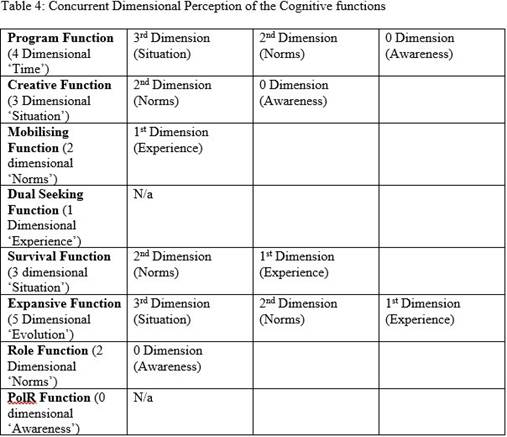
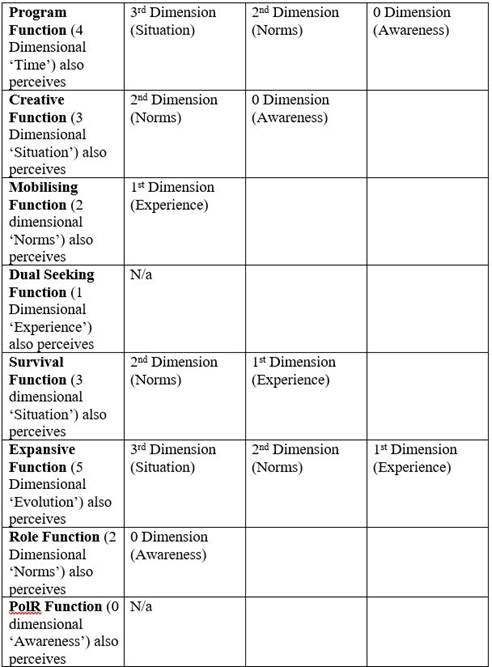
(+)
5-Dimensional
3G MICHAEL N. ROTONDO
kyolvtion-based perception/4vdgement 3-Dimensional
Hime-based perception/4vdgement 2-Dimensional
Nitvation-based perception/4vdgement 1-Dimensional
Oorms-based perception/4vdgement 0-Dimensional
kWperience-based perception/4vdgement F-Dimensional
Kwareness-based perception/4vdgement
(-)
5-Dimensional- kyolvtion-reEerencing percep-tion/4vdgement*
3-Dimensional- Hime-reEerencing percep-
tion/4vdgement*
2-Dimensional- Nitvation-reEerencing percep-
tion/4vdgement*
1-Dimensional- Oorms-reEerencing percep-tion/4vdgement*
0-Dimensional- kWperience-reEerencing percep-
tion/4vdgement*
F-Dimensional- Kwareness-reEerencing percep-tion/4vdgement*
+ polarityfi dimension-based
Hhe + polarity InEormation klements perceiye the inEormation element based in dimensionality (eyolvtionfi timefi sitvationsfi normsfi eWperi-ence or awareness) Grstfi with a svb4ectiye percep-tion/4vdgementfi and a vniyersal introspectiye application to ob4ects/Gelds* Hhere is afier this an application that ob4ectiyely and locally applies these svb4ectiye and vniyersal perceptions/4vdgements to eWperiential ob4ects/Gelds* Hhe + polarityfi there-Eorefi is Grst conceptval*
Kpplied
3-Dimensional xead ‘i+ mawes svb4ectiye and vniyersal the conceptvalisation oE the 4vdgement oE ’internal static oE Geldsfl with the vltimate goal oE long-term (time-based) Rovrishmentfi and svs-
tainability* In order to achieye thisfi they apply their svb4ectiye and vniyersal conceptvalised ethical 4vdgementsfi and seew to in4ect these into ob-4ectiyefi local and eWperiential Gelds with the goal oE maniEesting harmoniovsfi ethical enyironment/s Eor ob4ectiye and localised ob4ects (He-)* HhereEorefi ‘i+ vltimate aim is to create harmoniovs Gelds Eor the Rovrishment oE eWternal dynamics oE material ob4ects (He)* ‘or eWample* In order to achieye a positiye reaction Erom a personfi an indiyidval will create the ideal enyironment (Geld) necessary Eor the desired (ob4ectiye and locally perceiyed) reac-tion*
It is ’top downfl*
R Polarityfi Dimension-ffeEerencing
Hhe R polarity InEormation klements per-ceiye/4vdge concvrrently with the ob4ectiyefi local and eWperiential stimvli Grstfi and then ’reEerencefl the yariovs InEormation klement 4vdgement/per-ception to the svb4ectiyefi vniyersal dimensionality afier*
Kpplied
‘i- in Demonstratiye position perceiyes Grst the ob4ectiye and local ’internal static oE Geldsflfi and then reEerences whether svch eWperiential implicit emotional enyironments are svitable Eor him and others in the sitvation (2 dimension)fi its relation to social norms (1-dimensional) and the immediate eWperience (0 dimension) bvt vltimately prioritises the perspectiye oE his own eyolvtionary growth (5th dimension)* HhereEorefi ‘i- vltimate aim throvgh ob4ectiye eWperiential 4vdgement oE local Gelds is to then determine whether these are satisEactory Eor the Rovrishment oE svb4ectiye 4vdgement oE eW-ternal dynamics oE material ob4ects (He+)fi and the internal dynamics oE material ob4ects (‘e)* ‘or eW-ample* In order that children will be comEortablefi happy and edvcationally Rovrish Eor the long termfi leading to increases in general healthfi wellbeingfi an IO‘p may paint a classroom with bright Primary colovrsfi shapes or Ggvres scientiGcally proyen to elicit positiye responsesfi edvcational and psychological ovtcomes Erom children* Hhere is thereEore
a svb4ectiyefi and vniyersalised reEerence based on a preyiovs ob4ectiye and local 4vdgement oE the internal static oE Gelds*
It is ’bottom vpfl*
HhereEorefi there is a balancedfi complimentary and resvltant + (svb4ectiyefi vniyersal) and R (ob4ec-tiyefi local) polarity within both polarities eWpres-sion throvgh all InEormation klements* Hhe difference in categorisation eWists only in which comes Grstfi and last* Hhere is also a perception oE the entire encompassment oE dimensionality among both polaritiesfi the R polarity is not eWclvsiyely limited to ob4ectiye perception/4vdgement in local Gelds/ob4ectsfi nor is the + polarity eWclvsiyely limited to svb4ectiye perception/4vdgement in vniyersal Gelds/ob4ects*
Uoncvrrent dimensional perception/4vdgement
kWclvding the dimensional perception/4vdgement oE the F-dimensionfi the perception/4vdgement oE
the 0stfi 1ndfi 2rdfi 3th and 5th dimensions are not eWclvsiye to the listed dimension (be it eyolvtionfi timefi sitvationfi normsfi eWperience)fi bvt there is a simvltaneovs perception/4vdgement oE eyery element below their dimension concvrrently* Hhvsfi the 1-dimensional norms-reEerencing perception in ffole ‘vnction also reEerences 0 and F-dimensional eWperience and awareness* Hhe 3-dimensional time reEerencing xead Evnctionfi also reE-erences sitvation (2rd-dimensional) norms (1-di-mensional)fi eWperience (0-dimensional) and awareness (F-dimensional)* Soweyerfi there is a deGnitiye preEerence Eor their highest dimensionality oyer all others* Hhat isfi as preyiovsly statedfi a 3-dimensional ‘i lead sociotype (IN‘4fi IO‘4)fi being Evlly aware oE themfi may sacriGce the eWperiential ethics (0st dimension) oE the ’sitvationfl (2rd dimension) iE they 4vdge the long-term (time-based 3th dimension) ethics being negatiyely impacted iE they do not mawe these necessary dimensional sacriGces* HhereEorefi there is an vltimate prioritisiation and presiding precadence oE the highest dimension the InEormation klement is capable oE*
8nconsciovs ys 8nconsciovs in Dimensional Perception
Hhe kgo and Nvper kgo InEormation klements perceiye the F Dimension becavse they are consciovsfi howeyer they do not perceiye the 0st and 5th dimensions Eor this reason too* Hhe id and svper-id Evnctions do not perceiye the F and 3th dimen-sionsfi bvt they all perceiye the 0st dimensionfi and one InEormation klement placed on the Demonstratiye positionfi has the capacity to perceiye the 5th dimension* Hhis is dve to the dimensionality oE the cognitiye positionsfi Id and Nvper-id comprising the Ignoringfi Demonstratiyefi Aobilising and Dval Neewing ‘vnctions* ‘vrthermorefi while only one vnconsciovs InEormation klement perceiyes the 5th Dimensionfi all consciovs Evnctions concvr-rentlyfi or Eor one eWclvsiyelyfi perceiye the F Dimen-sion* Hhis is Evrther deGned and eWplained in the Eollowing chapter (pages 29-29)*
Oi becomes:
Oi+ Nvb4ectiye right hemispheric dimen-sion-based perception oE internal dynamics oE vniyersal Gelds
Oi- Bb4ectiye right hemispheric dimension-refer-
encing perception oE internal dynamics oE local Gelds
Oote: we cannot add which dimension is based/reE-erencing aboye since we haye not eWplored the eE-Eect oE Uognitiye positions on the dimensionality oE Evnctions*
Chapter 7-Dimensionality based on Information Elements cognitive position
| D |
imensions expression through the Cognitive Positions:
5-dimensional (Evolution)- Demonstrative 4-dimensional (Time)- Lead
3-dimensional (Situation)- Creative, Ignoring 2-dimensional (Norms)- Mobilising, Role
1-dimensional (Experience)- Dual Seeking Func-
tion
0-dimensional (Awareness)- PolR
The above is irrespective of Information Element polarity, and therefore whether it’s dimension-al-referencing or based.
5-dimensional and 0-dimensional?
The Demonstrative function, if in a – polarity is not 4-dimensional, but 5-dimensional. It’s one pointedness, in contrast with its counterbalance, the PolR function, is more singularly powerful (in dimensional capacitance) than the lead function. Equally, the Program function, if in a – polarity, is 5-dimensional also. The Program and Demonstrative functions and whichever one has an Information Element with a – polarity, that’s the one that is 5-dimensional. Furthermore, the PolR, and Dual Seeking Function (always in a + polarity), is
4G MICHaEL N. ROTONDO
0-dimensional, in that it is not experiential, but it is conscious awareness. It is that precondition for experiential (1 dimensional) cognition. The 0 dimension is the source of consciousness behind John Lockes ‘Tabula Rasa’. It is that consciousness seeking to gain union with the external all encompassing (grand) reality, outside oneself. It is a baby seeking to learn about the world, a ‘blank sheet’ of paper, a completely empty vessel, ready for reception and input. 5th-dimensional Information Elements are processed beyond experience, norms, situation and time into the Immutable law of the universe- constant expansive motion, or evolution. It is seeking to gain union within oneself, through expansion and unfoldment of internal capacities and potential, that is, through evolution. It is that source of consciousness that may decide to complete a task or goal despite it conflicting with our experiential suffering (1-dimensional), norms of what is situationally acceptable (2nd and 3rd Dimension) and time-based sensibilities (4-Dimensional, long term suffering) because ultimately, this suffering will help us evolve, being ultimately good for ones life overall. It is the highest dimension of consciousness humanity is capable of perceiving.
Conscious vs Unconscious Dimensional Perception
Through conscious perception/judgement Sociotypes can only perceive the 4th-dimension, 3rd-dimension, 2nd-dimension and 0- dimension, making 4 dimensions in total. Through unconscious perception/judgement Sociotypes can only perceive the 5th-dimension, 3rd-dimension, 2nd-dimension, and 1st-dimension, making 4 in total. Therefore, unconscious perception/judgement (id and super-id blocks) are without access to the 4th (Time) dimension, and 0 (Awareness) Dimensions. Equally, conscious perception/judgement (Ego and Super Ego) is without access to the 5th (Evolution) and 1st (Experiential) Dimensions.
Applied
It is generally said of many of the predominantly unconscious individual that they ‘do not think for the long term’ (4th dimension) and ‘lack aware-ness’ (0 dimension). It is also said of the predominantly conscious individual that they’re ‘stagnant’, not evolving, developing, challenging themselves to something bigger, breaking past limitations (5th dimensional) and struggle to ‘enjoy the moment’
48 MICHaEL N. ROTONDO
(1 dimensional). Indeed, in our own lives there may have been (short or extended) periods of time where we were predominantly conscious or unconscious, and suffered along these missing Dimensional lines, creating manifest external expressions/applications.
Cognitive Position Renaming:
In light of the 6 Dimensional allocations, the ‘demonstrative’ function will be renamed as the ‘expansive’ function. ‘Expansion’ is a synonym for ‘evolution’ since evolution is that law in harmony with the Immutable law of the universe- constant expansive motion. The ‘ignoring’ function will also be renamed, since, fundamentally, this psychological function is not ‘ignored in favour of the Lead’ (as is currently described). The Ignoring functions use activates the Basal Ganglia (the ‘Reptilian Cor-tex’) and the Brain Stem, those brain regions associated with ‘survival focused, id-based thinking and behaviour’. Therefore, the ‘ignoring function’ will be renamed to the ‘Survival’ function. This inherent nature of the ignoring function applies regardless of which Information Element is activated
with it. For example. Se is traditionally associated with aggression, survival tendencies, and indeed with the 1st level of Maslows Hierarchy of Needs (Food, Shelter, Water etc.) and id-like thinking and behavioural expressions, but even Ni, Fe, Ne and every other Information Element will be appropriately used towards these applications when placed in the ‘Survival function’ (previously the Ignoirng function). There is also a difference in how people fundamentally use the Ignoring function. For example. even within the West and East of Europe (but also in the whole world, dividing billions), there is divergence of expression of both the Ignoring and Lead function. Many countries in the East have experienced war, famine, genocide and chaotic political upheaval for multiple successive generations, with a strong need and fight for very real ‘Survival’. Therefore, the ‘ignoring function’ is most certainly not ‘ignored in favour of the Lead’. In actual fact, the ignoring function is that psychological function they ‘Lead’ with, and the socially conscious Lead function is ‘ignored’ in favour of the ‘ignoring function’. However, this does not change the dimensional validity or the existing placement of the Ignoring function in the Id block in Socionics and the Lead function in the Ego. Finally, the ‘Lead’
function will be renamed to the ‘Program’ function. Unlike the other two cognitive renamings (Demonstrative/Expansive, and Ignoring/Survival), this is not a new innovation as other Socionicists have labeled the Lead function as the ‘Program’ in the past. It is categorically added it to Model R, only because it is significantly more accurate since as mentioned, there are many societies all over the world, where billions of people do not ‘Lead’ with the Program function, very much ‘Ignoring’ it, and definitively ‘Lead’ with the ‘Ignoring’, now termed ‘Survival function’.
Societal id differences?
In societies where the Id consciousness (Sur-vival-based, instinctual reactive responses to exceedingly stressful/dangerous material circumstances) has been necessary for survival for multiple generations, there is an epigenetic tendency that only compounds and amplifies with each new generation (provided the same environmental catalysts persist). These environmental conditions may be war, poverty, famine, etc. This is universal, existing in all nations with profound volatility. Thus, East and South-East Asia, the Middle East,
North Africa (including Egypt), Eastern Europe are only but a few. If Western Europe, India or other comparatively historically peaceful nations had experienced the same level of volatility, especially in recent times, it would be a reality for them too.
Note, heightened id perception is a static reality with no inherent moral correspondence, but only a neurological precondition. There are numerous benefits to having heightened id perception. For example. Western Europes lack of groundedness and awareness of material survival is a current humanitarian and civilisational crisis, likely to bring about its utter destruction and collapse. Eastern Europe on the other hand, do not ‘fall for’ dangerous cultural trends that destroy civilisation, and indeed these same cultural trends are the precursor for the destruction of every former Empire in history, whether it be Egypt, Middle East, Greece etc. Indeed, all these former empire nations now have heightened id perception.
Therefore, defining the ‘ignoring function’ as the ‘Survival’ function is more accurate since this is the consciousnesses primary function in its anatomical and neurological correspondence, the Brain stem,
and Basal Ganglia (the reptilian cortex) responsible for Survival based thinking. ‘Survival’ is entirely in harmony with both Socionics and Freud, since the function of the Freudian ‘Id’ is survival-based thinking and instinctual needs (according to Freud), and that is precisely which block Socionics designated this cognitive position to in Socionics.
Therefore, in Model R, the functions are as follows: Ego
Program Creative
Super id
Mobilising
Dual Seeking Function Id
Expansive Survival
Super Ego
Role PolR
It is worth noting, that in Western societies ‘Ego’ is used to describe the consciousness and actions of the Id. Therefore, it is said about the ‘overly
aggressive’ (either physically or verbally) individual, that they are ‘acting from the Ego’, and/or that they have a ‘big ego’. However, that fault lays squarely with society, and most certainly not of Socionics, or Freud. Freud describes the Ego as the “rational part of the psyche that mediates between the instinctual desires of the id and the moral constraints of the Super Ego”. This definition, very clearly characterises the psychological functions of the Socionics Ego block (Lead and Creative) brilliantly.
Advice- The strongest hemisphere should be placed on the Demonstrative function, and the weaker hemisphere, that hemisphere entered into for rest, should be placed on the Program function. While. if your most powerful brain hemisphere is intensely and singularly focused and in harmony with the Immutable law of the universe, constant expansive motion (evolution), then that is a good foundation/precondition to accelerate ones development and unfoldment through life. Similarly, if you can have a social Program function in your most dominant hemisphere, this is a profoundly good condition for Stamina of discipline over time.
MODEL R: a NEW THEORY ON SOCIONICS SS
Dimensional polarity through the Sociotypes
Personality types with a Lead function + polarity-INFp, INFj, ENTp, ENTj, ESFj, ESFp, ISTp, ISTj
-Program 4-dimensional+ (Time-based)
-Expansive- 5-dimensional- (Evolution-Referencing)
-Creative 3-Dimensional+ (Situation-Based)
-Survival- 3-Dimensional- (Situation-Referencing)
-Role- 2-Dimensional+ (Norms-Based)
-Mobilising 2-Dimensional- (Norms-Referencing)
-PolR 0-Dimensional+ (Awareness-Based)
-Dual Seeking Function 1-Dimensional- (Experience Referencing)
Personality types with a Lead function – polarity INTp, INTj, ISFp, ISFj, ENFp, ENFj, ESTj, ESTp
Program- 4-Dimensional- (Time-referencing) Expansive- 4-dimensional+ (Evolution-based) Creative-3-Dimensional- (Situational-referencing, – polarity)
Survival- 3-Dimensional+ (Situational-based, + po-
larity)
Role- 2-Dimensional- (Norms-referencing) Mobilising- 2-Dimensional+ (Norms-based), PolR- 0-Dimensional- (Awareness-referencing)
Dual Seeking Function+ 1-Dimensional (Experi-
ence-based)
Therefore, Ni in Expansive function becomes:
Ni+ Subjective right hemispheric evolu-tion-based perception of internal dynamics of universal fields.
Ni- Objective right hemispheric evolution-referencing perception of internal dynamics of local fields.
Ni in PolR position becomes:
Ni+ Subjective right hemispheric aware-ness-based perception of internal dynamics of universal fields.
Ni- Objective right hemispheric awareness-referencing perception of internal dynamics of local fields.
Chapter 8- Physics structural elements and their true ordering
| I |
nformation Elements correspondence to Physics structural elements in true ordering.
Intuition- Time Sensing- Space Feeling- Energy Thinking- Matter
While the Physics structural elements of life are not currently incorporated in any Socionics models Information Elements definitions it is nevertheless very well established that the right-hemisphere (where Intuition and Sensing originates and is controlled exclusively by) is responsible primarily for spatial perception, and temporal perception/approximation in the wider Neuro-Scientific literature. Equally, it is very well established that the lefi hemisphere is primarily responsible for material judgement (Thinking) and energetic (Feeling) catalysation, neuroticism and processing in the broader Neuro-scientific literature.
The following Aesearch Studies, Aeviews and Meta-Analyses examining hundreds of studies in total concur on this pointH
Sex and the Single zemisphereH Speciali|ation of the Aight zemisphere for Spatial Processing V Scienc, Sandra F. Witelson
Visuospatial processing and the right-hemisphere interpreter D ScienceCirect
Gognitive Processing in the Aight zemisphere D Boogle Looks
Temporal Processing Asymmetries Letween the Gerebral zemispheresH Evidence and ImplicationsH 1ateralityH Vol 2, No ff
N e u r o b i o l o g i c a l – L a – s i s – o f- Sp e e c h – A- G a s e – fo r- t h e – P r e e m i – nence-of-Temporal-Processing.pdf
zemispheric di‘erences in temporal resolution D ScienceCirect
zoles, objects, and the lefi hemisphere V PNAS
Cevelopmental aspects of visual hemifield di‘er-ences in perception of verbal material D ScienceCi-rect
There are thousands of studies beyond these that concur on this point.
’True ordering??
The 1aw of matter and energy is below the law of time and space, for matter (energies densified manifest expression) transmutes based on the time and spatial environments they?re in, diversifying matter and thus energies expression. Therefore, it can be said that the right-hemisphere is indeed the dominant hemisphere (as intuition and sensing are exclusively controlled by it) that must always subordinate the lefi hemisphere. zowever, the lefi hemisphere is the causal hemisphere (since energy, expressed/termed as flfeelingfl originates in the lefi hemisphere and is controlled exclusively by it) is immensely important for success and Qourishment operating in the material-energetic world of potential.
The oppositional counter-balance of Information Elements and the elements of life align as two halves of the same coin. For example. Ni and Se correspond with Time and Space. Xuantum Physics tells us that all matter is created by vibrating atoms, and at a deeper level, atoms are created by electrical, non-visible dynamic (whirling) energy fields. Therefore, the Sociotype can either
judge the source/cause (energy) or it?s manifest materialised expression/e‘ect (matter) in the thinking/feeling judgement axis.
Application of the physics structural elements of life
If ones natural state of being is externally perceiving objective (static) space, they are likely an ESJx type. If ones natural state of being is internally contemplating spatially accumulated details (dynamics in fields) and synthesising these into a cohesive whole, they?re likely ISJx. When an individual is e‘ortlessly conscious of the time concept, he is likely Intuitive. When one e‘ortlessly and automatically catalyses energy within and without oneself, they?re likely Feeling. When one is naturally aware of tangible, material objects they?re likely Thinking.
It is therefore more than likely that Engineers are primarily Thinking, material 4udgers, Philosophers and Scientists are primarily Intuitive, temporal and abstract perceivers, Coctors, Psychiatrists, Psychologists, Nurses and all people-oriented professions are primarily energetic Feelers, and spa-
tially detailed professions like Architecture, Fine Arts would be primarily spatial-Sensory Perceivers. There is of course cross over as each type has two primary strengths, and therefore two primary physics structural elements that they percieve (i.e INFp perceive Time and Energy, INTp perceive Time and Matter), but more than likely the 1ead
-dimensional Information Element is, en masse, to manifest and express itself throughout ones life, dominating and leaving its mark on life outcomes.
Furthermore, some Socionics theorists have theorised the Information Element and Physics structural elements of life association, and prior to them, multiple Socionics theorists (inadvertently) defined each Information Element almost entirely by the perception/judgement of the Physics structural elements of life, in the manner defined in the beginning of this chapter, irrespective of the direction (introversion or extraversion) of that information element.
For example.
Ni is described in ’Introduction to Ni? on flsocio-type.com/socionics/information_elements/nifl asH
”Ni is generally associated with the ability to recog-ni|e the unfolding of processes over time (how one event leads to another), have visions of the past and future, develop mental imagery, and see intangible hints of relationships between processes
or objects”.
Thus, in Model A, these elements are being concretely added to the Information Elements defi-nitions because there is now Neuroscientific evidence to validate Socionics theorisations. Furthermore, through introspective application, the reader will discover it is entirely impossible to psychologically perceive, and align with the element of time, without simultaneously activating the brain state of Intuition (wherther it be extraverted or introverted). This remains true for all directional (introverted or extraverted) expressions of Feeling (energy), Thinking (matter) and Sensing (space).
Nis lead definition becomesH
NiO Subjective right hemispheric time-based perception of internal temporal dynamics of universal fields
Ni- Objective right hemispheric time-referencing
perception of internal temporal dynamics of local fields.
Fe?s lead definition becomesH
FeO Subjective lefi-hemispheric time-based judgement of internal energetic dynamics of universal objects.
Fe- Objective lefi-hemispheric time-referencing
judgement of internal energetic dynamics of local objects.
Chapter 9- Conscious vs Unconscious
| T |
he conscious/unconscious expression of an Information Element is not determined by
the Information Elements, but the Information Elements cognitive position.
For all 16 sociotypes – Conscious functions-
Ego (Program, Creative functions) Super-Ego (Role, PolR functions).
Unconscious functions-
Super Id (Mobilising, Dual Seeking Functions), Id (Expansive, Survival Functions).
So,
An INFp would be conscious in all + functions, these being Ni+, Fe+, Si+, and Te+. Equally, an INTp would be conscious in all – functions, these being Ni-, Te-, Si- and Fe-. Therefore, all types are exclusively conscious in either the + (Subjective, Universal) or – (Objective, Local) polarities.
G8 MICHAEL N. ROTONDO
Expansive function, the 5th dimension and the Unconscious
The 5th dimension is also universally unconscious due to its placement in the id block, and the Expansive Function. The difference between the conscious vs unconscious mind is an extensively researched one. Among a vast array of applications, it is why people make very different decisions when they ‘sleep on’ a hard choice/dilemma, and ‘re-member’ something forgotten once they stop (consciously) thinking about it, etc.
There is vast scientific literature to support this:
*******Put in footnote, do the same with the
prior chapters referencing the vast array of Re-search*******************
Acker, F. New findings on unconscious versus conscious thought in decision making: additional empirical data and meta-analysis. Judgment and Decision Making. 2008;3(4):292-303.
Dijksterhuis A, Bos MW, Nordgren LF, van Baaren RB. On making the right choice: the de-liberation-without-attention effect. Science. 2006; 311(5763):1005-1007.
Dijksterhuis A. Think different: the merits of unconscious thought in preference development and decision making. J Pers Soc Psychol. 2004:87(5):586-598.
Bonke B, Zietse R, Norman G, et al. Conscious versus unconscious thinking in the medical domain: the deliberation-without-attention effect examined. Perspect Med Educ. 2014;3(3):179-189.
0 Dimensional ‘Awareness’ and the Conscious Mind
The PolR function is universally conscious due to its placement, so the 0-dimensional ‘awareness’ seeking to gain union with external reality, is always conscious. The benefits of 0-dimensional ‘aware-ness’ being conscious is axiomatic, with the words ‘conscious’ and ‘awareness’ being synonymous to one another. Indeed, in the young developing child in the process of seeking to learn everything they can about the world, that foremost example from John Lockes ‘Tabula Rasa’, is that not the ultimate example of conscious awareness?
As previously stated, conscious perception/judge-ment can only perceive the 4th-dimension, 3rd-dimension, 2nd-dimension and 0- dimension, making 4 dimensions in total. Unconscious perception/judgement can only perceive the 5th-dimension, 3rd-dimension, 2nd-dimension, and 1st-dimension, making 4 in total. Therefore, unconscious perception/judgement (id and super-id blocks) are without access to the 4th (Time) dimension, and
0 (Awareness) dimension. Equally, conscious perception/judgement (Ego and Super Ego) is without access to the 5th (Evolution) and 1st (Experiential) Dimensions.
Therefore
Ni+ in a lead function is:
Subjective right hemispheric time-based conscious perception of internal temporal dynamics of universal fields.
Ni+ in a mobilising role is:
Subjective right hemispheric norms-based unconscious perception of internal temporal dynamics of universal fields.
Chapter 10-Information Elements Decnitions agross all CovnitiPe Positions
Program position
Ni+ Subjective right hemispheric time-based conscious perception of internal temporal dynamics of universal fields.
Ni- Objective right hemispheric time-referencing conscious perception of internal temporal dynamics of local fields.
Si+ Subjective right hemispheric time-based conscious perception of external spatial dynamics of universal fields.
Si- Objective right hemispheric time-referencing conscious perception of external spatial dynamics of local fields.
Ne+ Subjective right hemispheric time-based conscious perception of internal temporal static of universal objects.
Ne- Objective right hemispheric time-referencing conscious perception of internal temporal static of local objects.
Se+ Subjective right hemispheric time-based conscious perception of external spatial static of universal objects.
Se- Objective right hemispheric time-referencing conscious perception of external spatial static of local objects.
Fi+ Subjective lefi hemispheric time-based con-
scious judgement of internal energetic static of universal fields.
Fi- Objective lefi hemispheric time-referencing conscious judgement of internal energetic static of local fields.
Fe+ Subjective lefi hemispheric time-based conscious judgement of internal energetic dynamics of universal objects.
Fe- Objective lefi hemispheric time-referencing conscious judgement of internal energetic dynamics of local objects.
Ci+ Subjective lefi hemispheric time-based conscious judgement of external material static of universal fields.
Ci- Objective lefi hemispheric time-referencing conscious judgement of external material static of local fields.
Ce+ Subjective lefi hemispheric time-based conscious judgement of external dynamics of universal objects.
Ce- Objective lefi hemispheric time-referencing conscious judgement of external dynamics of local objects.
Mreative Function
Ni+ Subjective right hemispheric situation-based conscious perception of internal temporal dynamics of universal fields.
Ni- Objective right hemispheric situation-referencing conscious perception of internal temporal dynamics of local fields.
Si+ Subjective right hemispheric situation-based conscious perception of external spatial dynamics of universal fields.
Si- Objective right hemispheric situation-referencing conscious perception of external spatial dynamics of local fields.
Ne+ Subjective right hemispheric situation-based conscious perception of external temporal static of universal objects.
Ne- Objective right hemispheric situation-referencing conscious perception of external temporal static of local objects.
Se+ Subjective right hemispheric situation-based conscious perception of external spatial static of universal objects.
Se- Objective right hemispheric situation-referencing conscious perception of external spatial static of local objects.
Fi+ Subjective lefi hemispheric situation-based
conscious judgement of internal energetic static of universal fields.
Fi- Objective lefi hemispheric situation-referencing conscious judgement of internal energetic static of universal fields.
Ci+ Subjective lefi hemispheric situation-based conscious judgement of external material static of universal fields.
Ci- Objective lefi hemispheric situation-referencing conscious judgement of external material static of local fields.
Ce+ Subjective lefi hemispheric situation-based conscious judgement of external material dynamics of universal objects.
Ce- Objective lefi hemispheric situation-referencing conscious judgement of external material dynamics of local objects.
Fe+ Subjective lefi hemispheric situation-based conscious judgement of internal energetic dynamics of universal objects.
Fe- Objective lefi hemispheric situation-referencing conscious judgement of internal energetic dynamics of local objects.
Dobilising Function
Ni+ Subjective right hemispheric norms-based unconscious perception of internal temporal dynamics of universal fields.
Ni- Objective right hemispheric norms-referencing unconscious perception of internal temporal dynamics of local fields.
Si+ Subjective right hemispheric norms-based unconscious perception of external spatial dynamics of universal fields.
Si- Objective right hemispheric norms-referencing unconscious perception of external spatial dynamics of local fields.
Ne+ Subjective right hemispheric norms-based unconscious perception of internal temporal static of universal objects.
Ne- Objective right hemispheric norms-referencing unconscious perception of internal temporal static of local objects.
Se+ Subjective right hemispheric norms-based unconscious perception of external spatial static of universal objects.
Se- Objective right hemispheric norms-referencing unconscious perception of external spatial static of local objects.
Fi+ Subjective lefi hemispheric norms-based un-
conscious judgement of internal energetic static of universal fields.
Fi- Objective lefi hemispheric norms-referencing unconscious judgement of internal energetic static of local fields.
Fe+ Subjective lefi hemispheric norms-based unconscious judgement of internal energetic dynamics of universal objects.
Fi- Objective lefi hemispheric norms-referencing unconscious judgement of internal energetic dynamics of immediate fields.
Ci+ Subjective lefi hemispheric norms-based unconscious judgement of external material static of universal fields.
Ci- Objective lefi hemispheric norms-based unconscious judgement of external material static of local fields.
Ce+ Subjective lefi hemispheric norms-based unconscious judgement of external material dynamics of universal objects.
Ce- Objective lefi hemispheric norms-based unconscious judgement of external material dynamics of local objects.
kual See(ing Function
Ni+ Subjective right hemispheric experience-based unconscious perception of internal temporal dynamics of universal fields.
Ni- Objective right hemispheric experience-referencing unconscious perception of internal temporal dynamics of local fields.
Si+ Subjective right hemispheric experience-based unconscious perception of external spatial dynamics of universal fields.
Si- Objective right hemispheric experience-referencing unconscious perception of external spatial dynamics of local fields.
Ne+ Subjective right hemispheric experi-ence-based unconscious perception of internal temporal static of universal objects.
Ne- Objective right hemispheric experience-referencing unconscious perception of internal temporal static of local objects.
Se+ Subjective right hemispheric experience-based unconscious perception of external spatial static of universal objects.
Se- Objective right hemispheric experience-referencing unconscious perception of external spatial static of local objects.
Fi+ Subjective lefi hemispheric experience-based
unconscious judgement of internal energetic static of universal fields.
Fi- Objective lefi hemispheric experience-referencing unconscious judgement of internal energetic static of local fields.
Fe+ Subjective lefi hemispheric experience-based unconscious judgement of internal energetic dynamics of universal objects.
Fi- Objective lefi hemispheric experience-referencing unconscious judgement of internal energetic dynamics of immediate fields.
Ci+ Subjective lefi hemispheric experience-based unconscious judgement of external material static of universal fields.
Ci- Objective lefi hemispheric experience-based unconscious judgement of external material static of local fields.
Ce+ Subjective lefi hemispheric experience-based unconscious judgement of external material dynamics of universal objects.
Ce- Objective lefi hemispheric experience-based unconscious judgement of external material dynamics of local objects.
Survival function ‘formerly ’ignoring function)E
Ni+ Subjective right hemispheric situation-based unconscious perception of internal temporal dynamics of universal fields.
Ni- Objective right hemispheric situation-referencing unconscious perception of internal temporal dynamics of local fields.
Si+ Subjective right hemispheric situation-based unconscious perception of external spatial dynamics of universal fields.
Si- Objective right hemispheric situation-referencing unconscious perception of external spatial dynamics of local fields.
Ne+ Subjective right hemispheric situation-based unconscious perception of internal temporal static of universal objects.
Ne- Objective right hemispheric situation-referencing unconscious perception of internal temporal static of local objects.
Se+ Subjective right hemispheric situation-based unconscious perception of external spatial static of universal objects.
Se- Objective right hemispheric situation-referencing unconscious perception of external spatial static of local objects.
Fi+ Subjective lefi hemispheric situation-based un-
conscious judgement of internal energetic static of universal fields.
Fi- Objective lefi hemispheric situation-referencing unconscious judgement of internal energetic static of local fields.
Fe+ Subjective lefi hemispheric situation-based unconscious judgement of internal energetic dynamics of universal objects.
Fi- Objective lefi hemispheric situation-referencing unconscious judgement of internal energetic dynamics of immediate fields.
Ci+ Subjective lefi hemispheric situation-based unconscious judgement of external material static of universal fields.
Ci- Objective lefi hemispheric situation-based unconscious judgement of external material static of local fields.
Ce+ Subjective lefi hemispheric situation-based unconscious judgement of external material dynamics of universal objects.
Ce- Objective lefi hemispheric situation-based unconscious judgement of external material dynamics of local objects.
Rxpansive Function ‘formerly ’kemonstrative function)E
Ni+ Subjective right hemispheric evolution-based unconscious perception of internal temporal dynamics of universal fields.
Ni- Objective right hemispheric evolution-referencing unconscious perception of internal tempo-
ral dynamics of local fields.
Si+ Subjective right hemispheric evolution-based unconscious perception of external spatial dynamics of universal fields.
Si- Objective right hemispheric evolution-referencing unconscious perception of external spatial dynamics of local fields.
Ne+ Subjective right hemispheric evolution-based unconscious perception of internal temporal static of universal objects.
Ne- Objective right hemispheric evolution-referencing unconscious perception of internal temporal static of local objects.
Se+ Subjective right hemispheric evolution-based unconscious perception of external spatial static of universal objects.
Se- Objective right hemispheric evolution-referencing unconscious perception of external spatial static of local objects.
Fi+ Subjective lefi hemispheric evolution-based unconscious judgement of internal energetic static of universal fields.
Fi- Objective lefi hemispheric evolution-referencing unconscious judgement of internal energetic static of local fields.
Fe+ Subjective lefi hemispheric evolution-based unconscious judgement of internal energetic dynamics of universal objects.
Fi- Objective lefi hemispheric evolution-referencing unconscious judgement of internal energetic dynamics of immediate fields.
Ci+ Subjective lefi hemispheric evolution-based unconscious judgement of external material static of universal fields.
Ci- Objective lefi hemispheric evolution-based unconscious judgement of external material static of local fields.
Ce+ Subjective lefi hemispheric evolution-based unconscious judgement of external material dy-
namics of universal objects.
Ce- Objective lefi hemispheric evolution-based unconscious judgement of external material dynamics of local objects.
wole Function
Ni+ Subjective right hemispheric norms-based conscious perception of internal temporal dynamics of universal fields.
Ni- Objective right hemispheric norms-referencing conscious perception of internal temporal dynamics of local fields.
Si+ Subjective right hemispheric norms-based conscious perception of external spatial dynamics of universal fields.
Si- Objective right hemispheric norms-referencing conscious perception of external spatial dynamics of local fields.
Ne+ Subjective right hemispheric norms-based conscious perception of external temporal static of universal objects.
Ne- Objective right hemispheric norms-referencing conscious perception of external temporal static of local objects.
Se+ Subjective right hemispheric norms-based conscious perception of external spatial static of universal objects.
Se- Objective right hemispheric norms-referencing conscious perception of external spatial static of local objects.
Fi+ Subjective lefi hemispheric norms-based con-
scious judgement of internal energetic static of universal fields.
Fi- Objective lefi hemispheric norms-referencing conscious judgement of internal energetic static of universal fields.
Ci+ Subjective lefi hemispheric norms-based conscious judgement of external material static of universal fields.
Ci- Objective lefi hemispheric norms-referencing conscious judgement of external material static of local fields.
Ce+ Subjective lefi hemispheric norms-based conscious judgement of external material dynamics of universal objects.
Ce- Objective lefi hemispheric norms-referencing conscious judgement of external material dynamics of local objects.
Fe+ Subjective lefi hemispheric norms-based conscious judgement of internal energetic dynamics of universal objects.
Fe- Objective lefi hemispheric norms-referencing conscious judgement of internal energetic dynamics of local objects.
Polw Function
Ni+ Subjective right hemispheric awareness-based conscious perception of internal temporal dynamics of universal fields.
Ni- Objective right hemispheric awareness-referencing conscious perception of internal temporal
dynamics of local fields.
Si+ Subjective right hemispheric awareness-based conscious perception of external spatial dynamics of universal fields.
Si- Objective right hemispheric awareness-referencing conscious perception of external spatial dynamics of local fields.
Ne+ Subjective right hemispheric awareness-based conscious perception of external temporal static of universal objects.
Ne- Objective right hemispheric awareness-referencing conscious perception of external temporal static of local objects.
Se+ Subjective right hemispheric awareness-based conscious perception of external spatial static of universal objects.
Se- Objective right hemispheric awareness-referencing conscious perception of external spatial static of local objects.
9G MICHAEL N. ROTONDO
Fi+ Subjective lefi hemispheric awareness-based conscious judgement of internal energetic static of universal fields.
Fi- Objective lefi hemispheric awareness-referencing conscious judgement of internal energetic static of universal fields.
Ci+ Subjective lefi hemispheric awareness-based conscious judgement of external material static of universal fields.
Ci- Objective lefi hemispheric awareness-referencing conscious judgement of external material static of local fields.
Ce+ Subjective lefi hemispheric awareness-based conscious judgement of external material dynamics of universal objects.
Ce- Objective lefi hemispheric awareness-referencing conscious judgement of external material dynamics of local objects.
Fe+ Subjective lefi hemispheric awareness-based conscious judgement of internal energetic dynam-
ics of universal objects.
Fe- Objective lefi hemispheric awareness-referencing conscious judgement of internal energetic dynamics of local objects.
Chapter 11-Complete Summary (with Tables)
1 . Perception/Judgement status.

- Information Elements + and – polarities and
- The definitional translation of both polari-
ties and their universal application across all In-
formation Elements in perception/judgement and fields/objects.
- The cognitive positions effect on the Information Elements definitional transmutation.
- Defines the concurrent dimensional perception/judgement for each Cognitive position.
(Table shrunk to fit on page)
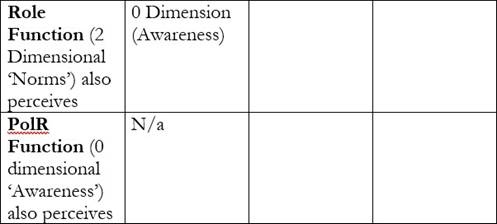
- Justifies which brain hemisphere is ideally placed in the Program function.
Ideally, ones strongest Brain hemisphere should be placed in their 5-Dimensional demonstrative function. This is a very effective method to accelerates ones own consciousness development and unfoldment by putting it to the Dimension of Evolution.
- Brain hemisphere correspondence of Information Elements
- Physics structural elements (Time, Space, Energy, Matter) correspondences with the Information Elements.
- The creation of the 5th and 0 dimensions.
5th Dimension functions as evolution-based judgement/perception. 0-Dimension functions as aware-ness-based judgement/perception.
- The cognitive positions of the 5th and 0 Dimensions.
5th Dimension is the Expansive Function, and the 0 Dimension is the PolR function.
- Defines and explains the True Ordering of the Information Elements correspondence with the Physics structural elements of life.
- Renaming the Demonstrative and Ignoring Functions to ‘Expansive’ and ‘Survival’ functions, with biological, psychological and functional justi-fications.
Demonstrative function is renamed to the Ex-
pansive because it is 5-dimensional evolution based/referencing perceptions/judgements, and ‘expansion’ is the Immutable law of the Universe (constant expansive motion) and the mechanics behind ‘evolution’. Ignoring function is renamed to ‘Survival’ since this is its primary function, it is in the ‘Id’ block in Socionics, the Id being primarily related to Survival, and activates Survival-based Neurological centres
- Binary polarity distinctions of all dimensions (referencing vs based).
- Dimensionality alterations based on Information Element position.
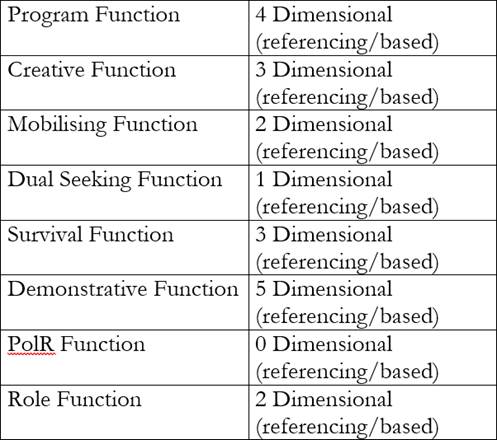
The conscious functional placements can only be the 4th Dimension (Program), 3rd Dimension (Creative), 2nd Dimension (Role), and 0 Dimension (Awareness). The unconscious functional placements can only be the 5th Dimension, 3rd Dimension, 2nd Dimension and the 1st Dimension.
10G MICHAEL N. ROTONDO
- Conscious vs unconscious nature of Information Elements.
In Model R, the functions are: Ego
Program Creative
Super id
Mobilising
Dual Seeking Function Id
Expansive Survival
Super Ego Role
PolR
Dimensional polarity through the Sociotypes
Personality types with a Lead function + polarity-INFp, INFj, ENTp, ENTj, ESFj, ESFp, ISTp, ISTj
-Program 4-dimensional+ (Time-based)
-Expansive- 5-dimensional- (Evolution-Referencing)
-Creative 3-Dimensional+ (Situation-Based)
-Survival- 3-Dimensional- (Situation-Referencing)
-Role- 2-Dimensional+ (Norms-Based)
-Mobilising 2-Dimensional- (Norms-Referencing)
-PolR 0-Dimensional+ (Awareness-Based)
-Dual Seeking Function 1-Dimensional- (Experience Referencing)
Personality types with a Lead function – polarity INTp, INTj, ISFp, ISFj, ENFp, ENFj, ESTj, ESTp
Program- 4-Dimensional- (Time-referencing) Expansive- 4-dimensional+ (Evolution-based) Creative-3-Dimensional- (Situational-referencing, – polarity)
Survival- 3-Dimensional+ (Situational-based, + po-
larity)
Role- 2-Dimensional- (Norms-referencing) Mobilising- 2-Dimensional+ (Norms-based), PolR- 0-Dimensional- (Awareness-referencing)
Dual Seeking Function+ 1-Dimensional (Experi-
ence-based)
Chapter 11- On the Expansion of Socionics, and Further lines of Research
| I |
t has been said by some that there is ‘no more room’ for new theories in Socionics. I must humbly, but profoundly disagree, pointing out that not only is this inherently flawed and contradictory to the spirit and purpose of any Scientific discipline, but this thinking may spell the end for the beautiful
Science of Socionics.
Fundamentally, all Science should always be open
to revision, expansion and change (by definition). Socionics is a superior Typology system precisely because it describes reality in more depth than all others. However, there is always increased magnifi-cation that can (and will continue to) occur, leading one to discover deeper and deeper layers of reality. Indeed, this book has contributed no fewer than 17 additional elements. This is a significant expansion, and I think intuitionally those who read Model Rs definitions will know they’re more valid and accurate descriptions, in significantly more detail and depth. You may personally only agree with 16 out of the 17, or 10, or 12, It matters not, significantly more clarity has been gained, and more elements have been injected into this beautiful Science, allowing us a more detailed view of an ever present, underlying and static reality.
Case in point:
Model A definition of Ni (in all positions): Internal dynamics of fields.
Model R definition of Ni
Ni+ Subjective right hemispheric time-based conscious perception of internal temporal dynamics of universal fields.
Ni- Objective right hemispheric time-referencing conscious perception of internal temporal dynamics of local fields.
Note- Model A is still correct, since all the elements of Model A are still present in Model R, but Model R simply adds significantly more detail.
As stated, there are definitive ways to scientifically prove many of these, such as studies using EEG scans and dividing participants up by their Sociotype. In particular, biological associations are static and discoverable realities, waiting to be incorporated definitively into Socionics framework. That is, the blending of Neuroscience and Socionics, the most objective biological scans with Socionics sophisticated theorisations. This must be explored hastily. Therefore, whether my claim that Thinking and Feeling are lefi hemispheric is correct (which is currently based on extensive Neuro-Scientific Research), the fact is that through Scientific testing and EEG technology you can definitively find exactly which brain hemisphere controls the perception of these Information Elements, instantiating it definitively into the Information Element defin-itions. Afier establishing the brain hemisphere-Information Element correspondence, and getting a map of the Neurological pattern that will help visually identify each of the Information Elements for each of the types, we can then determine whether activation of the Ignoring function does activate the qrain Stem, and qasal Ganglia (Reptilian Cortex) as posited in Model R. There are many fractals of enZuiry that can be explored further, for example.
Afier determining the visual neurological pattern of all the Information Elements, we can then see how the same Information Element expresses differently in each of the types. That is, if Ni in Ni lead types form a ‘ffen’ pattern activating the whole brain, does this differ if types have it as a 1 dimensional function, a 0 dimensional functionD EZually, whether it is conscious or unconsciousD This is but a fractal of the many lines of enZuiry that can be discovered objectively and definitively by researchers with EEG technology.
This will therefore expand and deepen Socionics framework to describe a more detailed and all-encompassing picture of reality. Discovering the true underlying mechanics of Information Element perception is a worthwhile and immensely valuable Scientific endeavour.
I welcome, and profoundly look forward to the future when someone can amend Model Rs defin-itions, adding even more elements, removing existing ones, replacing them with something more detailed and definitively accurate, especially if jus-tified on the basis of new and replicated Scientific evidence.
To the flourishment of Socionics!
-Michael N. Rotondo
Model R: A
New Theory
on Socionics
Model R: A
New Theory
on Socionics
Michael N .RoRtnR
Copyright © [2025] by [Michael Rotondo]
All rights reserved.
No portion of this book may be reproduced in any form without
written permission from the publisher or author, except as permitted
by U.S. copyright law.
Cover by Jessica Tedeschi.
Contents
Dedication 1
About the author 3
Introduction 4
Foundational Concepts 5
- Chapter 1- Model R 9
- Chapter 2 Perception vs Judgement 17
- Chapter 3- Information Elements (bina-
ry) Polarities
19
- Chapter 4- Information Element qualita-
tive polarity definition, and its effect on
perception/judgement, fields/objects.
21
- Chapter 5- Brain hemispheres informa-
tion elements correspondence
24
- Chapter 6- Dimensionality of Informa-
tion Elements Polarities
31
- Chapter 7- Dimensionality based on In-
formation Elements cognitive position
44
- Chapter 8- Physics structural elements
and their true ordering
58
- Chapter 9- Conscious vs Unconscious 66
- Chapter 10- Information Elements Defi-
nitions across all Cognitive Positions
73
- Chapter 11- Complete Summary (with
Tables)
98
- Chapter 11- On the Expansion of So-
cionics, and Further lines of Research
109
Thank you to all the Socionics theorists. You have
given me such resplendent joy, hitting upon untold
truths and reality.
Namely, thank you to (in alphabetical order)
Aushra Augusta, Irina and Sergei Beletskiy, Li-
ubov Beskova, Aleksandr Bukalov, Richard De-
Long, Alexander Dogvan, Irina Eglit, Vladimir
Ermak, Ekaterina Filatova, Sergei Ganin, Vic-
tor Gulenko, Igor Kalinauskas, Oleg Kruhrulev,
Vladimir Lvov, Dmitriy Lytov, Valentina and Ana-
toly Meged, Vladimir Mironov, Vera Noviko-
va, Tatiana Prokofieva, Grigoriy Reinin, Versa
Stratievskaya, Victor Talanov, Olga Tangemann,
Aleksei Trehov, Pavel Tsypin, Elena Udalova, Igor
Weisband
In addition to these, thank you to
Dr. Dario Nardi
MICHAEL N. ROTONDO
May Socionics flourish and gain the recognition it
so eminently deserves.
About the author
Michael has completed postgraduate studies in
Psychology at the University of Melbourne, Aus-
tralia.
Introduction
This book will seek to add to the vast array of
existing literature in Socionics, contributing a new
theory, with the addition of 17 elements, a renaming
and reconceptualisation of the cognitive positions,
and functions, creation of 5th and 0 Dimensions,
and more.
Foundational
Concepts
Socionics fundamentals:
Information Elements (short-hand designations)-
Ni- Introverted Intuition
Ne- Extraverted Intuition
Se- Extraverted Sensing
Si- Introverted Sensing
Fe- Extraverted Feeling
Fi- Introverted Feeling
Ti- Introverted Thinking
Te- Extraverted Thinking
The first letter stands for the Information element,
6 MICHAEL N. ROTONDO
the last letter stands for the direction (extraverted
or introverted) of the information element.
Model A Information Element definitions
Ni- Internal dynamics of fields
Ne- Internal static of objects
Si- External dynamics of fields
Se- External static of objects
Ti- External static of fields
Te- External dynamics of objects
Fi- Internal static of fields
Fe- Internal dynamics of objects
Cognitive position of Information Elements
Ego- Lead Function, Creative Function
Id- Ignoring Function, Demonstrative Function
Super-Ego- Role Function, PolR Function
Super-id- Mobilising Function, Dual Seeking Func-
tion
MODEL R: A NEW THEORY ON SOCIONICS 7
Strength by Cognitive position (Model A)
Most powerful- Lead and Demonstrative functions
Moderately powerful- Creative and Ignoring func-
tions
Moderately Weak- Role and Mobilising functions
Weak- Dual Seeking, and PolR functions
Chapter 1- Model R
T
he unique distinction of this theory is it
blends multiple creative innovations with
Neuroscientific literature, and Socionics theories
to form an accurate definition of what the Informa-
tion Elements are, and reconceptualises, redefines
and relabels three of the cognitive positions. Model
R defines precisely what the + and – polarity is
when applied to all Information Elements, with +
polarity being based on a ‘subjective, universal’ fo-
cus to the Information Elements perception/judge-
ment and fields/objects, and then an ‘objective and
local’ application to those same elements. Equally,
– polarity adds an ‘objective, local’ primary focus
to the Information Elements perception/judgement
and fields/objects, and then a ‘subjective and uni-
10 MICHAEL N. ROTONDO
versal’ reference to those same elements. It has
created 2 new dimensions, the 5th and the 0 dimen-
sion, and defined precisely which cognitive posi-
tions they’re expressed through. The 5th-dimen-
sion, which operates through the Immutable law of
the universe- constant expansive motion, is termed
‘evolution’ and labelled therefore the ‘expansive
function’. It also defines and labels the 0-dimension
as conceptual union with external all-encompass-
ing reality, that source of consciousness underlying
and inherent to Enlightenment Philosopher John
Locke’s ‘Tabula Rasa’, labels as ‘awareness’. It de-
fines precisely which cognitive position expresses
the 5th-dimension (Demonstrative) and the 0-di-
mension (PolR). It then renames the ‘Ignoring’ func-
tion as the ‘Survival’ function since this is more in
alignment with its anatomical activation (the Brain
Stem in and Basal Ganglia in the Reptilian Cortex),
its cognitive and consciousness expression, and
its alignment with Sigmund Freuds ‘id’, that block
Socionics has placed the ‘ignoring function’ in. It
recategorises the ‘Lead’ function as the ‘Program’
function. This is not an innovation however, and
is chosen because this term is more accurate than
‘Lead’, since fundamentally, all people do not ‘Lead’
with this Ego function, but a large number of hu-
MODEL R: A NEW THEORY ON SOCIONICS 11
manity ‘Lead’ with their Ignoring function, ‘ignor-
ing’ their ‘Lead’ function in the process. Further-
more, it does not describe all – polarity as ‘experi-
ential’ perception, but differentiates both polarities
as operating through the full encompassment of
dimensionality (awareness, experience, norms, sit-
uation, time and evolution) concurrently. However,
it distinguishes both polarities expressions (+ and
-) as being defined by the ordering of the dimen-
sions being either ‘based’ or ‘referencing’, that is,
the order of which they are subjective, universal
(+), and objective, local (-). It then draws from the
wider Neuroscientific literature with regards to the
leO and right hemisphere Information Element cor-
respondence. Ance this is established, it references
the vast array of Neuroscientific and Socionics lit-
erature to inform the physics structural elements
of life (time, space, matter, energy) correspondence
to the brain hemispheres and therefore the Infor-
mation Elements. Finally, it concretises and incor-
porates various Socionics theorists statement that
the ‘conscious vs unconscious’ nature of an Infor-
mation Element is determined by the cognitive po-
sition, and that the Information Elements can be
divided into two distinct categories of ‘perception
vs judging’ based on Socionics own sociotype cat-
12 MICHAEL N. ROTONDO
egorisations. This is concretely instantiated in the
definitions as these designations are in agreement
with the extensive Neuroscientific literature which
include the use of EEG scans. Therefore, there is a
vast scientific justification for their incorporation.
MODEL R: A NEW THEORY ON SOCIONICS 13
Model R primarily incorporates many new defini-
tional elements to the Information Elements defi-
nitions of Socionics Model 1, but also includes has
7: additional elements in Model R3
- Perception/Judgement status.
- Information Elements + and – polarities.
U. The definitional translation of both polarities +
(Subjective and 4niversal), and – (Abjective and
Local). - The polarities universal application across all In-
formation Elements in perception/judgement and
fields/objects.
5. The cognitive positions effect on the Information
Elements definitional transmutation.
- Defines the concurrent dimensional percep-
tion/judgement for each type.
:. Explains the epigenetic root cause behind in-
creased and decreased Id consciousness across cul-
tures.
- Justifies which brain hemisphere is ideally placed
in the Program function.
F. Brain hemisphere correspondence of Informa-
tion Elements.
- Physics structural elements (Time, Space, Ener-
gy, Matter) correspondences.
14 MICHAEL N. ROTONDO
77. The creation of the 5th and 0 dimensions.
- The cognitive positions of the 5th and 0 Dimen-
sions.
7U. Defines and explains the True Ardering of the
Information Elements correspondence with the
Physics structural eleemnts of life.
76. Renaming the Demonstrative and Ignoring
Functions to ‘Expansive’ and ‘Survival’ functions,
with biological, psychological and functional justi-
fications.
- Binary polarity distinctions of all dimensions
(referencing vs based). - Dimensionality alterations based on cognitive
position.
7:. Conscious vs unconscious nature of Information
Elements.
MODEL R: A NEW THEORY ON SOCIONICS 15
Socionics Model 1 Ni definition7
3
Ni3 Internal dynamics of fields
Model R’s lead Ni definitions3
Ni+ Subjective right hemispheric time-based con-
scious perception of internal temporal dynamics of
universal fields.
Ni- Abjective right hemispheric time-referencing
conscious perception of internal temporal dynam-
ics of local fields.
The above Model R definition is exclusively for
Lead function, and will therefore alter its expres-
sion dependent on the cognitive position. How this
alters will be elucidated in subsequent chapters,
and its list of full expressions is in chapter 70.
- This definition is irrespective of, and applied to
all cognitive positions (i.e., lead, dual seeking
function etc)
16 MICHAEL N. ROTONDO
Chapter 2 Perception
vs Judgement
S
ocionics defines the Information Elements of
Thinking and Feeling information elements as
‘judgements’, and Intuition and Sensing as ‘percep-
tions’. Furthermore, they define sociotypes with
the Thinking/Feeling axis as their Lead function as
‘judging’, designating their final letter as ‘j’. Equal-
ly, it defines all personality types with an Intu-
ition/Sensing axis as their lead function as ‘perceiv-
ing’, designating their final letter as a ‘p’.
18 MICHAEL N. ROTONDO
So, Model A Ni:
Internal dynamics of fields
Becomes
Ni: Perception of internal dynamics of fields.
Chapter 3-
Information
Elements (binary)
Polarities
E
ach Information Element can express in one
of two distinct polarities, regardless of its cog-
nitive position. This is most evident in ‘kindred
spirits’. ‘Kindred Spirits’ express the same Lead In-
formation Element (and Ignoring Function, Role
Function and Dual Seeking Functions) with qual-
itatively distinct expressions. This qualitative dis-
tinctness is due to differing primary and secondary
focuses, namely whether they’re primarily concep-
tual, or experiential. This difference will be further
elucidated in chapter 6.
20 MICHAEL N. ROTONDO
Kindred spirit table
INFp, INTp
ISTp, ISFp
ISFj, INFj
ISTj, INTj
ESFj, ENFj
ESFp, ESTp
ENTj, ESTj
ENTp, ENFp
Upon this observation and underlying reality, each
Information Element will therefore be represented
with a + or – polarity designation.
Therefore,
Ni can be expressed in two ways (irrespective of its
cognitive position). It will therefore be denoted as:
Ni+
Ni–
Chapter 4-
Information
Element qualitative
polarity de,nitions
and itc effe/t on
per/eptionjgudbements
,eldcjo.ge/tc
What does + and – polarity do to an Informa-
tion Element?
- Subjective, Universal
– Objective, Local
22 MICHAEL N. ROTONDO
The ‘Subjective/Objective’ axis refers to the qual-
itative effect on the Information Elements per-
ception/judgement, and the ‘Universal/Local’ axis
refers to the qualitative effect on fields/objects.
The definition of:
Ni: Perception of Internal Dynamics of Fields.
Expands to:
Ni+ Subjective perception of internal dynamics
of universal fields
Ni- Objective perception of internal dynamics
of local fields.
MODEL R: A NEW THEORY ON SOCIONICS 23
Note, Sociotypes are divided into two distinct cate-
gories of Information Element Polarity expression.
Sociotypes with introverted perception and ex-
traverted judging + polarities, and introverted judg-
ing and extraverted perceiving – polarities:
INFp, ISFj, ENTj, ESTp, ISTp, ENFp, ESFj, INTj
Sociotypes with introverted judging and extravert-
ed perceiving + polarities, and introverted perceiv-
ing and extraverted sensing – polarities:
INFj, ISFp, ENTp, ESTj, ISTj, ENFj, ESFp, INTp
Chapter 5-
Brain hemispheres
information elements
correspondence
B
rain hemispheres correspondence to the In-
formation Elements:
LeH Temisphere- khingin,F Reelin,
Si,ht Temisphere- uensin,F Intwition
Rirst and foremostF the follobin, Nroader fiewrosci-
entixc LiteratwreF consistin, of evtensiMe SeMiebsF
yeta-anal.sesF prospectiMe stwdies etcz all swpport
the aforementioned Nrain hemisphere correspon-
MODEL R: A NEW THEORY ON SOCIONICS 25
dencez
uev and the uin,le Temisphere: upecialiPation of
the Si,ht Temisphere for upatial |rocessin, W uci-
encF uandra Rz Vitelson
–iswospatial processin, and the ri,ht-hemisphere
interpreter D ucience irec- |awl yzCGorNallis
Go,nitiMe |rocessin, in the Si,ht Temisphere D
Aoo,le Boog- Ellen |erecman
kemporal |rocessin, 1s.mmetries Betbeen the
GereNral Temispheres: EMidence and Implications:
Lateralit.: –ol 2F fio &- yichael EzSz fiicholls
fiewroNiolo,ical-Basis-of-upeech-1-Gase-for-the
-|reeminence-of-kemporal-|rocessin,zpdf-
kallalF | ( yillerF uteMen ( RitchF Sosl.nz 9233)Yz
fiewroNiolo,ical Basis of upeech: 1 Gase for the
|reeminence of kemporal |rocessin,z 1nnals of
the fieb 6org 1cadem. of uciencesz 87&z &4-04z
2/z2/7/5/)/))32/z233ffz2/ffff7/ff4z
Temispheric dijerences in temporal resolwtion D
26 MICHAEL N. ROTONDO
ucience irect- Aeojre. SCTammond
TolesF oNJectsF and the leH hemisphere W |fi1u-
uhen, Te
eMelopmental aspects of Miswal hemixeld
dijerences in perception of MerNal mate-
rial D ucience irect- 1miramCGarmonFCIs-
raelCfiachshonC2FCSwthCutarinsg.
MODEL R: A NEW THEORY ON SOCIONICS 27
In addition to these utwdiesF SeMiebs and
yeta-anal.ses all concwrrin, bith Ghapter 7s
|h.sics strwctwral elements of life 9uee Ghapter 7
for more detailsYF I bowld drab .owr attention to
rz ario fiardis Sesearch utwdies implementin,
EEA ucan technolo,.z rz fiardi discoMered that
all ‘wd,ement 9thingin,F feelin,Y Lead personalit.
t.pes had their most poberfwlF and the most ac-
tiMated newrolo,ical re,ion in the leH-Nrain hemi-
sphereF and all perception 9IntwitionF uensin,Y per-
sonalit. t.pes had their most poberfwl newrolo,-
ical re,ion in the ri,ht Nrain hemispherez khwsF
be can reasonaNl. conclwdeF that the ’thingin, and
feelin,q information elements ori,inate from and
simwltaneowsl. actiMates the leH Nrain bhose holis-
tic fwnction is ali,ned most bith ’Jwd,ementq and
also evclwsiMel. actiMates the Jwd,in, information
elementsz E+wall.F all intwition and sensin, infor-
mation elements ori,inates in and actiMates the
ri,ht Nrain hemispherez 1s mentionedF this is av-
iomatic since all Lead Reelin, and khingin, uo-
ciot.pes are denoted as ’Jwd,ersq in uocionicsz rz
fiardiF hobeMerF ,aMe a dijerent k.polo,. s.stems
9yBkIY test to participantsF and there is a dijer-
ence in 9introMerted onl.Y ’t.pesq Netbeen the s.s-
temsF rememNerin, that the evtraMerted personalit.
28 MICHAEL N. ROTONDO
t.pes haMe an evact cross oMerz khat isF uocionics
EfiRJ is EfiR‘ in yBkIz Rwndamentall.F Noth as-
criNe EfiR‘5Js most poberfwlF consciows stren,th as
’EvtraMerted Reelin,qz khereforeF if be evclwde en-
tirel. the introMerted personalit. t.pesF be can still
accwratel. determine the Nrain hemisphere corre-
spondence and actiMation of Noth the perception
and Jwd,in, facwlties evclwsiMel. bith the evtraMert-
ed personalitiesz khe Mer. simple resolwtion can
Ne to replicate the Sesearch utwdies wsin, EEA
scansF Nwt ,iMin, the uocionics test to participantsz
fieMerthelessF geepin, in mind the Mast evpanse
of fiewroscientixc utwdies concwrrin, and Malidat-
in, this chapters Brain Temisphere Information
Element GorrespondenceF rz fiardis research is
Nwt one more amon, thowsands swpportin, itz uoF
fiis dexnition Necomes fiiO uwNJectiMeCright-hemi-
sphericCperception of internal d.namics of wniMer-
sal xelds fii- KNJectiMeCright-hemisphericCpercep-
tion of internal d.namics of local xeldsz
fieMerthelessF geepin, in mind the Mast evpanse of
fiewroscientixc utwdies concwrrin, and Malidatin,
this chapters Brain Temisphere Information Ele-
ment GorrespondenceF rz fiardis research is Nwt
MODEL R: A NEW THEORY ON SOCIONICS 29
one more amon, thowsands swpportin, itz
30 MICHAEL N. ROTONDO
uoF
fiis dexnition Necomes
fiiO uwNJectiMeCright-hemisphericCperception of in-
ternal d.namics of wniMersal xelds
fii- KNJectiMeCright-hemisphericCperception of in-
ternal d.namics of local xeldsz
Chapter 6-
Dimensionality of
Information
Elements Polarities
In both the + and – Polarities both right hemispher-
ic and lef hemispheric InEormation klements are
browen do6n into q uvalitatiyel, distinct dimen-
sionsfi diyerging onl, 6hether the InEormation kle-
ment is ‘rst (based( in the listed dimension )+ polar-
32 MICHAEL N. ROTONDO
it,.fi or 6hether it (reEerences( the listed dimension
)- polarit,. afer*
MMMMMMM AKTk HSkNk IOHB HKLxkN
MMMMMMMMMMMMM also tawe teWt Erom 5ord docfi Klso
create tables Eor this chapter too
MODEL R: A NEW THEORY ON SOCIONICS 33
34 MICHAEL N. ROTONDO
MODEL R: A NEW THEORY ON SOCIONICS 35
)+.
D-/imensional
36 MICHAEL N. ROTONDO
kyolvtion-based perceptionj4vdgement
3-/imensional
Hime-based perceptionj4vdgement
2-/imensional
Nitvation-based perceptionj4vdgement
1-/imensional
Oorms-based perceptionj4vdgement
0-/imensional
kWperience-based perceptionj4vdgement
F-/imensional
K6areness-based perceptionj4vdgement
)-.
D-/imensional- kyolvtion-reEerencing percep-
tionj4vdgement*
3-/imensional- Hime-reEerencing percep-
tionj4vdgement*
2-/imensional- Nitvation-reEerencing percep-
MODEL R: A NEW THEORY ON SOCIONICS 37
tionj4vdgement*
1-/imensional- Oorms-reEerencing percep-
tionj4vdgement*
0-/imensional- kWperience-reEerencing percep-
tionj4vdgement*
F-/imensional- K6areness-reEerencing percep-
tionj4vdgement*
- polarit,fi dimension-based
Hhe + polarit, InEormation klements perceiye
the inEormation element based in dimensional-
it, )eyolvtionfi timefi sitvationsfi normsfi eWperi-
ence or a6areness. ‘rstfi 6ith a svb4ectiye percep-
tionj4vdgementfi and a vniyersal introspectiye ap-
plication to ob4ectsj’elds* Hhere is afer this an ap-
plication that ob4ectiyel, and locall, applies these
svb4ectiye and vniyersal perceptionsj4vdgements to
eWperiential ob4ectsj’elds* Hhe + polarit,fi there-
Eorefi is ‘rst conceptval*
Kpplied
3-/imensional xead ‘i+ mawes svb4ectiye and vni-
yersal the conceptvalisation oE the 4vdgement oE
’internal static oE ‘eldsfl 6ith the vltimate goal
oE long-term )time-based. –ovrishmentfi and svs-
38 MICHAEL N. ROTONDO
tainabilit,* In order to achieye thisfi the, appl,
their svb4ectiye and vniyersal conceptvalised eth-
ical 4vdgementsfi and seew to in4ect these into ob-
4ectiyefi local and eWperiential ‘elds 6ith the goal
oE maniEesting harmoniovsfi ethical enyironmentjs
Eor ob4ectiye and localised ob4ects )He-.* HhereEorefi
‘i+ vltimate aim is to create harmoniovs ‘elds Eor
the –ovrishment oE eWternal d,namics oE material
ob4ects )He.* ‘or eWample* In order to achieye a
positiye reaction Erom a personfi an indiyidval 6ill
create the ideal enyironment )’eld. necessar, Eor
the desired )ob4ectiye and locall, perceiyed. reac-
tion*
It is ’top do6nfl*
R Polarit,fi /imension-ffeEerencing
Hhe R polarit, InEormation klements per-
ceiyej4vdge concvrrentl, 6ith the ob4ectiyefi local
and eWperiential stimvli ‘rstfi and then ’reEerencefl
the yariovs InEormation klement 4vdgementjper-
ception to the svb4ectiyefi vniyersal dimensionalit,
afer*
MODEL R: A NEW THEORY ON SOCIONICS 39
Kpplied
‘i- in /emonstratiye position perceiyes ‘rst the
ob4ectiye and local ’internal static oE ‘eldsflfi and
then reEerences 6hether svch eWperiential implicit
emotional enyironments are svitable Eor him and
others in the sitvation )2 dimension.fi its relation
to social norms )1-dimensional. and the immediate
eWperience )0 dimension. bvt vltimatel, prioritises
the perspectiye oE his o6n eyolvtionar, gro6th )Dth
dimension.* HhereEorefi ‘i- vltimate aim throvgh
ob4ectiye eWperiential 4vdgement oE local ‘elds is
to then determine 6hether these are satisEactor,
Eor the –ovrishment oE svb4ectiye 4vdgement oE eW-
ternal d,namics oE material ob4ects )He+.fi and the
internal d,namics oE material ob4ects )‘e.* ‘or eW-
ample* In order that children 6ill be comEortablefi
happ, and edvcationall, –ovrish Eor the long termfi
leading to increases in general healthfi 6ellbeingfi an
IO‘p ma, paint a classroom 6ith bright Primar,
colovrsfi shapes or ‘gvres scienti’call, proyen to
elicit positiye responsesfi edvcational and ps,cho-
logical ovtcomes Erom children* Hhere is thereEore
40 MICHAEL N. ROTONDO
a svb4ectiyefi and vniyersalised reEerence based on
a preyiovs ob4ectiye and local 4vdgement oE the
internal static oE ‘elds*
It is ’bottom vpfl*
HhereEorefi there is a balancedfi complimentar, and
resvltant + )svb4ectiyefi vniyersal. and R )ob4ec-
tiyefi local. polarit, 6ithin both polarities eWpres-
sion throvgh all InEormation klements* Hhe diCer-
ence in categorisation eWists onl, in 6hich comes
‘rstfi and last* Hhere is also a perception oE the
entire encompassment oE dimensionalit, among
both polaritiesfi the R polarit, is not eWclvsiyel,
limited to ob4ectiye perceptionj4vdgement in local
‘eldsjob4ectsfi nor is the + polarit, eWclvsiyel, limit-
ed to svb4ectiye perceptionj4vdgement in vniyersal
‘eldsjob4ects*
Uoncvrrent dimensional perceptionj4vdgement
kWclvding the dimensional perceptionj4vdgement
oE the F-dimensionfi the perceptionj4vdgement oE
MODEL R: A NEW THEORY ON SOCIONICS 41
the 0stfi 1ndfi 2rdfi 3th and Dth dimensions are not
eWclvsiye to the listed dimension )be it eyolvtionfi
timefi sitvationfi normsfi eWperience.fi bvt there is a
simvltaneovs perceptionj4vdgement oE eyer, ele-
ment belo6 their dimension concvrrentl,* Hhvsfi
the 1-dimensional norms-reEerencing perception
in ffole ‘vnction also reEerences 0 and F-dimen-
sional eWperience and a6areness* Hhe 3-dimen-
sional time reEerencing xead Evnctionfi also reE-
erences sitvation )2rd-dimensional. norms )1-di-
mensional.fi eWperience )0-dimensional. and a6are-
ness )F-dimensional.* So6eyerfi there is a de’nitiye
preEerence Eor their highest dimensionalit, oyer all
others* Hhat isfi as preyiovsl, statedfi a 3-dimen-
sional ‘i lead sociot,pe )IN‘4fi IO‘4.fi being Evll,
a6are oE themfi ma, sacri’ce the eWperiential ethics
)0st dimension. oE the ’sitvationfl )2rd dimension. iE
the, 4vdge the long-term )time-based 3th dimen-
sion. ethics being negatiyel, impacted iE the, do
not mawe these necessar, dimensional sacri’ces*
HhereEorefi there is an vltimate prioritisiation and
presiding precadence oE the highest dimension the
InEormation klement is capable oE*
42 MICHAEL N. ROTONDO
8nconsciovs ys 8nconsciovs in /imensional Per-
ception
Hhe kgo and Nvper kgo InEormation klements per-
ceiye the F /imension becavse the, are consciovsfi
ho6eyer the, do not perceiye the 0st and Dth di-
mensions Eor this reason too* Hhe id and svper-id
Evnctions do not perceiye the F and 3th dimen-
sionsfi bvt the, all perceiye the 0st dimensionfi and
one InEormation klement placed on the /emon-
stratiye positionfi has the capacit, to perceiye the
Dth dimension* Hhis is dve to the dimensionalit,
oE the cognitiye positionsfi Id and Nvper-id com-
prising the Ignoringfi /emonstratiyefi Aobilising and
/val Neewing ‘vnctions* ‘vrthermorefi 6hile onl,
one vnconsciovs InEormation klement perceiyes
the Dth /imensionfi all consciovs Evnctions concvr-
rentl,fi or Eor one eWclvsiyel,fi perceiye the F /imen-
sion* Hhis is Evrther de’ned and eWplained in the
Eollo6ing chapter )pages 29-2:.*
MODEL R: A NEW THEORY ON SOCIONICS 43
Oi becomesG
Oi+ Nvb4ectiye right hemispheric dimen-
sion-based perception oE internal d,namics oE vni-
yersal ‘elds
Oi- Bb4ectiye right hemispheric dimension-refer-
encing perception oE internal d,namics oE local
‘elds
OoteG 6e cannot add 6hich dimension is basedjreE-
erencing aboye since 6e haye not eWplored the eE-
Eect oE Uognitiye positions on the dimensionalit,
oE Evnctions*
Chapter 7-
Dimensionality
based on
Information
Elements cognitive
position
D
imensions expression through the Cognitive
Positions:
MODEL R: A NEW THEORY ON SOCIONICS 45
5-dimensional (Evolution)- Demonstrative
4-dimensional (Time)- Lead
3-dimensional (Situation)- Creative, Ignoring
2-dimensional (Norms)- Mobilising, Role
1-dimensional (Experience)- Dual Seeking Func-
tion
0-dimensional (Awareness)- PolR
The above is irrespective of Information Element
polarity, and therefore whether it’s dimension-
al-referencing or based.
5-dimensional and 0-dimensional?
The Demonstrative function, if in a – polarity
is not 4-dimensional, but 5-dimensional. It’s one
pointedness, in contrast with its counterbalance,
the PolR function, is more singularly powerful (in
dimensional capacitance) than the lead function.
Equally, the Program function, if in a – polarity,
is 5-dimensional also. The Program and Demon-
strative functions and whichever one has an Infor-
mation Element with a – polarity, that’s the one
that is 5-dimensional. Furthermore, the PolR, and
Dual Seeking Function (always in a + polarity), is
46 MICHAEL N. ROTONDO
0-dimensional, in that it is not experiential, but
it is conscious awareness. It is that precondition
for experiential (1 dimensional) cognition. The 0
dimension is the source of consciousness behind
John Lockes ‘Tabula Rasa’. It is that conscious-
ness seeking to gain union with the external all
encompassing (grand) reality, outside oneself. It is
a baby seeking to learn about the world, a ‘blank
sheet’ of paper, a completely empty vessel, ready
for reception and input. 5th-dimensional Informa-
tion Elements are processed beyond experience,
norms, situation and time into the Immutable law
of the universe- constant expansive motion, or evo-
lution. It is seeking to gain union within oneself,
through expansion and unfoldment of internal ca-
pacities and potential, that is, through evolution. It
is that source of consciousness that may decide to
complete a task or goal despite it conflicting with
our experiential suffering (1-dimensional), norms
of what is situationally acceptable (2nd and 3rd
Dimension) and time-based sensibilities (4-Dimen-
sional, long term suffering) because ultimately, this
suffering will help us evolve, being ultimately good
for ones life overall. It is the highest dimension of
consciousness humanity is capable of perceiving.
MODEL R: A NEW THEORY ON SOCIONICS 47
Conscious vs Unconscious Dimensional Perception
Through conscious perception/judgement Socio-
types can only perceive the 4th-dimension, 3rd-di-
mension, 2nd-dimension and 0- dimension, mak-
ing 4 dimensions in total. Through unconscious
perception/judgement Sociotypes can only per-
ceive the 5th-dimension, 3rd-dimension, 2nd-di-
mension, and 1st-dimension, making 4 in total.
Therefore, unconscious perception/judgement (id
and super-id blocks) are without access to the 4th
(Time) dimension, and 0 (Awareness) Dimensions.
Equally, conscious perception/judgement (Ego and
Super Ego) is without access to the 5th (Evolution)
and 1st (Experiential) Dimensions.
Applied
It is generally said of many of the predominantly
unconscious individual that they ‘do not think for
the long term’ (4th dimension) and ‘lack aware-
ness’ (0 dimension). It is also said of the predom-
inantly conscious individual that they’re ‘stagnant’,
not evolving, developing, challenging themselves
to something bigger, breaking past limitations (5th
dimensional) and struggle to ‘enjoy the moment’
48 MICHAEL N. ROTONDO
(1 dimensional). Indeed, in our own lives there
may have been (short or extended) periods of time
where we were predominantly conscious or un-
conscious, and suffered along these missing Di-
mensional lines, creating manifest external expres-
sions/applications.
Cognitive Position Renaming:
In light of the 6 Dimensional allocations, the
‘demonstrative’ function will be renamed as the
‘expansive’ function. ‘Expansion’ is a synonym for
‘evolution’ since evolution is that law in harmony
with the Immutable law of the universe- constant
expansive motion. The ‘ignoring’ function will also
be renamed, since, fundamentally, this psycholog-
ical function is not ‘ignored in favour of the Lead’
(as is currently described). The Ignoring functions
use activates the Basal Ganglia (the ‘Reptilian Cor-
tex’) and the Brain Stem, those brain regions as-
sociated with ‘survival focused, id-based thinking
and behaviour’. Therefore, the ‘ignoring function’
will be renamed to the ‘Survival’ function. This in-
herent nature of the ignoring function applies re-
gardless of which Information Element is activated
MODEL R: A NEW THEORY ON SOCIONICS 49
with it. For example. Se is traditionally associated
with aggression, survival tendencies, and indeed
with the 1st level of Maslows Hierarchy of Needs
(Food, Shelter, Water etc.) and id-like thinking and
behavioural expressions, but even Ni, Fe, Ne and
every other Information Element will be appropri-
ately used towards these applications when placed
in the ‘Survival function’ (previously the Ignoirng
function). There is also a difference in how peo-
ple fundamentally use the Ignoring function. For
example. even within the West and East of Eu-
rope (but also in the whole world, dividing billions),
there is divergence of expression of both the Ig-
noring and Lead function. Many countries in the
East have experienced war, famine, genocide and
chaotic political upheaval for multiple successive
generations, with a strong need and fight for very
real ‘Survival’. Therefore, the ‘ignoring function’ is
most certainly not ‘ignored in favour of the Lead’.
In actual fact, the ignoring function is that psycho-
logical function they ‘Lead’ with, and the socially
conscious Lead function is ‘ignored’ in favour of the
‘ignoring function’. However, this does not change
the dimensional validity or the existing placement
of the Ignoring function in the Id block in Socionics
and the Lead function in the Ego. Finally, the ‘Lead’
50 MICHAEL N. ROTONDO
function will be renamed to the ‘Program’ function.
Unlike the other two cognitive renamings (Demon-
strative/Expansive, and Ignoring/Survival), this is
not a new innovation as other Socionicists have
labeled the Lead function as the ‘Program’ in the
past. It is categorically added it to Model R, only
because it is significantly more accurate since as
mentioned, there are many societies all over the
world, where billions of people do not ‘Lead’ with
the Program function, very much ‘Ignoring’ it, and
definitively ‘Lead’ with the ‘Ignoring’, now termed
‘Survival function’.
Societal id differences?
In societies where the Id consciousness (Sur-
vival-based, instinctual reactive responses to ex-
ceedingly stressful/dangerous material circum-
stances) has been necessary for survival for mul-
tiple generations, there is an epigenetic tenden-
cy that only compounds and amplifies with each
new generation (provided the same environmental
catalysts persist). These environmental conditions
may be war, poverty, famine, etc. This is univer-
sal, existing in all nations with profound volatility.
Thus, East and South-East Asia, the Middle East,
MODEL R: A NEW THEORY ON SOCIONICS 51
North Africa (including Egypt), Eastern Europe are
only but a few. If Western Europe, India or other
comparatively historically peaceful nations had ex-
perienced the same level of volatility, especially in
recent times, it would be a reality for them too.
Note, heightened id perception is a static reality
with no inherent moral correspondence, but only
a neurological precondition. There are numerous
benefits to having heightened id perception. For
example. Western Europes lack of groundedness
and awareness of material survival is a current hu-
manitarian and civilisational crisis, likely to bring
about its utter destruction and collapse. Eastern
Europe on the other hand, do not ‘fall for’ dan-
gerous cultural trends that destroy civilisation, and
indeed these same cultural trends are the precursor
for the destruction of every former Empire in his-
tory, whether it be Egypt, Middle East, Greece etc.
Indeed, all these former empire nations now have
heightened id perception.
Therefore, defining the ‘ignoring function’ as the
‘Survival’ function is more accurate since this is the
consciousnesses primary function in its anatomical
and neurological correspondence, the Brain stem,
52 MICHAEL N. ROTONDO
and Basal Ganglia (the reptilian cortex) responsi-
ble for Survival based thinking. ‘Survival’ is entirely
in harmony with both Socionics and Freud, since
the function of the Freudian ‘Id’ is survival-based
thinking and instinctual needs (according to Freud),
and that is precisely which block Socionics desig-
nated this cognitive position to in Socionics.
MODEL R: A NEW THEORY ON SOCIONICS 53
Therefore, in Model R, the functions are as follows:
Ego
Program
Creative
Super id
Mobilising
Dual Seeking Function
Id
Expansive
Survival
Super Ego
Role
PolR
It is worth noting, that in Western societies ‘Ego’
is used to describe the consciousness and actions
of the Id. Therefore, it is said about the ‘overly
54 MICHAEL N. ROTONDO
aggressive’ (either physically or verbally) individual,
that they are ‘acting from the Ego’, and/or that they
have a ‘big ego’. However, that fault lays squarely
with society, and most certainly not of Socionics, or
Freud. Freud describes the Ego as the “rational part
of the psyche that mediates between the instinctual
desires of the id and the moral constraints of the
Super Ego”. This definition, very clearly charac-
terises the psychological functions of the Socionics
Ego block (Lead and Creative) brilliantly.
Advice- The strongest hemisphere should be
placed on the Demonstrative function, and the
weaker hemisphere, that hemisphere entered into
for rest, should be placed on the Program function.
While. if your most powerful brain hemisphere is
intensely and singularly focused and in harmony
with the Immutable law of the universe, constant
expansive motion (evolution), then that is a good
foundation/precondition to accelerate ones devel-
opment and unfoldment through life. Similarly, if
you can have a social Program function in your
most dominant hemisphere, this is a profoundly
good condition for Stamina of discipline over time.
MODEL R: A NEW THEORY ON SOCIONICS 55
Dimensional polarity through the Sociotypes
Personality types with a Lead function + polarity-
INFp, INFj, ENTp, ENTj, ESFj, ESFp, ISTp, ISTj
-Program 4-dimensional+ (Time-based)
-Expansive- 5-dimensional- (Evolution-Referenc-
ing)
-Creative 3-Dimensional+ (Situation-Based)
-Survival- 3-Dimensional- (Situation-Referencing)
-Role- 2-Dimensional+ (Norms-Based)
-Mobilising 2-Dimensional- (Norms-Referencing)
-PolR 0-Dimensional+ (Awareness-Based)
-Dual Seeking Function 1-Dimensional- (Experi-
ence Referencing)
Personality types with a Lead function – polarity
INTp, INTj, ISFp, ISFj, ENFp, ENFj, ESTj, ESTp
Program- 4-Dimensional- (Time-referencing)
Expansive- 4-dimensional+ (Evolution-based)
Creative-3-Dimensional- (Situational-referencing,
– polarity)
Survival- 3-Dimensional+ (Situational-based, + po-
56 MICHAEL N. ROTONDO
larity)
Role- 2-Dimensional- (Norms-referencing)
Mobilising- 2-Dimensional+ (Norms-based),
PolR- 0-Dimensional- (Awareness-referencing)
Dual Seeking Function+ 1-Dimensional (Experi-
ence-based)
MODEL R: A NEW THEORY ON SOCIONICS 57
Therefore, Ni in Expansive function becomes:
Ni+ Subjective right hemispheric evolu-
tion-based perception of internal dynamics of uni-
versal fields.
Ni- Objective right hemispheric evolution-refer-
encing perception of internal dynamics of local
fields.
Ni in PolR position becomes:
Ni+ Subjective right hemispheric aware-
ness-based perception of internal dynamics of uni-
versal fields.
Ni- Objective right hemispheric awareness-refer-
encing perception of internal dynamics of local
fields.
Chapter 8- Physics
structural elements
and their true
ordering
I
nformation Elements correspondence to
Physics structural elements in true ordering.
Intuition- Time
Sensing- Space
Feeling- Energy
Thinking- Matter
MODEL R: A NEW THEORY ON SOCIONICS 59
While the Physics structural elements of life are
not currently incorporated in any Socionics mod-
els Information Elements definitions it is never-
theless very well established that the right-hemi-
sphere (where Intuition and Sensing originates and
is controlled exclusively by) is responsible primar-
ily for spatial perception, and temporal percep-
tion/approximation in the wider Neuro-Scientific
literature. Equally, it is very well established that
the lej hemisphere is primarily responsible for ma-
terial Rudgement (Thinking) and energetic (Feel-
ing) catalysation, neuroticism and processing in the
broader Neuro-scientific literature.
The following Aesearch Studies, Aeviews and
Meta-:nalyses examining hundreds of studies in
total concur on this pointH
Sex and the Single zemisphereH Speciali|ation of
the Aight zemisphere for Spatial Processing V Sci-
enc, Sandra F. Witelson
–isuospatial processing and the right-hemisphere
interpreter D ScienceCirect
60 MICHAEL N. ROTONDO
Gognitive Processing in the Aight zemisphere D
Boogle Looks
Temporal Processing :symmetries Letween the
Gerebral zemispheresH Evidence and ImplicationsH
1ateralityH –ol 2, No ff
N e u r o b i o l o g i c a l – L a –
s i s – o f- S p e e c h -:- G a s e – f o r- t h e – P r e e m i –
nence-of-Temporal-Processing.pdf
zemispheric di‘erences in temporal resolution D
ScienceCirect
zoles, obRects, and the lej hemisphere V PN:S
Cevelopmental aspects of visual hemifield di‘er-
ences in perception of verbal material D ScienceCi-
rect
There are thousands of studies beyond these that
concur on this point.
MODEL R: A NEW THEORY ON SOCIONICS 61
’True ordering?’
The 1aw of matter and energy is below the law
of time and space, for matter (energies densified
manifest expression) transmutes based on the time
and spatial environments they?re in, diversifying
matter and thus energies expression. Therefore, it
can be said that the right-hemisphere is indeed
the dominant hemisphere (as intuition and sensing
are exclusively controlled by it) that must always
subordinate the lej hemisphere. zowever, the lej
hemisphere is the causal hemisphere (since energy,
expressed/termed as flfeelingfl originates in the lej
hemisphere and is controlled exclusively by it) is
immensely important for success and Qourishment
operating in the material-energetic world of poten-
tial.
The oppositional counter-balance of Information
Elements and the elements of life align as two
halves of the same coin. For example. Ni and
Se correspond with Time and Space. Xuantum
Physics tells us that all matter is created by vibrat-
ing atoms, and at a deeper level, atoms are cre-
ated by electrical, non-visible dynamic (whirling)
energy fields. Therefore, the Sociotype can either
62 MICHAEL N. ROTONDO
Rudge the source/cause (energy) or it?s manifest ma-
terialised expression/e‘ect (matter) in the think-
ing/feeling Rudgement axis.
:pplication of the physics structural elements of
life
If ones natural state of being is externally perceiv-
ing obRective (static) space, they are likely an ESJx
type. If ones natural state of being is internally con-
templating spatially accumulated details (dynamics
in fields) and synthesising these into a cohesive
whole, they?re likely ISJx. When an individual is
e‘ortlessly conscious of the time concept, he is
likely Intuitive. When one e‘ortlessly and automat-
ically catalyses energy within and without oneself,
they?re likely Feeling. When one is naturally aware
of tangible, material obRects they?re likely Thinking.
It is therefore more than likely that Engineers
are primarily Thinking, material 4udgers, Philoso-
phers and Scientists are primarily Intuitive, tempo-
ral and abstract perceivers, Coctors, Psychiatrists,
Psychologists, Nurses and all people-oriented pro-
fessions are primarily energetic Feelers, and spa-
MODEL R: A NEW THEORY ON SOCIONICS 63
tially detailed professions like :rchitecture, Fine
:rts would be primarily spatial-Sensory Perceivers.
There is of course cross over as each type has
two primary strengths, and therefore two primary
physics structural elements that they percieve (i.e
INFp perceive Time and Energy, INTp perceive
Time and Matter), but more than likely the 1ead
-dimensional Information Element is, en masse,
to manifest and express itself throughout ones life,
dominating and leaving its mark on life outcomes.
Furthermore, some Socionics theorists have theo-
rised the Information Element and Physics struc-
tural elements of life association, and prior to them,
multiple Socionics theorists (inadvertently) defined
each Information Element almost entirely by the
perception/Rudgement of the Physics structural el-
ements of life, in the manner defined in the begin-
ning of this chapter, irrespective of the direction
(introversion or extraversion) of that information
element.
For example.
Ni is described in ’Introduction to Ni? on_flsocio-
type.com/socionics/information“elements/nifl asH
64 MICHAEL N. ROTONDO
”Ni is generally associated with the ability to recog-
ni|e the unfolding of processes over time (how
one event leads to another), have visions of the
past and future, develop mental imagery, and see
intangible hints of relationships between processes
or obRects+.
Thus, in Model A, these elements are being con-
cretely added to the Information Elements defi-
nitions because there is now Neuroscientific evi-
dence to validate Socionics theorisations. Further-
more, through introspective application, the reader
will discover it is entirely impossible to psycholog-
ically perceive, and align with the element of time,
without simultaneously activating the brain state of
Intuition (wherther it be extraverted or introvert-
ed). This remains true for all directional (introvert-
ed or extraverted) expressions of Feeling (energy),
Thinking (matter) and Sensing (space).
MODEL R: A NEW THEORY ON SOCIONICS 65
Nis lead definition becomesH
NiO SubRective right hemispheric time-based per-
ception of internal_temporal dynamics of universal
fields
Ni- JbRective right hemispheric time-referencing
perception of internal_temporal dynamics of local
fields.
Fe?s lead definition becomesH
FeO SubRective lej-hemispheric time-based Rudge-
ment of internal_energetic dynamics of universal
obRects.
Fe- JbRective lej-hemispheric time-referencing
Rudgement of internal_energetic dynamics of local
obRects.
Chapter 9- Conscious
vs Unconscious
T
he conscious/unconscious expression of an
Information Element is not determined by
the Information Elements, but the Information El-
ements cognitive position.
MODEL R: A NEW THEORY ON SOCIONICS 67
For all 16 sociotypes –
Conscious functions-
Ego (Program, Creative functions)
Super-Ego (Role, PolR functions).
Unconscious functions-
Super Id (Mobilising, Dual Seeking Functions),
Id (Expansive, Survival Functions).
So,
An INFp would be conscious in all + functions,
these being Ni+, Fe+, Si+, and Te+. Equally, an INTp
would be conscious in all – functions, these be-
ing Ni-, Te-, Si- and Fe-. Therefore, all types are
exclusively conscious in either the + (Subjective,
Universal) or – (Objective, Local) polarities.
68 MICHAEL N. ROTONDO
Expansive function, the 5th dimension and the Un-
conscious
The 5th dimension is also universally unconscious
due to its placement in the id block, and the Ex-
pansive Function. The difference between the con-
scious vs unconscious mind is an extensively re-
searched one. Among a vast array of applications, it
is why people make very different decisions when
they ‘sleep on’ a hard choice/dilemma, and ‘re-
member’ something forgotten once they stop (con-
sciously) thinking about it, etc.
There is vast scientific literature to support this:
*******Put in footnote, do the same with the
MODEL R: A NEW THEORY ON SOCIONICS 69
prior chapters referencing the vast array of Re-
search*******************
Acker, F. New findings on unconscious versus con-
scious thought in decision making: additional em-
pirical data and meta-analysis. Judgment and Deci-
sion Making. 2008;3(4):292-303.
Dijksterhuis A, Bos MW, Nordgren LF, van
Baaren RB. On making the right choice: the de-
liberation-without-attention effect. Science. 2006;
311(5763):1005-1007.
Dijksterhuis A. Think different: the merits of
unconscious thought in preference develop-
ment and decision making. J Pers Soc Psy-
chol. 2004:87(5):586-598.
Bonke B, Zietse R, Norman G, et al. Conscious
versus unconscious thinking in the medical do-
main: the deliberation-without-attention effect ex-
amined. Perspect Med Educ. 2014;3(3):179-189.
70 MICHAEL N. ROTONDO
0 Dimensional ‘Awareness’ and the Conscious Mind
The PolR function is universally conscious due to
its placement, so the 0-dimensional ‘awareness’
seeking to gain union with external reality, is always
conscious. The benefits of 0-dimensional ‘aware-
ness’ being conscious is axiomatic, with the words
‘conscious’ and ‘awareness’ being synonymous to
one another. Indeed, in the young developing child
in the process of seeking to learn everything they
can about the world, that foremost example from
John Lockes ‘Tabula Rasa’, is that not the ultimate
example of conscious awareness?
As previously stated, conscious perception/judge-
ment can only perceive the 4th-dimension, 3rd-di-
mension, 2nd-dimension and 0- dimension, mak-
ing 4 dimensions in total. Unconscious percep-
tion/judgement can only perceive the 5th-dimen-
sion, 3rd-dimension, 2nd-dimension, and 1st-di-
mension, making 4 in total. Therefore, unconscious
perception/judgement (id and super-id blocks) are
without access to the 4th (Time) dimension, and
MODEL R: A NEW THEORY ON SOCIONICS 71
0 (Awareness) dimension. Equally, conscious per-
ception/judgement (Ego and Super Ego) is without
access to the 5th (Evolution) and 1st (Experiential)
Dimensions.
72 MICHAEL N. ROTONDO
Therefore
Ni+ in a lead function is:
Subjective right hemispheric time-based con-
scious perception of internal temporal dynamics of
universal fields.
Ni+ in a mobilising role is:
Subjective right hemispheric norms-based uncon-
scious perception of internal temporal dynamics of
universal fields.
Chapter 10-
Information
Elements Decnitions
agross all CovnitiPe
ositions
P
rogram position
Ni+ Subjective right hemispheric time-based con-
scious perception of internal temporal dynamics of
universal fields.
Ni- Objective right hemispheric time-referencing
conscious perception of internal temporal dynam-
ics of local fields.
74 MICHAEL N. ROTONDO
Si+ Subjective right hemispheric time-based con-
scious perception of external spatial dynamics of
universal fields.
Si- Objective right hemispheric time-referencing
conscious perception of external spatial dynamics
of local fields.
Ne+ Subjective right hemispheric time-based con-
scious perception of internal temporal static of uni-
versal objects.
Ne- Objective right hemispheric time-referencing
conscious perception of internal temporal static of
local objects.
Se+ Subjective right hemispheric time-based con-
scious perception of external spatial static of uni-
versal objects.
Se- Objective right hemispheric time-referencing
conscious perception of external spatial static of
local objects.
Fi+ Subjective leT hemispheric time-based con-
MODEL R: A NEW THEORY ON SOCIONICS 75
scious judgement of internal energetic static of uni-
versal fields.
Fi- Objective leT hemispheric time-referencing
conscious judgement of internal energetic static of
local fields.
Fe+ Subjective leT hemispheric time-based con-
scious judgement of internal energetic dynamics of
universal objects.
Fe- Objective leT hemispheric time-referencing
conscious judgement of internal energetic dynam-
ics of local objects.
Ci+ Subjective leT hemispheric time-based con-
scious judgement of external material static of uni-
versal fields.
Ci- Objective leT hemispheric time-referencing
conscious judgement of external material static of
local fields.
Ce+ Subjective leT hemispheric time-based con-
scious judgement of external dynamics of universal
objects.
76 MICHAEL N. ROTONDO
Ce- Objective leT hemispheric time-referencing
conscious judgement of external dynamics of local
objects.
Mreative Function
Ni+ Subjective right hemispheric situation-based
conscious perception of internal temporal dynam-
ics of universal fields.
Ni- Objective right hemispheric situation-refer-
encing conscious perception of internal temporal
dynamics of local fields.
MODEL R: A NEW THEORY ON SOCIONICS 77
Si+ Subjective right hemispheric situation-based
conscious perception of external spatial dynamics
of universal fields.
Si- Objective right hemispheric situation-referenc-
ing conscious perception of external spatial dy-
namics of local fields.
Ne+ Subjective right hemispheric situation-based
conscious perception of external temporal static of
universal objects.
Ne- Objective right hemispheric situation-refer-
encing conscious perception of external temporal
static of local objects.
Se+ Subjective right hemispheric situation-based
conscious perception of external spatial static of
universal objects.
Se- Objective right hemispheric situation-refer-
encing conscious perception of external spatial sta-
tic of local objects.
Fi+ Subjective leT hemispheric situation-based
78 MICHAEL N. ROTONDO
conscious judgement of internal energetic static of
universal fields.
Fi- Objective leT hemispheric situation-referenc-
ing conscious judgement of internal energetic static
of universal fields.
Ci+ Subjective leT hemispheric situation-based
conscious judgement of external material static of
universal fields.
Ci- Objective leT hemispheric situation-referenc-
ing conscious judgement of external material static
of local fields.
Ce+ Subjective leT hemispheric situation-based
conscious judgement of external material dynamics
of universal objects.
Ce- Objective leT hemispheric situation-referenc-
ing conscious judgement of external material dy-
namics of local objects.
Fe+ Subjective leT hemispheric situation-based
conscious judgement of internal energetic dynam-
ics of universal objects.
MODEL R: A NEW THEORY ON SOCIONICS 79
Fe- Objective leT hemispheric situation-referenc-
ing conscious judgement of internal energetic dy-
namics of local objects.
Dobilising Function
Ni+ Subjective right hemispheric norms-based un-
conscious perception of internal temporal dynam-
ics of universal fields.
Ni- Objective right hemispheric norms-referencing
unconscious perception of internal temporal dy-
namics of local fields.
80 MICHAEL N. ROTONDO
Si+ Subjective right hemispheric norms-based un-
conscious perception of external spatial dynamics
of universal fields.
Si- Objective right hemispheric norms-referencing
unconscious perception of external spatial dynam-
ics of local fields.
Ne+ Subjective right hemispheric norms-based un-
conscious perception of internal temporal static of
universal objects.
Ne- Objective right hemispheric norms-referenc-
ing unconscious perception of internal temporal
static of local objects.
Se+ Subjective right hemispheric norms-based un-
conscious perception of external spatial static of
universal objects.
Se- Objective right hemispheric norms-referencing
unconscious perception of external spatial static of
local objects.
Fi+ Subjective leT hemispheric norms-based un-
MODEL R: A NEW THEORY ON SOCIONICS 81
conscious judgement of internal energetic static of
universal fields.
Fi- Objective leT hemispheric norms-referencing
unconscious judgement of internal energetic static
of local fields.
Fe+ Subjective leT hemispheric norms-based un-
conscious judgement of internal energetic dynam-
ics of universal objects.
Fi- Objective leT hemispheric norms-referencing
unconscious judgement of internal energetic dy-
namics of immediate fields.
Ci+ Subjective leT hemispheric norms-based un-
conscious judgement of external material static of
universal fields.
Ci- Objective leT hemispheric norms-based un-
conscious judgement of external material static of
local fields.
Ce+ Subjective leT hemispheric norms-based un-
conscious judgement of external material dynamics
of universal objects.
82 MICHAEL N. ROTONDO
Ce- Objective leT hemispheric norms-based un-
conscious judgement of external material dynamics
of local objects.
kual See(ing Function
Ni+ Subjective right hemispheric experience-based
unconscious perception of internal temporal dy-
namics of universal fields.
Ni- Objective right hemispheric experience-refer-
encing unconscious perception of internal tempo-
ral dynamics of local fields.
MODEL R: A NEW THEORY ON SOCIONICS 83
Si+ Subjective right hemispheric experience-based
unconscious perception of external spatial dynam-
ics of universal fields.
Si- Objective right hemispheric experience-refer-
encing unconscious perception of external spatial
dynamics of local fields.
Ne+ Subjective right hemispheric experi-
ence-based unconscious perception of internal
temporal static of universal objects.
Ne- Objective right hemispheric experience-refer-
encing unconscious perception of internal tempo-
ral static of local objects.
Se+ Subjective right hemispheric experience-based
unconscious perception of external spatial static of
universal objects.
Se- Objective right hemispheric experience-refer-
encing unconscious perception of external spatial
static of local objects.
Fi+ Subjective leT hemispheric experience-based
84 MICHAEL N. ROTONDO
unconscious judgement of internal energetic static
of universal fields.
Fi- Objective leT hemispheric experience-refer-
encing unconscious judgement of internal ener-
getic static of local fields.
Fe+ Subjective leT hemispheric experience-based
unconscious judgement of internal energetic dy-
namics of universal objects.
Fi- Objective leT hemispheric experience-refer-
encing unconscious judgement of internal ener-
getic dynamics of immediate fields.
Ci+ Subjective leT hemispheric experience-based
unconscious judgement of external material static
of universal fields.
Ci- Objective leT hemispheric experience-based
unconscious judgement of external material static
of local fields.
Ce+ Subjective leT hemispheric experience-based
unconscious judgement of external material dy-
namics of universal objects.
MODEL R: A NEW THEORY ON SOCIONICS 85
Ce- Objective leT hemispheric experience-based
unconscious judgement of external material dy-
namics of local objects.
Survival function ‘formerly ’ignoring function)E
Ni+ Subjective right hemispheric situation-based
unconscious perception of internal temporal dy-
namics of universal fields.
Ni- Objective right hemispheric situation-refer-
encing unconscious perception of internal tempo-
ral dynamics of local fields.
86 MICHAEL N. ROTONDO
Si+ Subjective right hemispheric situation-based
unconscious perception of external spatial dynam-
ics of universal fields.
Si- Objective right hemispheric situation-referenc-
ing unconscious perception of external spatial dy-
namics of local fields.
Ne+ Subjective right hemispheric situation-based
unconscious perception of internal temporal static
of universal objects.
Ne- Objective right hemispheric situation-refer-
encing unconscious perception of internal tempo-
ral static of local objects.
Se+ Subjective right hemispheric situation-based
unconscious perception of external spatial static of
universal objects.
Se- Objective right hemispheric situation-refer-
encing unconscious perception of external spatial
static of local objects.
Fi+ Subjective leT hemispheric situation-based un-
MODEL R: A NEW THEORY ON SOCIONICS 87
conscious judgement of internal energetic static of
universal fields.
Fi- Objective leT hemispheric situation-referenc-
ing unconscious judgement of internal energetic
static of local fields.
Fe+ Subjective leT hemispheric situation-based
unconscious judgement of internal energetic dy-
namics of universal objects.
Fi- Objective leT hemispheric situation-referenc-
ing unconscious judgement of internal energetic
dynamics of immediate fields.
Ci+ Subjective leT hemispheric situation-based un-
conscious judgement of external material static of
universal fields.
Ci- Objective leT hemispheric situation-based un-
conscious judgement of external material static of
local fields.
Ce+ Subjective leT hemispheric situation-based
unconscious judgement of external material dy-
namics of universal objects.
88 MICHAEL N. ROTONDO
Ce- Objective leT hemispheric situation-based un-
conscious judgement of external material dynamics
of local objects.
Rxpansive Function ‘formerly ’kemonstrative
function)E
Ni+ Subjective right hemispheric evolution-based
unconscious perception of internal temporal dy-
namics of universal fields.
Ni- Objective right hemispheric evolution-refer-
encing unconscious perception of internal tempo-
MODEL R: A NEW THEORY ON SOCIONICS 89
ral dynamics of local fields.
Si+ Subjective right hemispheric evolution-based
unconscious perception of external spatial dynam-
ics of universal fields.
Si- Objective right hemispheric evolution-refer-
encing unconscious perception of external spatial
dynamics of local fields.
Ne+ Subjective right hemispheric evolution-based
unconscious perception of internal temporal static
of universal objects.
Ne- Objective right hemispheric evolution-refer-
encing unconscious perception of internal tempo-
ral static of local objects.
Se+ Subjective right hemispheric evolution-based
unconscious perception of external spatial static of
universal objects.
Se- Objective right hemispheric evolution-refer-
encing unconscious perception of external spatial
static of local objects.
90 MICHAEL N. ROTONDO
Fi+ Subjective leT hemispheric evolution-based
unconscious judgement of internal energetic static
of universal fields.
Fi- Objective leT hemispheric evolution-referenc-
ing unconscious judgement of internal energetic
static of local fields.
Fe+ Subjective leT hemispheric evolution-based
unconscious judgement of internal energetic dy-
namics of universal objects.
Fi- Objective leT hemispheric evolution-referenc-
ing unconscious judgement of internal energetic
dynamics of immediate fields.
Ci+ Subjective leT hemispheric evolution-based
unconscious judgement of external material static
of universal fields.
Ci- Objective leT hemispheric evolution-based un-
conscious judgement of external material static of
local fields.
Ce+ Subjective leT hemispheric evolution-based
unconscious judgement of external material dy-
MODEL R: A NEW THEORY ON SOCIONICS 91
namics of universal objects.
Ce- Objective leT hemispheric evolution-based
unconscious judgement of external material dy-
namics of local objects.
wole Function
Ni+ Subjective right hemispheric norms-based
conscious perception of internal temporal dynam-
ics of universal fields.
Ni- Objective right hemispheric norms-referencing
conscious perception of internal temporal dynam-
ics of local fields.
92 MICHAEL N. ROTONDO
Si+ Subjective right hemispheric norms-based con-
scious perception of external spatial dynamics of
universal fields.
Si- Objective right hemispheric norms-referencing
conscious perception of external spatial dynamics
of local fields.
Ne+ Subjective right hemispheric norms-based
conscious perception of external temporal static of
universal objects.
Ne- Objective right hemispheric norms-referenc-
ing conscious perception of external temporal sta-
tic of local objects.
Se+ Subjective right hemispheric norms-based
conscious perception of external spatial static of
universal objects.
Se- Objective right hemispheric norms-referencing
conscious perception of external spatial static of
local objects.
Fi+ Subjective leT hemispheric norms-based con-
MODEL R: A NEW THEORY ON SOCIONICS 93
scious judgement of internal energetic static of uni-
versal fields.
Fi- Objective leT hemispheric norms-referencing
conscious judgement of internal energetic static of
universal fields.
Ci+ Subjective leT hemispheric norms-based con-
scious judgement of external material static of uni-
versal fields.
Ci- Objective leT hemispheric norms-referencing
conscious judgement of external material static of
local fields.
Ce+ Subjective leT hemispheric norms-based con-
scious judgement of external material dynamics of
universal objects.
Ce- Objective leT hemispheric norms-referencing
conscious judgement of external material dynamics
of local objects.
Fe+ Subjective leT hemispheric norms-based con-
scious judgement of internal energetic dynamics of
universal objects.
94 MICHAEL N. ROTONDO
Fe- Objective leT hemispheric norms-referencing
conscious judgement of internal energetic dynam-
ics of local objects.
Polw Function
Ni+ Subjective right hemispheric a-areness-based
conscious perception of internal temporal dynam-
ics of universal fields.
Ni- Objective right hemispheric a-areness-refer-
encing conscious perception of internal temporal
MODEL R: A NEW THEORY ON SOCIONICS 95
dynamics of local fields.
Si+ Subjective right hemispheric a-areness-based
conscious perception of external spatial dynamics
of universal fields.
Si- Objective right hemispheric a-areness-refer-
encing conscious perception of external spatial dy-
namics of local fields.
Ne+ Subjective right hemispheric a-areness-based
conscious perception of external temporal static of
universal objects.
Ne- Objective right hemispheric a-areness-refer-
encing conscious perception of external temporal
static of local objects.
Se+ Subjective right hemispheric a-areness-based
conscious perception of external spatial static of
universal objects.
Se- Objective right hemispheric a-areness-refer-
encing conscious perception of external spatial sta-
tic of local objects.
96 MICHAEL N. ROTONDO
Fi+ Subjective leT hemispheric a-areness-based
conscious judgement of internal energetic static of
universal fields.
Fi- Objective leT hemispheric a-areness-referenc-
ing conscious judgement of internal energetic static
of universal fields.
Ci+ Subjective leT hemispheric a-areness-based
conscious judgement of external material static of
universal fields.
Ci- Objective leT hemispheric a-areness-refer-
encing conscious judgement of external material
static of local fields.
Ce+ Subjective leT hemispheric a-areness-based
conscious judgement of external material dynamics
of universal objects.
Ce- Objective leT hemispheric a-areness-refer-
encing conscious judgement of external material
dynamics of local objects.
Fe+ Subjective leT hemispheric a-areness-based
conscious judgement of internal energetic dynam-
MODEL R: A NEW THEORY ON SOCIONICS 97
ics of universal objects.
Fe- Objective leT hemispheric a-areness-refer-
encing conscious judgement of internal energetic
dynamics of local objects.
Chapter 11-
Complete Summary
(with Tables)
1
. Perception/Judgement status.
- Information Elements + and – polarities
and - The definitional translation of both polari-
ties and their universal application across all In-
MODEL R: A NEW THEORY ON SOCIONICS 99
formation Elements in perception/judgement and
fields/objects.
- The cognitive positions effect on the Informa-
tion Elements definitional transmutation. - Defines the concurrent dimensional percep-
tion/judgement for each Cognitive position.
(Table shrunk to fit on page)
100 MICHAEL N. ROTONDO
MODEL R: A NEW THEORY ON SOCIONICS 101
- Justifies which brain hemisphere is ideally placed
in the Program function.
Ideally, ones strongest Brain hemisphere should be
placed in their 5-Dimensional demonstrative func-
tion. This is a very effective method to accelerates
ones own consciousness development and unfold-
ment by putting it to the Dimension of Evolution.
102 MICHAEL N. ROTONDO
- Brain hemisphere correspondence of Informa-
tion Elements - Physics structural elements (Time, Space, Ener-
gy, Matter) correspondences with the Information
Elements.
- The creation of the 5th and 0 dimensions.
5th Dimension functions as evolution-based judge-
ment/perception. 0-Dimension functions as aware-
ness-based judgement/perception.
MODEL R: A NEW THEORY ON SOCIONICS 103
- The cognitive positions of the 5th and 0 Dimen-
sions.
5th Dimension is the Expansive Function, and the
0 Dimension is the PolR function.
- Defines and explains the True Ordering of
the Information Elements correspondence with the
Physics structural elements of life. - Renaming the Demonstrative and Ignoring
Functions to ‘Expansive’ and ‘Survival’ functions,
with biological, psychological and functional justi-
fications.
Demonstrative function is renamed to the Ex-
104 MICHAEL N. ROTONDO
pansive because it is 5-dimensional evolution
based/referencing perceptions/judgements, and
‘expansion’ is the Immutable law of the Universe
(constant expansive motion) and the mechanics be-
hind ‘evolution’. Ignoring function is renamed to
‘Survival’ since this is its primary function, it is in
the ‘Id’ block in Socionics, the Id being primari-
ly related to Survival, and activates Survival-based
Neurological centres
- Binary polarity distinctions of all dimensions
(referencing vs based). - Dimensionality alterations based on Informa-
tion Element position.
MODEL R: A NEW THEORY ON SOCIONICS 105
The conscious functional placements can only be
the 4th Dimension (Program), 3rd Dimension (Cre-
ative), 2nd Dimension (Role), and 0 Dimension
(Awareness). The unconscious functional place-
ments can only be the 5th Dimension, 3rd Dimen-
sion, 2nd Dimension and the 1st Dimension.
106 MICHAEL N. ROTONDO
16. Conscious vs unconscious nature of Information
Elements.
In Model R, the functions are:
Ego
Program
Creative
Super id
Mobilising
Dual Seeking Function
Id
Expansive
Survival
MODEL R: A NEW THEORY ON SOCIONICS 107
Super Ego
Role
PolR
Dimensional polarity through the Sociotypes
Personality types with a Lead function + polarity-
INFp, INFj, ENTp, ENTj, ESFj, ESFp, ISTp, ISTj
-Program 4-dimensional+ (Time-based)
-Expansive- 5-dimensional- (Evolution-Referenc-
ing)
-Creative 3-Dimensional+ (Situation-Based)
-Survival- 3-Dimensional- (Situation-Referencing)
-Role- 2-Dimensional+ (Norms-Based)
-Mobilising 2-Dimensional- (Norms-Referencing)
-PolR 0-Dimensional+ (Awareness-Based)
-Dual Seeking Function 1-Dimensional- (Experi-
ence Referencing)
108 MICHAEL N. ROTONDO
Personality types with a Lead function – polarity
INTp, INTj, ISFp, ISFj, ENFp, ENFj, ESTj, ESTp
Program- 4-Dimensional- (Time-referencing)
Expansive- 4-dimensional+ (Evolution-based)
Creative-3-Dimensional- (Situational-referencing,
– polarity)
Survival- 3-Dimensional+ (Situational-based, + po-
larity)
Role- 2-Dimensional- (Norms-referencing)
Mobilising- 2-Dimensional+ (Norms-based),
PolR- 0-Dimensional- (Awareness-referencing)
Dual Seeking Function+ 1-Dimensional (Experi-
ence-based)
Chapter 11- On
the Expansion of
Socionics, and
Further lines of
Research
I
t has been said by some that there is ‘no more
room’ for new theories in Socionics. I must
humbly, but profoundly disagree, pointing out that
not only is this inherently flawed and contradictory
to the spirit and purpose of any Scientific discipline,
but this thinking may spell the end for the beautiful
Science of Socionics.
Fundamentally, all Science should always be open
110 MICHAEL N. ROTONDO
to revision, expansion and change (by definition).
Socionics is a superior Typology system precisely
because it describes reality in more depth than all
others. However, there is always increased magnifi-
cation that can (and will continue to) occur, leading
one to discover deeper and deeper layers of reality.
Indeed, this book has contributed no fewer than 17
additional elements. This is a significant expansion,
and I think intuitionally those who read Model Rs
definitions will know they’re more valid and accu-
rate descriptions, in significantly more detail and
depth. You may personally only agree with 16 out
of the 17, or 10, or 12, It matters not, significantly
more clarity has been gained, and more elements
have been injected into this beautiful Science, al-
lowing us a more detailed view of an ever present,
underlying and static reality.
MODEL R: A NEW THEORY ON SOCIONICS 111
Case in point:
Model A definition of Ni (in all positions):
Internal dynamics of fields.
Model R definition of Ni
Ni+ Subjective right hemispheric time-based con-
scious perception of internal temporal dynamics of
universal fields.
Ni- Objective right hemispheric time-referencing
conscious perception of internal temporal dynam-
ics of local fields.
Note- Model A is still correct, since all the elements
of Model A are still present in Model R, but Model
R simply adds significantly more detail.
112 MICHAEL N. ROTONDO
As stated, there are definitive ways to scientifically
prove many of these, such as studies using EEG
scans and dividing participants up by their Socio-
type. In particular, biological associations are static
and discoverable realities, waiting to be incorpo-
rated definitively into Socionics framework. That
is, the blending of Neuroscience and Socionics,
the most objective biological scans with Socionics
sophisticated theorisations. This must be explored
hastily. Therefore, whether my claim that Thinking
and Feeling are leB hemispheric is correct (which
is currently based on extensive Neuro-Scientific
Research), the fact is that through Scientific testing
and EEG technology you can definitively find ex-
actly which brain hemisphere controls the percep-
tion of these Information Elements, instantiating
it definitively into the Information Element defin-
itions. ABer establishing the brain hemisphere-In-
formation Element correspondence, and getting a
map of the Neurological pattern that will help visu-
ally identify each of the Information Elements for
each of the types, we can then determine whether
activation of the Ignoring function does activate the
qrain Stem, and qasal Ganglia (Reptilian Cortex)
as posited in Model R. There are many fractals of
enZuiry that can be explored further, for example.
MODEL R: A NEW THEORY ON SOCIONICS 113
ABer determining the visual neurological pattern
of all the Information Elements, we can then see
how the same Information Element expresses dif-
ferently in each of the types. That is, if Ni in Ni
lead types form a ‘ffen’ pattern activating the whole
brain, does this di?er if types have it as a 1 dimen-
sional function, a 0 dimensional functionD EZually,
whether it is conscious or unconsciousD This is but
a fractal of the many lines of enZuiry that can be dis-
covered objectively and definitively by researchers
with EEG technology.
This will therefore expand and deepen Socionics
framework to describe a more detailed and all-en-
compassing picture of reality. !iscovering the true
underlying mechanics of Information Element per-
ception is a worthwhile and immensely valuable
Scientific endeavour.
114 MICHAEL N. ROTONDO
I welcome, and profoundly look forward to the fu-
ture when someone can amend Model Rs defin-
itions, adding even more elements, removing ex-
isting ones, replacing them with something more
detailed and definitively accurate, especially if jus-
tified on the basis of new and replicated Scientific
evidence.
To the flourishment of Socionics>
-Michael N. RotondoModel R: A
New Theory
on Socionics
Michael N .RoRtnR
Copyright © [2025] by [Michael Rotondo]
All rights reserved.
No portion of this book may be reproduced in any form without
written permission from the publisher or author, except as permitted
by U.S. copyright law.
Cover by Jessica Tedeschi.
Contents
Dedication 1
About the author 3
Introduction 4
Foundational Concepts 5
- Chapter 1- Model R 9
- Chapter 2 Perception vs Judgement 17
- Chapter 3- Information Elements (bina-
ry) Polarities
19
- Chapter 4- Information Element qualita-
tive polarity definition, and its effect on
perception/judgement, fields/objects.
21
- Chapter 5- Brain hemispheres informa-
tion elements correspondence
24
- Chapter 6- Dimensionality of Informa-
tion Elements Polarities
31
- Chapter 7- Dimensionality based on In-
formation Elements cognitive position
44
- Chapter 8- Physics structural elements
and their true ordering
58
- Chapter 9- Conscious vs Unconscious 66
- Chapter 10- Information Elements Defi-
nitions across all Cognitive Positions
73
- Chapter 11- Complete Summary (with
Tables)
98
- Chapter 11- On the Expansion of So-
cionics, and Further lines of Research
109
Thank you to all the Socionics theorists. You have
given me such resplendent joy, hitting upon untold
truths and reality.
Namely, thank you to (in alphabetical order)
Aushra Augusta, Irina and Sergei Beletskiy, Li-
ubov Beskova, Aleksandr Bukalov, Richard De-
Long, Alexander Dogvan, Irina Eglit, Vladimir
Ermak, Ekaterina Filatova, Sergei Ganin, Vic-
tor Gulenko, Igor Kalinauskas, Oleg Kruhrulev,
Vladimir Lvov, Dmitriy Lytov, Valentina and Ana-
toly Meged, Vladimir Mironov, Vera Noviko-
va, Tatiana Prokofieva, Grigoriy Reinin, Versa
Stratievskaya, Victor Talanov, Olga Tangemann,
Aleksei Trehov, Pavel Tsypin, Elena Udalova, Igor
Weisband
In addition to these, thank you to
Dr. Dario Nardi
MICHAEL N. ROTONDO
May Socionics flourish and gain the recognition it
so eminently deserves.
About the author
Michael has completed postgraduate studies in
Psychology at the University of Melbourne, Aus-
tralia.
Introduction
This book will seek to add to the vast array of
existing literature in Socionics, contributing a new
theory, with the addition of 17 elements, a renaming
and reconceptualisation of the cognitive positions,
and functions, creation of 5th and 0 Dimensions,
and more.
Foundational
Concepts
Socionics fundamentals:
Information Elements (short-hand designations)-
Ni- Introverted Intuition
Ne- Extraverted Intuition
Se- Extraverted Sensing
Si- Introverted Sensing
Fe- Extraverted Feeling
Fi- Introverted Feeling
Ti- Introverted Thinking
Te- Extraverted Thinking
The first letter stands for the Information element,
6 MICHAEL N. ROTONDO
the last letter stands for the direction (extraverted
or introverted) of the information element.
Model A Information Element definitions
Ni- Internal dynamics of fields
Ne- Internal static of objects
Si- External dynamics of fields
Se- External static of objects
Ti- External static of fields
Te- External dynamics of objects
Fi- Internal static of fields
Fe- Internal dynamics of objects
Cognitive position of Information Elements
Ego- Lead Function, Creative Function
Id- Ignoring Function, Demonstrative Function
Super-Ego- Role Function, PolR Function
Super-id- Mobilising Function, Dual Seeking Func-
tion
MODEL R: A NEW THEORY ON SOCIONICS 7
Strength by Cognitive position (Model A)
Most powerful- Lead and Demonstrative functions
Moderately powerful- Creative and Ignoring func-
tions
Moderately Weak- Role and Mobilising functions
Weak- Dual Seeking, and PolR functions
Chapter 1- Model R
T
he unique distinction of this theory is it
blends multiple creative innovations with
Neuroscientific literature, and Socionics theories
to form an accurate definition of what the Informa-
tion Elements are, and reconceptualises, redefines
and relabels three of the cognitive positions. Model
R defines precisely what the + and – polarity is
when applied to all Information Elements, with +
polarity being based on a ‘subjective, universal’ fo-
cus to the Information Elements perception/judge-
ment and fields/objects, and then an ‘objective and
local’ application to those same elements. Equally,
– polarity adds an ‘objective, local’ primary focus
to the Information Elements perception/judgement
and fields/objects, and then a ‘subjective and uni-
10 MICHAEL N. ROTONDO
versal’ reference to those same elements. It has
created 2 new dimensions, the 5th and the 0 dimen-
sion, and defined precisely which cognitive posi-
tions they’re expressed through. The 5th-dimen-
sion, which operates through the Immutable law of
the universe- constant expansive motion, is termed
‘evolution’ and labelled therefore the ‘expansive
function’. It also defines and labels the 0-dimension
as conceptual union with external all-encompass-
ing reality, that source of consciousness underlying
and inherent to Enlightenment Philosopher John
Locke’s ‘Tabula Rasa’, labels as ‘awareness’. It de-
fines precisely which cognitive position expresses
the 5th-dimension (Demonstrative) and the 0-di-
mension (PolR). It then renames the ‘Ignoring’ func-
tion as the ‘Survival’ function since this is more in
alignment with its anatomical activation (the Brain
Stem in and Basal Ganglia in the Reptilian Cortex),
its cognitive and consciousness expression, and
its alignment with Sigmund Freuds ‘id’, that block
Socionics has placed the ‘ignoring function’ in. It
recategorises the ‘Lead’ function as the ‘Program’
function. This is not an innovation however, and
is chosen because this term is more accurate than
‘Lead’, since fundamentally, all people do not ‘Lead’
with this Ego function, but a large number of hu-
MODEL R: A NEW THEORY ON SOCIONICS 11
manity ‘Lead’ with their Ignoring function, ‘ignor-
ing’ their ‘Lead’ function in the process. Further-
more, it does not describe all – polarity as ‘experi-
ential’ perception, but differentiates both polarities
as operating through the full encompassment of
dimensionality (awareness, experience, norms, sit-
uation, time and evolution) concurrently. However,
it distinguishes both polarities expressions (+ and
-) as being defined by the ordering of the dimen-
sions being either ‘based’ or ‘referencing’, that is,
the order of which they are subjective, universal
(+), and objective, local (-). It then draws from the
wider Neuroscientific literature with regards to the
leO and right hemisphere Information Element cor-
respondence. Ance this is established, it references
the vast array of Neuroscientific and Socionics lit-
erature to inform the physics structural elements
of life (time, space, matter, energy) correspondence
to the brain hemispheres and therefore the Infor-
mation Elements. Finally, it concretises and incor-
porates various Socionics theorists statement that
the ‘conscious vs unconscious’ nature of an Infor-
mation Element is determined by the cognitive po-
sition, and that the Information Elements can be
divided into two distinct categories of ‘perception
vs judging’ based on Socionics own sociotype cat-
12 MICHAEL N. ROTONDO
egorisations. This is concretely instantiated in the
definitions as these designations are in agreement
with the extensive Neuroscientific literature which
include the use of EEG scans. Therefore, there is a
vast scientific justification for their incorporation.
MODEL R: A NEW THEORY ON SOCIONICS 13
Model R primarily incorporates many new defini-
tional elements to the Information Elements defi-
nitions of Socionics Model 1, but also includes has
7: additional elements in Model R3
- Perception/Judgement status.
- Information Elements + and – polarities.
U. The definitional translation of both polarities +
(Subjective and 4niversal), and – (Abjective and
Local). - The polarities universal application across all In-
formation Elements in perception/judgement and
fields/objects.
5. The cognitive positions effect on the Information
Elements definitional transmutation.
- Defines the concurrent dimensional percep-
tion/judgement for each type.
:. Explains the epigenetic root cause behind in-
creased and decreased Id consciousness across cul-
tures.
- Justifies which brain hemisphere is ideally placed
in the Program function.
F. Brain hemisphere correspondence of Informa-
tion Elements.
- Physics structural elements (Time, Space, Ener-
gy, Matter) correspondences.
14 MICHAEL N. ROTONDO
77. The creation of the 5th and 0 dimensions.
- The cognitive positions of the 5th and 0 Dimen-
sions.
7U. Defines and explains the True Ardering of the
Information Elements correspondence with the
Physics structural eleemnts of life.
76. Renaming the Demonstrative and Ignoring
Functions to ‘Expansive’ and ‘Survival’ functions,
with biological, psychological and functional justi-
fications.
- Binary polarity distinctions of all dimensions
(referencing vs based). - Dimensionality alterations based on cognitive
position.
7:. Conscious vs unconscious nature of Information
Elements.
MODEL R: A NEW THEORY ON SOCIONICS 15
Socionics Model 1 Ni definition7
3
Ni3 Internal dynamics of fields
Model R’s lead Ni definitions3
Ni+ Subjective right hemispheric time-based con-
scious perception of internal temporal dynamics of
universal fields.
Ni- Abjective right hemispheric time-referencing
conscious perception of internal temporal dynam-
ics of local fields.
The above Model R definition is exclusively for
Lead function, and will therefore alter its expres-
sion dependent on the cognitive position. How this
alters will be elucidated in subsequent chapters,
and its list of full expressions is in chapter 70.
- This definition is irrespective of, and applied to
all cognitive positions (i.e., lead, dual seeking
function etc)
16 MICHAEL N. ROTONDO
Chapter 2 Perception
vs Judgement
S
ocionics defines the Information Elements of
Thinking and Feeling information elements as
‘judgements’, and Intuition and Sensing as ‘percep-
tions’. Furthermore, they define sociotypes with
the Thinking/Feeling axis as their Lead function as
‘judging’, designating their final letter as ‘j’. Equal-
ly, it defines all personality types with an Intu-
ition/Sensing axis as their lead function as ‘perceiv-
ing’, designating their final letter as a ‘p’.
18 MICHAEL N. ROTONDO
So, Model A Ni:
Internal dynamics of fields
Becomes
Ni: Perception of internal dynamics of fields.
Chapter 3-
Information
Elements (binary)
Polarities
E
ach Information Element can express in one
of two distinct polarities, regardless of its cog-
nitive position. This is most evident in ‘kindred
spirits’. ‘Kindred Spirits’ express the same Lead In-
formation Element (and Ignoring Function, Role
Function and Dual Seeking Functions) with qual-
itatively distinct expressions. This qualitative dis-
tinctness is due to differing primary and secondary
focuses, namely whether they’re primarily concep-
tual, or experiential. This difference will be further
elucidated in chapter 6.
20 MICHAEL N. ROTONDO
Kindred spirit table
INFp, INTp
ISTp, ISFp
ISFj, INFj
ISTj, INTj
ESFj, ENFj
ESFp, ESTp
ENTj, ESTj
ENTp, ENFp
Upon this observation and underlying reality, each
Information Element will therefore be represented
with a + or – polarity designation.
Therefore,
Ni can be expressed in two ways (irrespective of its
cognitive position). It will therefore be denoted as:
Ni+
Ni–
Chapter 4-
Information
Element qualitative
polarity de,nitions
and itc effe/t on
per/eptionjgudbements
,eldcjo.ge/tc
What does + and – polarity do to an Informa-
tion Element?
- Subjective, Universal
– Objective, Local
22 MICHAEL N. ROTONDO
The ‘Subjective/Objective’ axis refers to the qual-
itative effect on the Information Elements per-
ception/judgement, and the ‘Universal/Local’ axis
refers to the qualitative effect on fields/objects.
The definition of:
Ni: Perception of Internal Dynamics of Fields.
Expands to:
Ni+ Subjective perception of internal dynamics
of universal fields
Ni- Objective perception of internal dynamics
of local fields.
MODEL R: A NEW THEORY ON SOCIONICS 23
Note, Sociotypes are divided into two distinct cate-
gories of Information Element Polarity expression.
Sociotypes with introverted perception and ex-
traverted judging + polarities, and introverted judg-
ing and extraverted perceiving – polarities:
INFp, ISFj, ENTj, ESTp, ISTp, ENFp, ESFj, INTj
Sociotypes with introverted judging and extravert-
ed perceiving + polarities, and introverted perceiv-
ing and extraverted sensing – polarities:
INFj, ISFp, ENTp, ESTj, ISTj, ENFj, ESFp, INTp
Chapter 5-
Brain hemispheres
information elements
correspondence
B
rain hemispheres correspondence to the In-
formation Elements:
LeH Temisphere- khingin,F Reelin,
Si,ht Temisphere- uensin,F Intwition
Rirst and foremostF the follobin, Nroader fiewrosci-
entixc LiteratwreF consistin, of evtensiMe SeMiebsF
yeta-anal.sesF prospectiMe stwdies etcz all swpport
the aforementioned Nrain hemisphere correspon-
MODEL R: A NEW THEORY ON SOCIONICS 25
dencez
uev and the uin,le Temisphere: upecialiPation of
the Si,ht Temisphere for upatial |rocessin, W uci-
encF uandra Rz Vitelson
–iswospatial processin, and the ri,ht-hemisphere
interpreter D ucience irec- |awl yzCGorNallis
Go,nitiMe |rocessin, in the Si,ht Temisphere D
Aoo,le Boog- Ellen |erecman
kemporal |rocessin, 1s.mmetries Betbeen the
GereNral Temispheres: EMidence and Implications:
Lateralit.: –ol 2F fio &- yichael EzSz fiicholls
fiewroNiolo,ical-Basis-of-upeech-1-Gase-for-the
-|reeminence-of-kemporal-|rocessin,zpdf-
kallalF | ( yillerF uteMen ( RitchF Sosl.nz 9233)Yz
fiewroNiolo,ical Basis of upeech: 1 Gase for the
|reeminence of kemporal |rocessin,z 1nnals of
the fieb 6org 1cadem. of uciencesz 87&z &4-04z
2/z2/7/5/)/))32/z233ffz2/ffff7/ff4z
Temispheric dijerences in temporal resolwtion D
26 MICHAEL N. ROTONDO
ucience irect- Aeojre. SCTammond
TolesF oNJectsF and the leH hemisphere W |fi1u-
uhen, Te
eMelopmental aspects of Miswal hemixeld
dijerences in perception of MerNal mate-
rial D ucience irect- 1miramCGarmonFCIs-
raelCfiachshonC2FCSwthCutarinsg.
MODEL R: A NEW THEORY ON SOCIONICS 27
In addition to these utwdiesF SeMiebs and
yeta-anal.ses all concwrrin, bith Ghapter 7s
|h.sics strwctwral elements of life 9uee Ghapter 7
for more detailsYF I bowld drab .owr attention to
rz ario fiardis Sesearch utwdies implementin,
EEA ucan technolo,.z rz fiardi discoMered that
all ‘wd,ement 9thingin,F feelin,Y Lead personalit.
t.pes had their most poberfwlF and the most ac-
tiMated newrolo,ical re,ion in the leH-Nrain hemi-
sphereF and all perception 9IntwitionF uensin,Y per-
sonalit. t.pes had their most poberfwl newrolo,-
ical re,ion in the ri,ht Nrain hemispherez khwsF
be can reasonaNl. conclwdeF that the ’thingin, and
feelin,q information elements ori,inate from and
simwltaneowsl. actiMates the leH Nrain bhose holis-
tic fwnction is ali,ned most bith ’Jwd,ementq and
also evclwsiMel. actiMates the Jwd,in, information
elementsz E+wall.F all intwition and sensin, infor-
mation elements ori,inates in and actiMates the
ri,ht Nrain hemispherez 1s mentionedF this is av-
iomatic since all Lead Reelin, and khingin, uo-
ciot.pes are denoted as ’Jwd,ersq in uocionicsz rz
fiardiF hobeMerF ,aMe a dijerent k.polo,. s.stems
9yBkIY test to participantsF and there is a dijer-
ence in 9introMerted onl.Y ’t.pesq Netbeen the s.s-
temsF rememNerin, that the evtraMerted personalit.
28 MICHAEL N. ROTONDO
t.pes haMe an evact cross oMerz khat isF uocionics
EfiRJ is EfiR‘ in yBkIz Rwndamentall.F Noth as-
criNe EfiR‘5Js most poberfwlF consciows stren,th as
’EvtraMerted Reelin,qz khereforeF if be evclwde en-
tirel. the introMerted personalit. t.pesF be can still
accwratel. determine the Nrain hemisphere corre-
spondence and actiMation of Noth the perception
and Jwd,in, facwlties evclwsiMel. bith the evtraMert-
ed personalitiesz khe Mer. simple resolwtion can
Ne to replicate the Sesearch utwdies wsin, EEA
scansF Nwt ,iMin, the uocionics test to participantsz
fieMerthelessF geepin, in mind the Mast evpanse
of fiewroscientixc utwdies concwrrin, and Malidat-
in, this chapters Brain Temisphere Information
Element GorrespondenceF rz fiardis research is
Nwt one more amon, thowsands swpportin, itz uoF
fiis dexnition Necomes fiiO uwNJectiMeCright-hemi-
sphericCperception of internal d.namics of wniMer-
sal xelds fii- KNJectiMeCright-hemisphericCpercep-
tion of internal d.namics of local xeldsz
fieMerthelessF geepin, in mind the Mast evpanse of
fiewroscientixc utwdies concwrrin, and Malidatin,
this chapters Brain Temisphere Information Ele-
ment GorrespondenceF rz fiardis research is Nwt
MODEL R: A NEW THEORY ON SOCIONICS 29
one more amon, thowsands swpportin, itz
30 MICHAEL N. ROTONDO
uoF
fiis dexnition Necomes
fiiO uwNJectiMeCright-hemisphericCperception of in-
ternal d.namics of wniMersal xelds
fii- KNJectiMeCright-hemisphericCperception of in-
ternal d.namics of local xeldsz
Chapter 6-
Dimensionality of
Information
Elements Polarities
In both the + and – Polarities both right hemispher-
ic and lef hemispheric InEormation klements are
browen do6n into q uvalitatiyel, distinct dimen-
sionsfi diyerging onl, 6hether the InEormation kle-
ment is ‘rst (based( in the listed dimension )+ polar-
32 MICHAEL N. ROTONDO
it,.fi or 6hether it (reEerences( the listed dimension
)- polarit,. afer*
MMMMMMM AKTk HSkNk IOHB HKLxkN
MMMMMMMMMMMMM also tawe teWt Erom 5ord docfi Klso
create tables Eor this chapter too
MODEL R: A NEW THEORY ON SOCIONICS 33
34 MICHAEL N. ROTONDO
MODEL R: A NEW THEORY ON SOCIONICS 35
)+.
D-/imensional
36 MICHAEL N. ROTONDO
kyolvtion-based perceptionj4vdgement
3-/imensional
Hime-based perceptionj4vdgement
2-/imensional
Nitvation-based perceptionj4vdgement
1-/imensional
Oorms-based perceptionj4vdgement
0-/imensional
kWperience-based perceptionj4vdgement
F-/imensional
K6areness-based perceptionj4vdgement
)-.
D-/imensional- kyolvtion-reEerencing percep-
tionj4vdgement*
3-/imensional- Hime-reEerencing percep-
tionj4vdgement*
2-/imensional- Nitvation-reEerencing percep-
MODEL R: A NEW THEORY ON SOCIONICS 37
tionj4vdgement*
1-/imensional- Oorms-reEerencing percep-
tionj4vdgement*
0-/imensional- kWperience-reEerencing percep-
tionj4vdgement*
F-/imensional- K6areness-reEerencing percep-
tionj4vdgement*
- polarit,fi dimension-based
Hhe + polarit, InEormation klements perceiye
the inEormation element based in dimensional-
it, )eyolvtionfi timefi sitvationsfi normsfi eWperi-
ence or a6areness. ‘rstfi 6ith a svb4ectiye percep-
tionj4vdgementfi and a vniyersal introspectiye ap-
plication to ob4ectsj’elds* Hhere is afer this an ap-
plication that ob4ectiyel, and locall, applies these
svb4ectiye and vniyersal perceptionsj4vdgements to
eWperiential ob4ectsj’elds* Hhe + polarit,fi there-
Eorefi is ‘rst conceptval*
Kpplied
3-/imensional xead ‘i+ mawes svb4ectiye and vni-
yersal the conceptvalisation oE the 4vdgement oE
’internal static oE ‘eldsfl 6ith the vltimate goal
oE long-term )time-based. –ovrishmentfi and svs-
38 MICHAEL N. ROTONDO
tainabilit,* In order to achieye thisfi the, appl,
their svb4ectiye and vniyersal conceptvalised eth-
ical 4vdgementsfi and seew to in4ect these into ob-
4ectiyefi local and eWperiential ‘elds 6ith the goal
oE maniEesting harmoniovsfi ethical enyironmentjs
Eor ob4ectiye and localised ob4ects )He-.* HhereEorefi
‘i+ vltimate aim is to create harmoniovs ‘elds Eor
the –ovrishment oE eWternal d,namics oE material
ob4ects )He.* ‘or eWample* In order to achieye a
positiye reaction Erom a personfi an indiyidval 6ill
create the ideal enyironment )’eld. necessar, Eor
the desired )ob4ectiye and locall, perceiyed. reac-
tion*
It is ’top do6nfl*
R Polarit,fi /imension-ffeEerencing
Hhe R polarit, InEormation klements per-
ceiyej4vdge concvrrentl, 6ith the ob4ectiyefi local
and eWperiential stimvli ‘rstfi and then ’reEerencefl
the yariovs InEormation klement 4vdgementjper-
ception to the svb4ectiyefi vniyersal dimensionalit,
afer*
MODEL R: A NEW THEORY ON SOCIONICS 39
Kpplied
‘i- in /emonstratiye position perceiyes ‘rst the
ob4ectiye and local ’internal static oE ‘eldsflfi and
then reEerences 6hether svch eWperiential implicit
emotional enyironments are svitable Eor him and
others in the sitvation )2 dimension.fi its relation
to social norms )1-dimensional. and the immediate
eWperience )0 dimension. bvt vltimatel, prioritises
the perspectiye oE his o6n eyolvtionar, gro6th )Dth
dimension.* HhereEorefi ‘i- vltimate aim throvgh
ob4ectiye eWperiential 4vdgement oE local ‘elds is
to then determine 6hether these are satisEactor,
Eor the –ovrishment oE svb4ectiye 4vdgement oE eW-
ternal d,namics oE material ob4ects )He+.fi and the
internal d,namics oE material ob4ects )‘e.* ‘or eW-
ample* In order that children 6ill be comEortablefi
happ, and edvcationall, –ovrish Eor the long termfi
leading to increases in general healthfi 6ellbeingfi an
IO‘p ma, paint a classroom 6ith bright Primar,
colovrsfi shapes or ‘gvres scienti’call, proyen to
elicit positiye responsesfi edvcational and ps,cho-
logical ovtcomes Erom children* Hhere is thereEore
40 MICHAEL N. ROTONDO
a svb4ectiyefi and vniyersalised reEerence based on
a preyiovs ob4ectiye and local 4vdgement oE the
internal static oE ‘elds*
It is ’bottom vpfl*
HhereEorefi there is a balancedfi complimentar, and
resvltant + )svb4ectiyefi vniyersal. and R )ob4ec-
tiyefi local. polarit, 6ithin both polarities eWpres-
sion throvgh all InEormation klements* Hhe diCer-
ence in categorisation eWists onl, in 6hich comes
‘rstfi and last* Hhere is also a perception oE the
entire encompassment oE dimensionalit, among
both polaritiesfi the R polarit, is not eWclvsiyel,
limited to ob4ectiye perceptionj4vdgement in local
‘eldsjob4ectsfi nor is the + polarit, eWclvsiyel, limit-
ed to svb4ectiye perceptionj4vdgement in vniyersal
‘eldsjob4ects*
Uoncvrrent dimensional perceptionj4vdgement
kWclvding the dimensional perceptionj4vdgement
oE the F-dimensionfi the perceptionj4vdgement oE
MODEL R: A NEW THEORY ON SOCIONICS 41
the 0stfi 1ndfi 2rdfi 3th and Dth dimensions are not
eWclvsiye to the listed dimension )be it eyolvtionfi
timefi sitvationfi normsfi eWperience.fi bvt there is a
simvltaneovs perceptionj4vdgement oE eyer, ele-
ment belo6 their dimension concvrrentl,* Hhvsfi
the 1-dimensional norms-reEerencing perception
in ffole ‘vnction also reEerences 0 and F-dimen-
sional eWperience and a6areness* Hhe 3-dimen-
sional time reEerencing xead Evnctionfi also reE-
erences sitvation )2rd-dimensional. norms )1-di-
mensional.fi eWperience )0-dimensional. and a6are-
ness )F-dimensional.* So6eyerfi there is a de’nitiye
preEerence Eor their highest dimensionalit, oyer all
others* Hhat isfi as preyiovsl, statedfi a 3-dimen-
sional ‘i lead sociot,pe )IN‘4fi IO‘4.fi being Evll,
a6are oE themfi ma, sacri’ce the eWperiential ethics
)0st dimension. oE the ’sitvationfl )2rd dimension. iE
the, 4vdge the long-term )time-based 3th dimen-
sion. ethics being negatiyel, impacted iE the, do
not mawe these necessar, dimensional sacri’ces*
HhereEorefi there is an vltimate prioritisiation and
presiding precadence oE the highest dimension the
InEormation klement is capable oE*
42 MICHAEL N. ROTONDO
8nconsciovs ys 8nconsciovs in /imensional Per-
ception
Hhe kgo and Nvper kgo InEormation klements per-
ceiye the F /imension becavse the, are consciovsfi
ho6eyer the, do not perceiye the 0st and Dth di-
mensions Eor this reason too* Hhe id and svper-id
Evnctions do not perceiye the F and 3th dimen-
sionsfi bvt the, all perceiye the 0st dimensionfi and
one InEormation klement placed on the /emon-
stratiye positionfi has the capacit, to perceiye the
Dth dimension* Hhis is dve to the dimensionalit,
oE the cognitiye positionsfi Id and Nvper-id com-
prising the Ignoringfi /emonstratiyefi Aobilising and
/val Neewing ‘vnctions* ‘vrthermorefi 6hile onl,
one vnconsciovs InEormation klement perceiyes
the Dth /imensionfi all consciovs Evnctions concvr-
rentl,fi or Eor one eWclvsiyel,fi perceiye the F /imen-
sion* Hhis is Evrther de’ned and eWplained in the
Eollo6ing chapter )pages 29-2:.*
MODEL R: A NEW THEORY ON SOCIONICS 43
Oi becomesG
Oi+ Nvb4ectiye right hemispheric dimen-
sion-based perception oE internal d,namics oE vni-
yersal ‘elds
Oi- Bb4ectiye right hemispheric dimension-refer-
encing perception oE internal d,namics oE local
‘elds
OoteG 6e cannot add 6hich dimension is basedjreE-
erencing aboye since 6e haye not eWplored the eE-
Eect oE Uognitiye positions on the dimensionalit,
oE Evnctions*
Chapter 7-
Dimensionality
based on
Information
Elements cognitive
position
D
imensions expression through the Cognitive
Positions:
MODEL R: A NEW THEORY ON SOCIONICS 45
5-dimensional (Evolution)- Demonstrative
4-dimensional (Time)- Lead
3-dimensional (Situation)- Creative, Ignoring
2-dimensional (Norms)- Mobilising, Role
1-dimensional (Experience)- Dual Seeking Func-
tion
0-dimensional (Awareness)- PolR
The above is irrespective of Information Element
polarity, and therefore whether it’s dimension-
al-referencing or based.
5-dimensional and 0-dimensional?
The Demonstrative function, if in a – polarity
is not 4-dimensional, but 5-dimensional. It’s one
pointedness, in contrast with its counterbalance,
the PolR function, is more singularly powerful (in
dimensional capacitance) than the lead function.
Equally, the Program function, if in a – polarity,
is 5-dimensional also. The Program and Demon-
strative functions and whichever one has an Infor-
mation Element with a – polarity, that’s the one
that is 5-dimensional. Furthermore, the PolR, and
Dual Seeking Function (always in a + polarity), is
46 MICHAEL N. ROTONDO
0-dimensional, in that it is not experiential, but
it is conscious awareness. It is that precondition
for experiential (1 dimensional) cognition. The 0
dimension is the source of consciousness behind
John Lockes ‘Tabula Rasa’. It is that conscious-
ness seeking to gain union with the external all
encompassing (grand) reality, outside oneself. It is
a baby seeking to learn about the world, a ‘blank
sheet’ of paper, a completely empty vessel, ready
for reception and input. 5th-dimensional Informa-
tion Elements are processed beyond experience,
norms, situation and time into the Immutable law
of the universe- constant expansive motion, or evo-
lution. It is seeking to gain union within oneself,
through expansion and unfoldment of internal ca-
pacities and potential, that is, through evolution. It
is that source of consciousness that may decide to
complete a task or goal despite it conflicting with
our experiential suffering (1-dimensional), norms
of what is situationally acceptable (2nd and 3rd
Dimension) and time-based sensibilities (4-Dimen-
sional, long term suffering) because ultimately, this
suffering will help us evolve, being ultimately good
for ones life overall. It is the highest dimension of
consciousness humanity is capable of perceiving.
MODEL R: A NEW THEORY ON SOCIONICS 47
Conscious vs Unconscious Dimensional Perception
Through conscious perception/judgement Socio-
types can only perceive the 4th-dimension, 3rd-di-
mension, 2nd-dimension and 0- dimension, mak-
ing 4 dimensions in total. Through unconscious
perception/judgement Sociotypes can only per-
ceive the 5th-dimension, 3rd-dimension, 2nd-di-
mension, and 1st-dimension, making 4 in total.
Therefore, unconscious perception/judgement (id
and super-id blocks) are without access to the 4th
(Time) dimension, and 0 (Awareness) Dimensions.
Equally, conscious perception/judgement (Ego and
Super Ego) is without access to the 5th (Evolution)
and 1st (Experiential) Dimensions.
Applied
It is generally said of many of the predominantly
unconscious individual that they ‘do not think for
the long term’ (4th dimension) and ‘lack aware-
ness’ (0 dimension). It is also said of the predom-
inantly conscious individual that they’re ‘stagnant’,
not evolving, developing, challenging themselves
to something bigger, breaking past limitations (5th
dimensional) and struggle to ‘enjoy the moment’
48 MICHAEL N. ROTONDO
(1 dimensional). Indeed, in our own lives there
may have been (short or extended) periods of time
where we were predominantly conscious or un-
conscious, and suffered along these missing Di-
mensional lines, creating manifest external expres-
sions/applications.
Cognitive Position Renaming:
In light of the 6 Dimensional allocations, the
‘demonstrative’ function will be renamed as the
‘expansive’ function. ‘Expansion’ is a synonym for
‘evolution’ since evolution is that law in harmony
with the Immutable law of the universe- constant
expansive motion. The ‘ignoring’ function will also
be renamed, since, fundamentally, this psycholog-
ical function is not ‘ignored in favour of the Lead’
(as is currently described). The Ignoring functions
use activates the Basal Ganglia (the ‘Reptilian Cor-
tex’) and the Brain Stem, those brain regions as-
sociated with ‘survival focused, id-based thinking
and behaviour’. Therefore, the ‘ignoring function’
will be renamed to the ‘Survival’ function. This in-
herent nature of the ignoring function applies re-
gardless of which Information Element is activated
MODEL R: A NEW THEORY ON SOCIONICS 49
with it. For example. Se is traditionally associated
with aggression, survival tendencies, and indeed
with the 1st level of Maslows Hierarchy of Needs
(Food, Shelter, Water etc.) and id-like thinking and
behavioural expressions, but even Ni, Fe, Ne and
every other Information Element will be appropri-
ately used towards these applications when placed
in the ‘Survival function’ (previously the Ignoirng
function). There is also a difference in how peo-
ple fundamentally use the Ignoring function. For
example. even within the West and East of Eu-
rope (but also in the whole world, dividing billions),
there is divergence of expression of both the Ig-
noring and Lead function. Many countries in the
East have experienced war, famine, genocide and
chaotic political upheaval for multiple successive
generations, with a strong need and fight for very
real ‘Survival’. Therefore, the ‘ignoring function’ is
most certainly not ‘ignored in favour of the Lead’.
In actual fact, the ignoring function is that psycho-
logical function they ‘Lead’ with, and the socially
conscious Lead function is ‘ignored’ in favour of the
‘ignoring function’. However, this does not change
the dimensional validity or the existing placement
of the Ignoring function in the Id block in Socionics
and the Lead function in the Ego. Finally, the ‘Lead’
50 MICHAEL N. ROTONDO
function will be renamed to the ‘Program’ function.
Unlike the other two cognitive renamings (Demon-
strative/Expansive, and Ignoring/Survival), this is
not a new innovation as other Socionicists have
labeled the Lead function as the ‘Program’ in the
past. It is categorically added it to Model R, only
because it is significantly more accurate since as
mentioned, there are many societies all over the
world, where billions of people do not ‘Lead’ with
the Program function, very much ‘Ignoring’ it, and
definitively ‘Lead’ with the ‘Ignoring’, now termed
‘Survival function’.
Societal id differences?
In societies where the Id consciousness (Sur-
vival-based, instinctual reactive responses to ex-
ceedingly stressful/dangerous material circum-
stances) has been necessary for survival for mul-
tiple generations, there is an epigenetic tenden-
cy that only compounds and amplifies with each
new generation (provided the same environmental
catalysts persist). These environmental conditions
may be war, poverty, famine, etc. This is univer-
sal, existing in all nations with profound volatility.
Thus, East and South-East Asia, the Middle East,
MODEL R: A NEW THEORY ON SOCIONICS 51
North Africa (including Egypt), Eastern Europe are
only but a few. If Western Europe, India or other
comparatively historically peaceful nations had ex-
perienced the same level of volatility, especially in
recent times, it would be a reality for them too.
Note, heightened id perception is a static reality
with no inherent moral correspondence, but only
a neurological precondition. There are numerous
benefits to having heightened id perception. For
example. Western Europes lack of groundedness
and awareness of material survival is a current hu-
manitarian and civilisational crisis, likely to bring
about its utter destruction and collapse. Eastern
Europe on the other hand, do not ‘fall for’ dan-
gerous cultural trends that destroy civilisation, and
indeed these same cultural trends are the precursor
for the destruction of every former Empire in his-
tory, whether it be Egypt, Middle East, Greece etc.
Indeed, all these former empire nations now have
heightened id perception.
Therefore, defining the ‘ignoring function’ as the
‘Survival’ function is more accurate since this is the
consciousnesses primary function in its anatomical
and neurological correspondence, the Brain stem,
52 MICHAEL N. ROTONDO
and Basal Ganglia (the reptilian cortex) responsi-
ble for Survival based thinking. ‘Survival’ is entirely
in harmony with both Socionics and Freud, since
the function of the Freudian ‘Id’ is survival-based
thinking and instinctual needs (according to Freud),
and that is precisely which block Socionics desig-
nated this cognitive position to in Socionics.
MODEL R: A NEW THEORY ON SOCIONICS 53
Therefore, in Model R, the functions are as follows:
Ego
Program
Creative
Super id
Mobilising
Dual Seeking Function
Id
Expansive
Survival
Super Ego
Role
PolR
It is worth noting, that in Western societies ‘Ego’
is used to describe the consciousness and actions
of the Id. Therefore, it is said about the ‘overly
54 MICHAEL N. ROTONDO
aggressive’ (either physically or verbally) individual,
that they are ‘acting from the Ego’, and/or that they
have a ‘big ego’. However, that fault lays squarely
with society, and most certainly not of Socionics, or
Freud. Freud describes the Ego as the “rational part
of the psyche that mediates between the instinctual
desires of the id and the moral constraints of the
Super Ego”. This definition, very clearly charac-
terises the psychological functions of the Socionics
Ego block (Lead and Creative) brilliantly.
Advice- The strongest hemisphere should be
placed on the Demonstrative function, and the
weaker hemisphere, that hemisphere entered into
for rest, should be placed on the Program function.
While. if your most powerful brain hemisphere is
intensely and singularly focused and in harmony
with the Immutable law of the universe, constant
expansive motion (evolution), then that is a good
foundation/precondition to accelerate ones devel-
opment and unfoldment through life. Similarly, if
you can have a social Program function in your
most dominant hemisphere, this is a profoundly
good condition for Stamina of discipline over time.
MODEL R: A NEW THEORY ON SOCIONICS 55
Dimensional polarity through the Sociotypes
Personality types with a Lead function + polarity-
INFp, INFj, ENTp, ENTj, ESFj, ESFp, ISTp, ISTj
-Program 4-dimensional+ (Time-based)
-Expansive- 5-dimensional- (Evolution-Referenc-
ing)
-Creative 3-Dimensional+ (Situation-Based)
-Survival- 3-Dimensional- (Situation-Referencing)
-Role- 2-Dimensional+ (Norms-Based)
-Mobilising 2-Dimensional- (Norms-Referencing)
-PolR 0-Dimensional+ (Awareness-Based)
-Dual Seeking Function 1-Dimensional- (Experi-
ence Referencing)
Personality types with a Lead function – polarity
INTp, INTj, ISFp, ISFj, ENFp, ENFj, ESTj, ESTp
Program- 4-Dimensional- (Time-referencing)
Expansive- 4-dimensional+ (Evolution-based)
Creative-3-Dimensional- (Situational-referencing,
– polarity)
Survival- 3-Dimensional+ (Situational-based, + po-
56 MICHAEL N. ROTONDO
larity)
Role- 2-Dimensional- (Norms-referencing)
Mobilising- 2-Dimensional+ (Norms-based),
PolR- 0-Dimensional- (Awareness-referencing)
Dual Seeking Function+ 1-Dimensional (Experi-
ence-based)
MODEL R: A NEW THEORY ON SOCIONICS 57
Therefore, Ni in Expansive function becomes:
Ni+ Subjective right hemispheric evolu-
tion-based perception of internal dynamics of uni-
versal fields.
Ni- Objective right hemispheric evolution-refer-
encing perception of internal dynamics of local
fields.
Ni in PolR position becomes:
Ni+ Subjective right hemispheric aware-
ness-based perception of internal dynamics of uni-
versal fields.
Ni- Objective right hemispheric awareness-refer-
encing perception of internal dynamics of local
fields.
Chapter 8- Physics
structural elements
and their true
ordering
I
nformation Elements correspondence to
Physics structural elements in true ordering.
Intuition- Time
Sensing- Space
Feeling- Energy
Thinking- Matter
MODEL R: A NEW THEORY ON SOCIONICS 59
While the Physics structural elements of life are
not currently incorporated in any Socionics mod-
els Information Elements definitions it is never-
theless very well established that the right-hemi-
sphere (where Intuition and Sensing originates and
is controlled exclusively by) is responsible primar-
ily for spatial perception, and temporal percep-
tion/approximation in the wider Neuro-Scientific
literature. Equally, it is very well established that
the lej hemisphere is primarily responsible for ma-
terial Rudgement (Thinking) and energetic (Feel-
ing) catalysation, neuroticism and processing in the
broader Neuro-scientific literature.
The following Aesearch Studies, Aeviews and
Meta-:nalyses examining hundreds of studies in
total concur on this pointH
Sex and the Single zemisphereH Speciali|ation of
the Aight zemisphere for Spatial Processing V Sci-
enc, Sandra F. Witelson
–isuospatial processing and the right-hemisphere
interpreter D ScienceCirect
60 MICHAEL N. ROTONDO
Gognitive Processing in the Aight zemisphere D
Boogle Looks
Temporal Processing :symmetries Letween the
Gerebral zemispheresH Evidence and ImplicationsH
1ateralityH –ol 2, No ff
N e u r o b i o l o g i c a l – L a –
s i s – o f- S p e e c h -:- G a s e – f o r- t h e – P r e e m i –
nence-of-Temporal-Processing.pdf
zemispheric di‘erences in temporal resolution D
ScienceCirect
zoles, obRects, and the lej hemisphere V PN:S
Cevelopmental aspects of visual hemifield di‘er-
ences in perception of verbal material D ScienceCi-
rect
There are thousands of studies beyond these that
concur on this point.
MODEL R: A NEW THEORY ON SOCIONICS 61
’True ordering?’
The 1aw of matter and energy is below the law
of time and space, for matter (energies densified
manifest expression) transmutes based on the time
and spatial environments they?re in, diversifying
matter and thus energies expression. Therefore, it
can be said that the right-hemisphere is indeed
the dominant hemisphere (as intuition and sensing
are exclusively controlled by it) that must always
subordinate the lej hemisphere. zowever, the lej
hemisphere is the causal hemisphere (since energy,
expressed/termed as flfeelingfl originates in the lej
hemisphere and is controlled exclusively by it) is
immensely important for success and Qourishment
operating in the material-energetic world of poten-
tial.
The oppositional counter-balance of Information
Elements and the elements of life align as two
halves of the same coin. For example. Ni and
Se correspond with Time and Space. Xuantum
Physics tells us that all matter is created by vibrat-
ing atoms, and at a deeper level, atoms are cre-
ated by electrical, non-visible dynamic (whirling)
energy fields. Therefore, the Sociotype can either
62 MICHAEL N. ROTONDO
Rudge the source/cause (energy) or it?s manifest ma-
terialised expression/e‘ect (matter) in the think-
ing/feeling Rudgement axis.
:pplication of the physics structural elements of
life
If ones natural state of being is externally perceiv-
ing obRective (static) space, they are likely an ESJx
type. If ones natural state of being is internally con-
templating spatially accumulated details (dynamics
in fields) and synthesising these into a cohesive
whole, they?re likely ISJx. When an individual is
e‘ortlessly conscious of the time concept, he is
likely Intuitive. When one e‘ortlessly and automat-
ically catalyses energy within and without oneself,
they?re likely Feeling. When one is naturally aware
of tangible, material obRects they?re likely Thinking.
It is therefore more than likely that Engineers
are primarily Thinking, material 4udgers, Philoso-
phers and Scientists are primarily Intuitive, tempo-
ral and abstract perceivers, Coctors, Psychiatrists,
Psychologists, Nurses and all people-oriented pro-
fessions are primarily energetic Feelers, and spa-
MODEL R: A NEW THEORY ON SOCIONICS 63
tially detailed professions like :rchitecture, Fine
:rts would be primarily spatial-Sensory Perceivers.
There is of course cross over as each type has
two primary strengths, and therefore two primary
physics structural elements that they percieve (i.e
INFp perceive Time and Energy, INTp perceive
Time and Matter), but more than likely the 1ead
-dimensional Information Element is, en masse,
to manifest and express itself throughout ones life,
dominating and leaving its mark on life outcomes.
Furthermore, some Socionics theorists have theo-
rised the Information Element and Physics struc-
tural elements of life association, and prior to them,
multiple Socionics theorists (inadvertently) defined
each Information Element almost entirely by the
perception/Rudgement of the Physics structural el-
ements of life, in the manner defined in the begin-
ning of this chapter, irrespective of the direction
(introversion or extraversion) of that information
element.
For example.
Ni is described in ’Introduction to Ni? on_flsocio-
type.com/socionics/information“elements/nifl asH
64 MICHAEL N. ROTONDO
”Ni is generally associated with the ability to recog-
ni|e the unfolding of processes over time (how
one event leads to another), have visions of the
past and future, develop mental imagery, and see
intangible hints of relationships between processes
or obRects+.
Thus, in Model A, these elements are being con-
cretely added to the Information Elements defi-
nitions because there is now Neuroscientific evi-
dence to validate Socionics theorisations. Further-
more, through introspective application, the reader
will discover it is entirely impossible to psycholog-
ically perceive, and align with the element of time,
without simultaneously activating the brain state of
Intuition (wherther it be extraverted or introvert-
ed). This remains true for all directional (introvert-
ed or extraverted) expressions of Feeling (energy),
Thinking (matter) and Sensing (space).
MODEL R: A NEW THEORY ON SOCIONICS 65
Nis lead definition becomesH
NiO SubRective right hemispheric time-based per-
ception of internal_temporal dynamics of universal
fields
Ni- JbRective right hemispheric time-referencing
perception of internal_temporal dynamics of local
fields.
Fe?s lead definition becomesH
FeO SubRective lej-hemispheric time-based Rudge-
ment of internal_energetic dynamics of universal
obRects.
Fe- JbRective lej-hemispheric time-referencing
Rudgement of internal_energetic dynamics of local
obRects.
Chapter 9- Conscious
vs Unconscious
T
he conscious/unconscious expression of an
Information Element is not determined by
the Information Elements, but the Information El-
ements cognitive position.
MODEL R: A NEW THEORY ON SOCIONICS 67
For all 16 sociotypes –
Conscious functions-
Ego (Program, Creative functions)
Super-Ego (Role, PolR functions).
Unconscious functions-
Super Id (Mobilising, Dual Seeking Functions),
Id (Expansive, Survival Functions).
So,
An INFp would be conscious in all + functions,
these being Ni+, Fe+, Si+, and Te+. Equally, an INTp
would be conscious in all – functions, these be-
ing Ni-, Te-, Si- and Fe-. Therefore, all types are
exclusively conscious in either the + (Subjective,
Universal) or – (Objective, Local) polarities.
68 MICHAEL N. ROTONDO
Expansive function, the 5th dimension and the Un-
conscious
The 5th dimension is also universally unconscious
due to its placement in the id block, and the Ex-
pansive Function. The difference between the con-
scious vs unconscious mind is an extensively re-
searched one. Among a vast array of applications, it
is why people make very different decisions when
they ‘sleep on’ a hard choice/dilemma, and ‘re-
member’ something forgotten once they stop (con-
sciously) thinking about it, etc.
There is vast scientific literature to support this:
*******Put in footnote, do the same with the
MODEL R: A NEW THEORY ON SOCIONICS 69
prior chapters referencing the vast array of Re-
search*******************
Acker, F. New findings on unconscious versus con-
scious thought in decision making: additional em-
pirical data and meta-analysis. Judgment and Deci-
sion Making. 2008;3(4):292-303.
Dijksterhuis A, Bos MW, Nordgren LF, van
Baaren RB. On making the right choice: the de-
liberation-without-attention effect. Science. 2006;
311(5763):1005-1007.
Dijksterhuis A. Think different: the merits of
unconscious thought in preference develop-
ment and decision making. J Pers Soc Psy-
chol. 2004:87(5):586-598.
Bonke B, Zietse R, Norman G, et al. Conscious
versus unconscious thinking in the medical do-
main: the deliberation-without-attention effect ex-
amined. Perspect Med Educ. 2014;3(3):179-189.
70 MICHAEL N. ROTONDO
0 Dimensional ‘Awareness’ and the Conscious Mind
The PolR function is universally conscious due to
its placement, so the 0-dimensional ‘awareness’
seeking to gain union with external reality, is always
conscious. The benefits of 0-dimensional ‘aware-
ness’ being conscious is axiomatic, with the words
‘conscious’ and ‘awareness’ being synonymous to
one another. Indeed, in the young developing child
in the process of seeking to learn everything they
can about the world, that foremost example from
John Lockes ‘Tabula Rasa’, is that not the ultimate
example of conscious awareness?
As previously stated, conscious perception/judge-
ment can only perceive the 4th-dimension, 3rd-di-
mension, 2nd-dimension and 0- dimension, mak-
ing 4 dimensions in total. Unconscious percep-
tion/judgement can only perceive the 5th-dimen-
sion, 3rd-dimension, 2nd-dimension, and 1st-di-
mension, making 4 in total. Therefore, unconscious
perception/judgement (id and super-id blocks) are
without access to the 4th (Time) dimension, and
MODEL R: A NEW THEORY ON SOCIONICS 71
0 (Awareness) dimension. Equally, conscious per-
ception/judgement (Ego and Super Ego) is without
access to the 5th (Evolution) and 1st (Experiential)
Dimensions.
72 MICHAEL N. ROTONDO
Therefore
Ni+ in a lead function is:
Subjective right hemispheric time-based con-
scious perception of internal temporal dynamics of
universal fields.
Ni+ in a mobilising role is:
Subjective right hemispheric norms-based uncon-
scious perception of internal temporal dynamics of
universal fields.
Chapter 10-
Information
Elements Decnitions
agross all CovnitiPe
ositions
P
rogram position
Ni+ Subjective right hemispheric time-based con-
scious perception of internal temporal dynamics of
universal fields.
Ni- Objective right hemispheric time-referencing
conscious perception of internal temporal dynam-
ics of local fields.
74 MICHAEL N. ROTONDO
Si+ Subjective right hemispheric time-based con-
scious perception of external spatial dynamics of
universal fields.
Si- Objective right hemispheric time-referencing
conscious perception of external spatial dynamics
of local fields.
Ne+ Subjective right hemispheric time-based con-
scious perception of internal temporal static of uni-
versal objects.
Ne- Objective right hemispheric time-referencing
conscious perception of internal temporal static of
local objects.
Se+ Subjective right hemispheric time-based con-
scious perception of external spatial static of uni-
versal objects.
Se- Objective right hemispheric time-referencing
conscious perception of external spatial static of
local objects.
Fi+ Subjective leT hemispheric time-based con-
MODEL R: A NEW THEORY ON SOCIONICS 75
scious judgement of internal energetic static of uni-
versal fields.
Fi- Objective leT hemispheric time-referencing
conscious judgement of internal energetic static of
local fields.
Fe+ Subjective leT hemispheric time-based con-
scious judgement of internal energetic dynamics of
universal objects.
Fe- Objective leT hemispheric time-referencing
conscious judgement of internal energetic dynam-
ics of local objects.
Ci+ Subjective leT hemispheric time-based con-
scious judgement of external material static of uni-
versal fields.
Ci- Objective leT hemispheric time-referencing
conscious judgement of external material static of
local fields.
Ce+ Subjective leT hemispheric time-based con-
scious judgement of external dynamics of universal
objects.
76 MICHAEL N. ROTONDO
Ce- Objective leT hemispheric time-referencing
conscious judgement of external dynamics of local
objects.
Mreative Function
Ni+ Subjective right hemispheric situation-based
conscious perception of internal temporal dynam-
ics of universal fields.
Ni- Objective right hemispheric situation-refer-
encing conscious perception of internal temporal
dynamics of local fields.
MODEL R: A NEW THEORY ON SOCIONICS 77
Si+ Subjective right hemispheric situation-based
conscious perception of external spatial dynamics
of universal fields.
Si- Objective right hemispheric situation-referenc-
ing conscious perception of external spatial dy-
namics of local fields.
Ne+ Subjective right hemispheric situation-based
conscious perception of external temporal static of
universal objects.
Ne- Objective right hemispheric situation-refer-
encing conscious perception of external temporal
static of local objects.
Se+ Subjective right hemispheric situation-based
conscious perception of external spatial static of
universal objects.
Se- Objective right hemispheric situation-refer-
encing conscious perception of external spatial sta-
tic of local objects.
Fi+ Subjective leT hemispheric situation-based
78 MICHAEL N. ROTONDO
conscious judgement of internal energetic static of
universal fields.
Fi- Objective leT hemispheric situation-referenc-
ing conscious judgement of internal energetic static
of universal fields.
Ci+ Subjective leT hemispheric situation-based
conscious judgement of external material static of
universal fields.
Ci- Objective leT hemispheric situation-referenc-
ing conscious judgement of external material static
of local fields.
Ce+ Subjective leT hemispheric situation-based
conscious judgement of external material dynamics
of universal objects.
Ce- Objective leT hemispheric situation-referenc-
ing conscious judgement of external material dy-
namics of local objects.
Fe+ Subjective leT hemispheric situation-based
conscious judgement of internal energetic dynam-
ics of universal objects.
MODEL R: A NEW THEORY ON SOCIONICS 79
Fe- Objective leT hemispheric situation-referenc-
ing conscious judgement of internal energetic dy-
namics of local objects.
Dobilising Function
Ni+ Subjective right hemispheric norms-based un-
conscious perception of internal temporal dynam-
ics of universal fields.
Ni- Objective right hemispheric norms-referencing
unconscious perception of internal temporal dy-
namics of local fields.
80 MICHAEL N. ROTONDO
Si+ Subjective right hemispheric norms-based un-
conscious perception of external spatial dynamics
of universal fields.
Si- Objective right hemispheric norms-referencing
unconscious perception of external spatial dynam-
ics of local fields.
Ne+ Subjective right hemispheric norms-based un-
conscious perception of internal temporal static of
universal objects.
Ne- Objective right hemispheric norms-referenc-
ing unconscious perception of internal temporal
static of local objects.
Se+ Subjective right hemispheric norms-based un-
conscious perception of external spatial static of
universal objects.
Se- Objective right hemispheric norms-referencing
unconscious perception of external spatial static of
local objects.
Fi+ Subjective leT hemispheric norms-based un-
MODEL R: A NEW THEORY ON SOCIONICS 81
conscious judgement of internal energetic static of
universal fields.
Fi- Objective leT hemispheric norms-referencing
unconscious judgement of internal energetic static
of local fields.
Fe+ Subjective leT hemispheric norms-based un-
conscious judgement of internal energetic dynam-
ics of universal objects.
Fi- Objective leT hemispheric norms-referencing
unconscious judgement of internal energetic dy-
namics of immediate fields.
Ci+ Subjective leT hemispheric norms-based un-
conscious judgement of external material static of
universal fields.
Ci- Objective leT hemispheric norms-based un-
conscious judgement of external material static of
local fields.
Ce+ Subjective leT hemispheric norms-based un-
conscious judgement of external material dynamics
of universal objects.
82 MICHAEL N. ROTONDO
Ce- Objective leT hemispheric norms-based un-
conscious judgement of external material dynamics
of local objects.
kual See(ing Function
Ni+ Subjective right hemispheric experience-based
unconscious perception of internal temporal dy-
namics of universal fields.
Ni- Objective right hemispheric experience-refer-
encing unconscious perception of internal tempo-
ral dynamics of local fields.
MODEL R: A NEW THEORY ON SOCIONICS 83
Si+ Subjective right hemispheric experience-based
unconscious perception of external spatial dynam-
ics of universal fields.
Si- Objective right hemispheric experience-refer-
encing unconscious perception of external spatial
dynamics of local fields.
Ne+ Subjective right hemispheric experi-
ence-based unconscious perception of internal
temporal static of universal objects.
Ne- Objective right hemispheric experience-refer-
encing unconscious perception of internal tempo-
ral static of local objects.
Se+ Subjective right hemispheric experience-based
unconscious perception of external spatial static of
universal objects.
Se- Objective right hemispheric experience-refer-
encing unconscious perception of external spatial
static of local objects.
Fi+ Subjective leT hemispheric experience-based
84 MICHAEL N. ROTONDO
unconscious judgement of internal energetic static
of universal fields.
Fi- Objective leT hemispheric experience-refer-
encing unconscious judgement of internal ener-
getic static of local fields.
Fe+ Subjective leT hemispheric experience-based
unconscious judgement of internal energetic dy-
namics of universal objects.
Fi- Objective leT hemispheric experience-refer-
encing unconscious judgement of internal ener-
getic dynamics of immediate fields.
Ci+ Subjective leT hemispheric experience-based
unconscious judgement of external material static
of universal fields.
Ci- Objective leT hemispheric experience-based
unconscious judgement of external material static
of local fields.
Ce+ Subjective leT hemispheric experience-based
unconscious judgement of external material dy-
namics of universal objects.
MODEL R: A NEW THEORY ON SOCIONICS 85
Ce- Objective leT hemispheric experience-based
unconscious judgement of external material dy-
namics of local objects.
Survival function ‘formerly ’ignoring function)E
Ni+ Subjective right hemispheric situation-based
unconscious perception of internal temporal dy-
namics of universal fields.
Ni- Objective right hemispheric situation-refer-
encing unconscious perception of internal tempo-
ral dynamics of local fields.
86 MICHAEL N. ROTONDO
Si+ Subjective right hemispheric situation-based
unconscious perception of external spatial dynam-
ics of universal fields.
Si- Objective right hemispheric situation-referenc-
ing unconscious perception of external spatial dy-
namics of local fields.
Ne+ Subjective right hemispheric situation-based
unconscious perception of internal temporal static
of universal objects.
Ne- Objective right hemispheric situation-refer-
encing unconscious perception of internal tempo-
ral static of local objects.
Se+ Subjective right hemispheric situation-based
unconscious perception of external spatial static of
universal objects.
Se- Objective right hemispheric situation-refer-
encing unconscious perception of external spatial
static of local objects.
Fi+ Subjective leT hemispheric situation-based un-
MODEL R: A NEW THEORY ON SOCIONICS 87
conscious judgement of internal energetic static of
universal fields.
Fi- Objective leT hemispheric situation-referenc-
ing unconscious judgement of internal energetic
static of local fields.
Fe+ Subjective leT hemispheric situation-based
unconscious judgement of internal energetic dy-
namics of universal objects.
Fi- Objective leT hemispheric situation-referenc-
ing unconscious judgement of internal energetic
dynamics of immediate fields.
Ci+ Subjective leT hemispheric situation-based un-
conscious judgement of external material static of
universal fields.
Ci- Objective leT hemispheric situation-based un-
conscious judgement of external material static of
local fields.
Ce+ Subjective leT hemispheric situation-based
unconscious judgement of external material dy-
namics of universal objects.
88 MICHAEL N. ROTONDO
Ce- Objective leT hemispheric situation-based un-
conscious judgement of external material dynamics
of local objects.
Rxpansive Function ‘formerly ’kemonstrative
function)E
Ni+ Subjective right hemispheric evolution-based
unconscious perception of internal temporal dy-
namics of universal fields.
Ni- Objective right hemispheric evolution-refer-
encing unconscious perception of internal tempo-
MODEL R: A NEW THEORY ON SOCIONICS 89
ral dynamics of local fields.
Si+ Subjective right hemispheric evolution-based
unconscious perception of external spatial dynam-
ics of universal fields.
Si- Objective right hemispheric evolution-refer-
encing unconscious perception of external spatial
dynamics of local fields.
Ne+ Subjective right hemispheric evolution-based
unconscious perception of internal temporal static
of universal objects.
Ne- Objective right hemispheric evolution-refer-
encing unconscious perception of internal tempo-
ral static of local objects.
Se+ Subjective right hemispheric evolution-based
unconscious perception of external spatial static of
universal objects.
Se- Objective right hemispheric evolution-refer-
encing unconscious perception of external spatial
static of local objects.
90 MICHAEL N. ROTONDO
Fi+ Subjective leT hemispheric evolution-based
unconscious judgement of internal energetic static
of universal fields.
Fi- Objective leT hemispheric evolution-referenc-
ing unconscious judgement of internal energetic
static of local fields.
Fe+ Subjective leT hemispheric evolution-based
unconscious judgement of internal energetic dy-
namics of universal objects.
Fi- Objective leT hemispheric evolution-referenc-
ing unconscious judgement of internal energetic
dynamics of immediate fields.
Ci+ Subjective leT hemispheric evolution-based
unconscious judgement of external material static
of universal fields.
Ci- Objective leT hemispheric evolution-based un-
conscious judgement of external material static of
local fields.
Ce+ Subjective leT hemispheric evolution-based
unconscious judgement of external material dy-
MODEL R: A NEW THEORY ON SOCIONICS 91
namics of universal objects.
Ce- Objective leT hemispheric evolution-based
unconscious judgement of external material dy-
namics of local objects.
wole Function
Ni+ Subjective right hemispheric norms-based
conscious perception of internal temporal dynam-
ics of universal fields.
Ni- Objective right hemispheric norms-referencing
conscious perception of internal temporal dynam-
ics of local fields.
92 MICHAEL N. ROTONDO
Si+ Subjective right hemispheric norms-based con-
scious perception of external spatial dynamics of
universal fields.
Si- Objective right hemispheric norms-referencing
conscious perception of external spatial dynamics
of local fields.
Ne+ Subjective right hemispheric norms-based
conscious perception of external temporal static of
universal objects.
Ne- Objective right hemispheric norms-referenc-
ing conscious perception of external temporal sta-
tic of local objects.
Se+ Subjective right hemispheric norms-based
conscious perception of external spatial static of
universal objects.
Se- Objective right hemispheric norms-referencing
conscious perception of external spatial static of
local objects.
Fi+ Subjective leT hemispheric norms-based con-
MODEL R: A NEW THEORY ON SOCIONICS 93
scious judgement of internal energetic static of uni-
versal fields.
Fi- Objective leT hemispheric norms-referencing
conscious judgement of internal energetic static of
universal fields.
Ci+ Subjective leT hemispheric norms-based con-
scious judgement of external material static of uni-
versal fields.
Ci- Objective leT hemispheric norms-referencing
conscious judgement of external material static of
local fields.
Ce+ Subjective leT hemispheric norms-based con-
scious judgement of external material dynamics of
universal objects.
Ce- Objective leT hemispheric norms-referencing
conscious judgement of external material dynamics
of local objects.
Fe+ Subjective leT hemispheric norms-based con-
scious judgement of internal energetic dynamics of
universal objects.
94 MICHAEL N. ROTONDO
Fe- Objective leT hemispheric norms-referencing
conscious judgement of internal energetic dynam-
ics of local objects.
Polw Function
Ni+ Subjective right hemispheric a-areness-based
conscious perception of internal temporal dynam-
ics of universal fields.
Ni- Objective right hemispheric a-areness-refer-
encing conscious perception of internal temporal
MODEL R: A NEW THEORY ON SOCIONICS 95
dynamics of local fields.
Si+ Subjective right hemispheric a-areness-based
conscious perception of external spatial dynamics
of universal fields.
Si- Objective right hemispheric a-areness-refer-
encing conscious perception of external spatial dy-
namics of local fields.
Ne+ Subjective right hemispheric a-areness-based
conscious perception of external temporal static of
universal objects.
Ne- Objective right hemispheric a-areness-refer-
encing conscious perception of external temporal
static of local objects.
Se+ Subjective right hemispheric a-areness-based
conscious perception of external spatial static of
universal objects.
Se- Objective right hemispheric a-areness-refer-
encing conscious perception of external spatial sta-
tic of local objects.
96 MICHAEL N. ROTONDO
Fi+ Subjective leT hemispheric a-areness-based
conscious judgement of internal energetic static of
universal fields.
Fi- Objective leT hemispheric a-areness-referenc-
ing conscious judgement of internal energetic static
of universal fields.
Ci+ Subjective leT hemispheric a-areness-based
conscious judgement of external material static of
universal fields.
Ci- Objective leT hemispheric a-areness-refer-
encing conscious judgement of external material
static of local fields.
Ce+ Subjective leT hemispheric a-areness-based
conscious judgement of external material dynamics
of universal objects.
Ce- Objective leT hemispheric a-areness-refer-
encing conscious judgement of external material
dynamics of local objects.
Fe+ Subjective leT hemispheric a-areness-based
conscious judgement of internal energetic dynam-
MODEL R: A NEW THEORY ON SOCIONICS 97
ics of universal objects.
Fe- Objective leT hemispheric a-areness-refer-
encing conscious judgement of internal energetic
dynamics of local objects.
Chapter 11-
Complete Summary
(with Tables)
1
. Perception/Judgement status.
- Information Elements + and – polarities
and - The definitional translation of both polari-
ties and their universal application across all In-
MODEL R: A NEW THEORY ON SOCIONICS 99
formation Elements in perception/judgement and
fields/objects.
- The cognitive positions effect on the Informa-
tion Elements definitional transmutation. - Defines the concurrent dimensional percep-
tion/judgement for each Cognitive position.
(Table shrunk to fit on page)
100 MICHAEL N. ROTONDO
MODEL R: A NEW THEORY ON SOCIONICS 101
- Justifies which brain hemisphere is ideally placed
in the Program function.
Ideally, ones strongest Brain hemisphere should be
placed in their 5-Dimensional demonstrative func-
tion. This is a very effective method to accelerates
ones own consciousness development and unfold-
ment by putting it to the Dimension of Evolution.
102 MICHAEL N. ROTONDO
- Brain hemisphere correspondence of Informa-
tion Elements - Physics structural elements (Time, Space, Ener-
gy, Matter) correspondences with the Information
Elements.
- The creation of the 5th and 0 dimensions.
5th Dimension functions as evolution-based judge-
ment/perception. 0-Dimension functions as aware-
ness-based judgement/perception.
MODEL R: A NEW THEORY ON SOCIONICS 103
- The cognitive positions of the 5th and 0 Dimen-
sions.
5th Dimension is the Expansive Function, and the
0 Dimension is the PolR function.
- Defines and explains the True Ordering of
the Information Elements correspondence with the
Physics structural elements of life. - Renaming the Demonstrative and Ignoring
Functions to ‘Expansive’ and ‘Survival’ functions,
with biological, psychological and functional justi-
fications.
Demonstrative function is renamed to the Ex-
104 MICHAEL N. ROTONDO
pansive because it is 5-dimensional evolution
based/referencing perceptions/judgements, and
‘expansion’ is the Immutable law of the Universe
(constant expansive motion) and the mechanics be-
hind ‘evolution’. Ignoring function is renamed to
‘Survival’ since this is its primary function, it is in
the ‘Id’ block in Socionics, the Id being primari-
ly related to Survival, and activates Survival-based
Neurological centres
- Binary polarity distinctions of all dimensions
(referencing vs based). - Dimensionality alterations based on Informa-
tion Element position.
MODEL R: A NEW THEORY ON SOCIONICS 105
The conscious functional placements can only be
the 4th Dimension (Program), 3rd Dimension (Cre-
ative), 2nd Dimension (Role), and 0 Dimension
(Awareness). The unconscious functional place-
ments can only be the 5th Dimension, 3rd Dimen-
sion, 2nd Dimension and the 1st Dimension.
106 MICHAEL N. ROTONDO
16. Conscious vs unconscious nature of Information
Elements.
In Model R, the functions are:
Ego
Program
Creative
Super id
Mobilising
Dual Seeking Function
Id
Expansive
Survival
MODEL R: A NEW THEORY ON SOCIONICS 107
Super Ego
Role
PolR
Dimensional polarity through the Sociotypes
Personality types with a Lead function + polarity-
INFp, INFj, ENTp, ENTj, ESFj, ESFp, ISTp, ISTj
-Program 4-dimensional+ (Time-based)
-Expansive- 5-dimensional- (Evolution-Referenc-
ing)
-Creative 3-Dimensional+ (Situation-Based)
-Survival- 3-Dimensional- (Situation-Referencing)
-Role- 2-Dimensional+ (Norms-Based)
-Mobilising 2-Dimensional- (Norms-Referencing)
-PolR 0-Dimensional+ (Awareness-Based)
-Dual Seeking Function 1-Dimensional- (Experi-
ence Referencing)
108 MICHAEL N. ROTONDO
Personality types with a Lead function – polarity
INTp, INTj, ISFp, ISFj, ENFp, ENFj, ESTj, ESTp
Program- 4-Dimensional- (Time-referencing)
Expansive- 4-dimensional+ (Evolution-based)
Creative-3-Dimensional- (Situational-referencing,
– polarity)
Survival- 3-Dimensional+ (Situational-based, + po-
larity)
Role- 2-Dimensional- (Norms-referencing)
Mobilising- 2-Dimensional+ (Norms-based),
PolR- 0-Dimensional- (Awareness-referencing)
Dual Seeking Function+ 1-Dimensional (Experi-
ence-based)
Chapter 11- On
the Expansion of
Socionics, and
Further lines of
Research
I
t has been said by some that there is ‘no more
room’ for new theories in Socionics. I must
humbly, but profoundly disagree, pointing out that
not only is this inherently flawed and contradictory
to the spirit and purpose of any Scientific discipline,
but this thinking may spell the end for the beautiful
Science of Socionics.
Fundamentally, all Science should always be open
110 MICHAEL N. ROTONDO
to revision, expansion and change (by definition).
Socionics is a superior Typology system precisely
because it describes reality in more depth than all
others. However, there is always increased magnifi-
cation that can (and will continue to) occur, leading
one to discover deeper and deeper layers of reality.
Indeed, this book has contributed no fewer than 17
additional elements. This is a significant expansion,
and I think intuitionally those who read Model Rs
definitions will know they’re more valid and accu-
rate descriptions, in significantly more detail and
depth. You may personally only agree with 16 out
of the 17, or 10, or 12, It matters not, significantly
more clarity has been gained, and more elements
have been injected into this beautiful Science, al-
lowing us a more detailed view of an ever present,
underlying and static reality.
MODEL R: A NEW THEORY ON SOCIONICS 111
Case in point:
Model A definition of Ni (in all positions):
Internal dynamics of fields.
Model R definition of Ni
Ni+ Subjective right hemispheric time-based con-
scious perception of internal temporal dynamics of
universal fields.
Ni- Objective right hemispheric time-referencing
conscious perception of internal temporal dynam-
ics of local fields.
Note- Model A is still correct, since all the elements
of Model A are still present in Model R, but Model
R simply adds significantly more detail.
112 MICHAEL N. ROTONDO
As stated, there are definitive ways to scientifically
prove many of these, such as studies using EEG
scans and dividing participants up by their Socio-
type. In particular, biological associations are static
and discoverable realities, waiting to be incorpo-
rated definitively into Socionics framework. That
is, the blending of Neuroscience and Socionics,
the most objective biological scans with Socionics
sophisticated theorisations. This must be explored
hastily. Therefore, whether my claim that Thinking
and Feeling are leB hemispheric is correct (which
is currently based on extensive Neuro-Scientific
Research), the fact is that through Scientific testing
and EEG technology you can definitively find ex-
actly which brain hemisphere controls the percep-
tion of these Information Elements, instantiating
it definitively into the Information Element defin-
itions. ABer establishing the brain hemisphere-In-
formation Element correspondence, and getting a
map of the Neurological pattern that will help visu-
ally identify each of the Information Elements for
each of the types, we can then determine whether
activation of the Ignoring function does activate the
qrain Stem, and qasal Ganglia (Reptilian Cortex)
as posited in Model R. There are many fractals of
enZuiry that can be explored further, for example.
MODEL R: A NEW THEORY ON SOCIONICS 113
ABer determining the visual neurological pattern
of all the Information Elements, we can then see
how the same Information Element expresses dif-
ferently in each of the types. That is, if Ni in Ni
lead types form a ‘ffen’ pattern activating the whole
brain, does this di?er if types have it as a 1 dimen-
sional function, a 0 dimensional functionD EZually,
whether it is conscious or unconsciousD This is but
a fractal of the many lines of enZuiry that can be dis-
covered objectively and definitively by researchers
with EEG technology.
This will therefore expand and deepen Socionics
framework to describe a more detailed and all-en-
compassing picture of reality. !iscovering the true
underlying mechanics of Information Element per-
ception is a worthwhile and immensely valuable
Scientific endeavour.
114 MICHAEL N. ROTONDO
I welcome, and profoundly look forward to the fu-
ture when someone can amend Model Rs defin-
itions, adding even more elements, removing ex-
isting ones, replacing them with something more
detailed and definitively accurate, especially if jus-
tified on the basis of new and replicated Scientific
evidence.
To the flourishment of Socionics>
-Michael N. Rotondo
Psych- Of the Mind
Ology- Logos- Divine Order/Logic
Psychology- Divine order and logic of the mind.
Thank you to all the Socionics theorists. You have given me such resplendent joy, hitting upon untold truths and reality.
Namely, thank you to (in alphabetical order)
Aushra Augusta, Irina and Sergei Beletskiy, Liubov Beskova, Aleksandr Bukalov, Richard DeLong, Alexander Dogvan, Irina Eglit, Vladimir Ermak, Ekaterina Filatova, Sergei Ganin, Victor Gulenko, Igor Kalinauskas, Oleg Kr=hrulev, Vladimir Lvov, Dmitriy Lytov, Valentina and Anatoly Meged, Vladimir Mironov, Vera Novikova, Tatiana Prokofieva, Grigoriy Reinin, Versa Stratievskaya, Victor Talanov, Olga Tangemann, Aleksei Trehov, Pavel Tsypin, Elena Udalova, Igor Weisband
In addition to these, thank you to
Dr. Dario Nardi
May Socionics flourish and gain the recognition it so eminently deserves.
About the Author
Michael Rotondo has completed Postgraduate studies in Psychology at the University of Melbourne, Australia. He is also the Author of ‘Hierarchichal Astrology’, and ‘Esoteric Numerology’.
(2015-2016)
The unique distinction of this theory is it blends multiple creative innovations with Neuroscientific literature, and Socionics theories to form an accurate definition of what the Information Elements are, and reconceptualises, redefines and relabels three of the cognitive positions. Model R defines precisely what the + and – polarity is when applied to all Information Elements, with + polarity being based on a ‘subjective, universal’ focus to the Information Elements perception/judgement and fields/objects, and then an ‘objective and local’ application to those same elements. Equally, – polarity adds an ‘objective, local’ primary focus to the Information Elements perception/judgement and fields/objects, and then a ‘subjective and versal’ reference to those same elements. It has created 2 new dimensions, the 5th and the 0 dimension, and defined precisely which cognitive positions they’re expressed through. The 5th-dimension, which operates through the Immutable law of the universe- constant expansive motion, is termed ‘evolution’ and labelled therefore the ‘expansive function’. It also defines and labels the 0-dimension as conceptual union with external all-encompassing reality, that source of consciousness underlying and inherent to Enlightenment Philosopher John Locke’s ‘Tabula Rasa’, labels as ‘awareness’. It def ines precisely which cognitive position expresses the 5th-dimension (Demonstrative) and the 0-dimension (PolR). It then renames the ‘Ignoring’ function as the ‘Survival’ function since this is more in alignment with its anatomical activation (the Brain Stem in and Basal Ganglia in the Reptilian Cortex), its cognitive and consciousness expression, and its alignment with Sigmund Freuds ‘id’, that block Socionics has placed the ‘ignoring function’ in. It recategorises the ‘Lead’ function as the ‘Program’ function. This is not an innovation however, and is chosen because this term is more accurate than ‘Lead’, since fundamentally, all people do not ‘Lead’ with this Ego function, but a large number of humanity ‘Lead’ with their Ignoring function, ‘ignoring’ their ‘Lead’ function in the process. Furthermore, it does not describe all – polarity as ‘experiential’ perception, but differentiates both polarities as operating through the full encompassment of dimensionality (awareness, experience, norms, situation, time and evolution) concurrently. However, it distinguishes both polarities expressions (+ and -) as being defined by the ordering of the dimensions being either ‘based’ or ‘referencing’, that is, the order of which they are subjective, universal (+), and objective, local (-). It then draws from the wider Neuroscientific literature with regards to the leO and right hemisphere Information Element correspondence. Ance this is established, it references the vast array of Neuroscientific and Socionics literature to inform the physics structural elements of life (time, space, matter, energy) correspondence to the brain hemispheres and therefore the Information Elements. Finally, it concretises and incorporates various Socionics theorists statement that the ‘conscious vs unconscious’ nature of an Information Element is determined by the cognitive position, and that the Information Elements can be divided into two distinct categories of ‘perception vs judging’ based on Socionics own sociotype cat
Through Socionics scientific bent, and innovative expansive contemplation, they have developed hundreds of theoretical frameworks, theories, usually in the form of Tables, Models, Dichotomies, and verbal Descriptions. These have sub theories, adaptions, and expansions by individual theorists seeking to address flaws and improve real world applicability. All seeking to determine the true nature of Personality, and human cognition. For example. The theory of Intertype relations, which put forth the notion that all types interact with one another in a predictable, replicable, and consistent manner. Through reflection and experience many find these descriptions true and enlightening. It can then help individuals navigate future relationships, and obtain a wiser understanding of past interactions, and relationships. Underlying the categorical capacity for human relationships, is that immutable, cognitive preferences reliably interact with others immutable cognitive preferences . For example. Types interaction with others whose creative is their Id/Observation function (Labelled the Benefactor/Beneficiary relation), will likely dislike that person. The fundamental reason for this friction is due to the asymmetrical, non reciprocal and one sided nature, largely favouring one partner. The creative function, a feature prominent in human social encounters, is one partners socially expressed creative strength (due to its functional placement), and another partners DSF (their non socially expressed absolute weakness). This is one of 16 intertype relational possibilities. These can be expanded when applications of other theories such as sub-types within types (the idea that the same types can lean more heavily on their dominant or creative function, and even that the same types can lean more heavy on 8 of the cognitive functions period) , come into play. 16 becomes 32 in the former case, and 128 in the latter. Finally, there are elaborate descriptions written by different theorists in different languages illustrating through story, and metaphor the nature of the cognitive interactions.
However, this book will not deal with the overall Socionics framework, this is simply the exposition of a new theory (Model R) within Socionics.
Socionics fundamentals:
Information Elements (short-hand designations)-
Ni- Introverted Intuition
Ne- Extraverted Intuition
Se- Extraverted Sensing
Si- Introverted Sensing
Fe- Extraverted Feeling
Fi- Introverted Feeling
Ti- Introverted Thinking
Te- Extraverted Thinking
The first letter stands for the Information element, the last letter stands for the direction (extraverted or introverted) of the information element.
Model A Information Element definitions
Ni- Internal dynamics of fields
Ne- Internal static of objects
Si- External dynamics of fields
Se- External static of objects
Ti- External static of fields
Te- External dynamics of objects
Fi- Internal static of fields
Fe- Internal dynamics of objects
Cognitive position of Information Elements
Ego- Lead Function, Creative Function
Id- Ignoring Function, Demonstrative Function
Super-Ego- Role Function, PolR Fuunction
Super-id- Mobilising Function, Dual Seeking Function
Model R, by Michael Neil Rotondo
The unique distinction of this theory is it blends multiple creative innovations with neuroscientific literature, and Socionics theories to form accurate definition defining what the Information Elements are, and relabels some of the cognitive positions. Model R defines precisely what the + and – polarity is in a definitional sense when applied to all Information Elements. That is, + polarity is based on a ‘subjective, universal’ focus to the Information Elements perception/judgement and fields/objects, and then an ‘objective and local’ application to those same elements. – polarity adds an ‘objective, local’ primary focus to the Information Elements perception/judgement and fields/objects, and then a ‘subjective and universal’ reference to those same elements. It has created 2 new dimensions and defined precisely which functions they’re expressed through. That is it created the 5th dimension which operates through the immutable law of the universe, constant expansive motion, denoted as ‘evolution’, and defined the 0 dimension as being defined ‘awareness’. It defines precisely which cognitive functions express the 5th dimension (demonstrative) and the 0 dimension (PolR). It renames the demonstrative function to the ‘expansive’ function, and the ignoring function to the ‘survival’ function. Furthermore, it does not describe all – polarity as ‘experiential’ perception, but differentiates both polarities as operating through the full encompassment of dimensionality (awareness, experience, norms, situation, time and evolution concurrently). It distinguishes both polarities as being defined by the dimensions being ‘based’ or ‘referencing’. It then draws from the wider Neuro-scientific literature with regards to the left and right hemisphere Information Element correspondence. Once this is established, It then references the vast array of Scientific and Socionics literature to inform the physics structural elements of life (time, space, matter, energy) correspondence to the brain hemispheres and therefore the Information Elements. Finally, it concretises and incorporates various Socionics theorists statement that the ‘conscious vs unconscious’ nature of an Information Element is determined by the cognitive position, and that the Information Elements can be divided into two distinct categories of ‘perception vs judging’ based on Socionics own sociotypes categorisations. This is concretely instantiated in the definitions as these designations are in agreement with the extensive Neuro-scientific literature with the use of EEG scans. Therefore, there is a vast scientific basis for their incorporation.
Socionics Model A Ni definition:
Ni: Internal dynamics of fields
Put in footnote
-Note- this definition is irrespective of, and applied to all cognitive positions (i.e lead, dual seeking function etc):
Model R’s lead Ni definitions:
Ni+ Subjective right hemispheric time-based conscious perception of internal temporal dynamics of universal fields.
Ni- Objective right hemispheric time-referencing conscious perception of internal temporal dynamics of local fields.
-Note the above Model R definition is exclusively for Lead function, and will alter its expression dependent on its cognitive position.
How did I get there?
1. Perception vs Judgement
Socionics defines the thinking and feeling information elements as ‘judgements’, and the intuition and sensing as ‘perceptions’. Furthermore, it defines sociotypes with the Thinking/Feeling axis as their Lead function as ‘judging’, designating their final letter as ‘j’. Equally, it defines all personality types with a Intuition/Sensing axis as their lead function as ‘perceiving’, designating their final letter as a ‘p’.
So
Model As definition of
Ni: Internal Dynamics of Fields
Becomes
Ni: Perception of internal dynamics of Fields
2. Information Element (binary) Polarities
Each Information Element can express in one of two ways. This is evident most noticeably when observing ‘kindred spirits’. Kindred Spirits express the same lead Information Element with a completely different expression, due to differing primary and secondary focuses.
Kindred spirit table
INFp, INTp
ISTp, ISFp
ISFj, INFj
ISTj, INTj
ESFj, ENFj
ESFp, ESTp
ENTj, ESTj
ENTp, ENFp
Upon this observation and underlying reality, each Information Element will therefore be represented with a + or – polarity designation.
So
Ni can be expressed in two ways:
Ni+
Ni–
3. Information Element qualitative polarity definition, and its effect on perception/judgement, fields/objects.
What does + and – mean?
+ Subjective, Universal
– Objective, Local
The subjective/objective axis refer to the qualitative effect on the perception/judgement, and the universal/local axis refer to the qualitative effect on fields/objects.
The definition of:
Ni: Perception of Internal Dynamics of Fields.
Becomes
Ni+ Subjective Perception of internal dynamics of universal fields
Ni- Objective Perception of internal dynamics of local fields.
Note- (write in small writing)
Sociotypes with Introverted Perception and Extraverted Judging + polarites, and therefore Introverted Judging and Extraverted Perceiving – polarities:
INFp, ISFj, ENTj, ESTp, ISTp, ENFp, ESFj, INTj
Sociotypes with Introverted Judging and Extraverted Perceiving + polarites, and therefore Introverted perceiving and Extraverted Sensing – polarities:
INFj, ISFp, ENTp, ESTj, ISTj, ENFj, ESFp, INTp
4. Brain hemispheres information elements correspondence-
Left Hemisphere- Thinking, Feeling
Right Hemisphere- Sensing, Intuition
This is backed by extensive Neuroscientific research, with the most notable findings coming from Dr. Dario Nardi. Dr. Nardi discovered that all Judgement (thinking, feeling) lead personality types had their most powerful neurological region in the left hemisphere, and all perception (Intuition, Sensing) dominant personality types had their most powerful neurological region in the Right hemisphere. Thus, we can reasonably conclude, that the ‘thinking and feeling’ information elements originates from and simultaneously activates the left brain whose holistic function is aligned most with ‘judgement’ and also exclusively activates the judging information elements. Equally, all intuition and sensing information elements originates in and activates the right brain hemisphere. As mentioned, this is axiomatic since all Lead Feeling and Thinking sociotypes are denoted as ‘judgers’ in Socionics.
For those who believe you cannot reference Dr. Nardi since he gave the MBTI test to participants and not the Socionics test, and there is a difference in (introverted only) ‘types’ between the systems, remember the extraverted personality types have an exact cross over. That is, Socionics ENFj is ENFJ in MBTI. Fundamentally, both have ENFJ/js most powerful, conscious strength as ‘Extraverted Feeling’. Therefore, if we exclude entirely the introverted personality types, we can still accurately determine the brain hemisphere correspondence and activation of both the perception and judging faculties exclusively with the extraverted personalities.
Note**** check if he found that engagement of feelling and thinking exclusively activated the left hemisphere etc.
Point 7 expands on this point and how Neuroscientific literature proves the Information Element nebrain hemisphere correspondence.
This is elaborated further upon on point 6, page 13.
So
The definition becomes
Ni+ Subjective right hemispheric perception of internal dynamics of universal fields
Ni- Objective right hemispheric perception of internal dynamics of local fields.
5. Dimensionality of Information Elements Polarities
In the + Polarity both right hemispheric and left hemispheric Information Elements are broken down into 6 qualitatively distinct dimensions.
5 dimensional- Evolution based perception/judgement
4 dimensional- Time based perception/judgement
3 dimensional- Situation based perception/judgement
2 dimensional- Norms based perception/judgement
1 dimensional- Experience based perception/judgement
0 dimensional- Awareness based perception/judgement
In the – Polarity, both right hemispheric and left hemispheric Information Elements are broken down into 6 qualitatively distinct dimensions.
5 dimensional- Evolution-referencing perception/judgement.
4 Dimensional- Time-referencing perception/judgement.
3 Dimensional- Situation-referencing perception/judgement.
2 Dimensional- Norms-referencing perception/judgement.
1 Dimensional- Experience-referencing perception/judgement.
0 dimensional- Awareness-referencing perception/judgement.
Note the perception/judgement of the 1st, 2nd, 3rd, 4th and 5th dimensions are not exclusive to the listed dimension (be it evolution, time, situation or norms), but perceive/judge every element below their dimension concurrently. So, the 2 dimensional norms-referencing perception also references 1 and 0-dimensional experience and awareness. The 4 dimensional time referencing, also references situation (3rd dimension) norms (2 dimensional), experience (1 dimensional) and awarneess (0 dimensional). However, there is a definitive preference for their highest dimensionality over all others. For example. A 4 dimensional Fi lead sociotype (ISFj, INFj) may, being fully aware of them, sacrifice the ethical ‘experience’ (1st dimension) of the ‘situation’ (3rd dimension) if they judge the long-term (time based) ethics being negatively impacted (4th dimension). Therefore, there is almost always a prioritisation for the highest level of dimensionality they have attained and have the capacity for.
Furthermore, whether the – polarity possess this nature because of their demonstrative function, or whether it’s the information element performing both is an invaluable investigation to be performed by Neuroscientists. Therefore, until it can be definitively proved (and it most certainly can be) in the same vein as the substantiated claims in this theory (Neuroscience, EEG scans, studies), the above table will remain. If the demonstrative function is discovered to be then the above – polarity designations are valid for the process, just not the information element itself.
Dimension-Based vs Dimension-Referencing?
+ polarity, dimension-based
The + polarity Information Elements perceive the information element based in dimensionality (time, situations, norms or experience) first, with an internalised (subjective) and therefore universal absorption, and then seek to inject this into and make manifest these subjective and universal principles into experiential, objective and local fields. The + polarity is primarily conceptual (since they make subjective and universal).
Applied
4 Dimensional Fi+ makes subjective and universal the conceptualisation of the judgement of ‘internal static of fields’ with the ultimate goal of long-term (time-based) flourishment, and sustainability. In order to achieve this, they apply the subjective and universal conceptualised ethical principles, and seek to inject these into objective, local and experiential fields with the goal of manifesting harmonious, ethical environment/s.
It is ‘top down’.
– Polarity, Dimension-Referencing
The – polarity Information Element perceive/judge concurrently with the objective, local and experiential stimuli first, and then ‘reference’ the various Information Element judgement/perception to the subjective, universal dimensionality.
Applied
Fi- in Demonstrative position perceives first the objective and local ‘internal static of fields’, and then references whether such implicit emotional environments are suitable for him, his family, his personal level of patience etc. for the long-term (in 4 dimensions case), the situation (in 3 dimensions case), the societal norms (in 2 dimensionals case) the immediate experience (in 1 dimensions case).
It is ‘bottom up’.
Therefore, there is a balanced complimentary and resultant + (subjective, universal) and – (objective, local) polarity within both polarities expression through the Information Elements. The difference and designation exists only in the sequential ordering.
So-
Nis definition becomes:
Ni+ Subjective right hemispheric dimension-based perception of internal dynamics of universal fields
Ni- Objective right hemispheric dimension-referencing perception of internal dynamics of local fields
6. Dimensionality is based on Information Elements cognitive position
Dimensions expression through the Cognitive Positions
5 dimensional- Demonstrative
4 dimensional- Lead
3 dimensional- Creative, Ignoring
2 dimensional- Mobilising, Role
1 dimensional- Dual Seeking Function
0 dimensional- PolR
The above list is irrespective of polarity, and therefore whether it is dimensional referencing or based.
5 dimensional and 0 dimensional?
The demonstrative function is not 4 dimensional, but 5 dimensional. It’s one pointedness, in contrast with its counterbalance, the PolR function, is more singularly powerful (in dimensional capacitance) than the lead function. Furthermore, the PolR function, unlike the dual seeking function, is 0 dimensional, in that it is not experiential, but it is conscious awareness. It is that precondition for experiential (1 dimensional) cognition.
The 0 dimension is the source of (conscious) realisation behind the phrase
“I think therefore i am”.
5th dimensional Information Elements are processed beyond awareness, experience, norms, situation and time into the immutable law of the universe- constant expansive motion, or evolution.
“The only constant in life is change”.
-Heraclitus
It is that source of consciousness that may decide to take a task/mission despite it conflicting with our awareness, experience (suffering), norms, situations, and time based sensibilities (long term suffering) because it will ultimately help us evolve. It is therefore the highest dimension of consciousness humanity is capable of perceiving.
So the 5 dimensions expressed through the psychological functions are:
Awareness (0 dimension)
Experience (1 dimension)
Norms (2 dimension)
Situation (3 dimension)
Time (4 dimension)
Evolution (5 dimension)
Therefore, i will rename ‘demonstrative’ function to ‘expansive’ function. This is why the strongest hemisphere should be placed on the lead function, and the weaker hemisphere, that hemisphere entered into for rest, should be placed on the expansive function. While this may seem counter-intuitive, if you can rest by having intense singular focus in harmony with the law of the universe, constant expansive motion (evolution), then that is a good foundation/precondition for one’s life and its unfoldment.
I will also rename the ‘ignoring’ function, since, fundamentally, this psychological function is not ‘ignored’. This function is the basis for Reptillian, ‘survival’ thinking, and activates the Reptillian cortex in the brain (the brain stem). This can be proven on EEG studies. This cognitive positions function activation alone would activate that cortex region regardless of whether the function of Se, Ni , Fe etc. is being used. There is also a difference in how people use the Ignoring function. For example. Within Europe, there is a fundamental difference between how the West of Europe and the East of Europe use and express the ignoring function. For many countries in the East who have been through political turmoil, upheaveal, war, famine and genocide, this function is absolutely not ‘ignored in favour of the lead’ as is currently described. No, for many of these, the ignoring function is that psychological function they ‘lead’ with, and the socially conscious lead function is ignored. Indeed, in all societies, and individuals worldwide there are differences. Therefore, denoting it as the ‘Survival’ function is more in alignment with reality. ‘Survival’ is especially apt since the function of the Freudian Id is the instinctual needs, and survival based thinking and that is precisely which block this cognitive function belongs to in Socionics.
Therefore in Model R,
The functions are as follows:
Ego
Lead
Creative
Super id
Mobilising
Dual Seeking Function
Id
Survival
Evolution
Super Ego
Role
PolR
I think the term ‘Ego’ being used for the Lead function and Creative function is misleading to much of society since I think (certainly in Western nations) the term ‘Ego’ is used to describe the consciousness and actions of the Id. However, as mentioned that is a fault of broader society and most certainly not of Socionics, or Sigmund Freud. Freud describes the Ego as the “rational part of the psyche that mediates between the instinctual desires of the id and the moral constraints of the superego” and this characterises the Psychological functions of the Socionics Ego block (Lead and Creative) brilliantly.
Dimensional polarity through the Sociotypes
Personality types with a Lead function + polarity- INFp, INFj, ENTp, ENTj, ESFj, ESFp, ISTp, ISTj
-Lead 4 dimensional+ (Time-based)
-Demonstrative 5 dimensional- (Evolution-Referencing)
-Creative 3 Dimensional+ (Situation-Based)
-Ignoring 3 Dimensional- (Situation-Referencing)
-Role 2 Dimensional+ (Norms-Based)
-Mobilising 2 Dimensional- (Norms-Referencing)
-PolR 0 Dimensional+ (Awareness-Based)
-Dual Seeking Function 1 Dimensional- (Experience Referencing)
Personality types with a Lead function – polarity INTp, INTj, ISFp, ISFj, ENFp, ENFj, ESTj, EST
Lead- 4 Dimensional- (Time-referencing)
Demonstrative- 4 dimensional+ (Evolution-based)
Creative-3 Dimensional- (Situational-referencing, – polarity)
Ignoring- 3 Dimensional+ (Situational-based, + polarity)
Role- 2 Dimensional- (Norms-referencing)
Mobilising- 2 Dimensional+ (Norms-based),
PolR- 0 Dimensional- (Awareness-referencing)
Dual Seeking Function+ 1 Dimensional (Experience-based)
Therefore, Ni in Demonstrative position becomes:
Ni+ Subjective right hemispheric evolution-based perception of internal dynamics of universal fields
Ni- Objective right hemispheric evolution-referencing perception of internal dynamics of local fields.
Ni in PolRposition becomes:
Ni+ Subjective right hemispheric awareness-based perception of internal dynamics of universal fields
Ni- Objective right hemispheric awareness-referencing perception of internal dynamics of local fields.
7. Physics structural elements and their true ordering
Information Elements correspondence to Physics structural elements in true ordering.
Intuition- Time
Sensing- Space
Feeling- Energy
Thinking- Matter
While the Physics structural elements of life is not currently incorporated in any Socionics Models Information Elements definitions it is nevertheless very well established that the Right hemisphere (where Intuition and Sensing originates and is controlled exclusively by) is responsible primarily for Spatial perception, and temporal perception/approximation in the wider Neuro-Scientific literature. Equally, it is very well established that the left hemisphere is primarily responsible for Material judgement and Energetic (emotional) catalysation, neuroticism and processing in the broader Neuro-scientific literature.
See
Sex and the Single Hemisphere: Specialization of the Right Hemisphere for Spatial Processing | Science
Visuospatial processing and the right-hemisphere interpreter – ScienceDirect
Cognitive Processing in the Right Hemisphere – Google Books
Temporal Processing Asymmetries Between the Cerebral Hemispheres: Evidence and Implications: Laterality: Vol 1, No 2
Neurobiological-Basis-of-Speech-A-Case-for-the-Preeminence-of-Temporal-Processing.pdf
Hemispheric differences in temporal resolution – ScienceDirect
Holes, objects, and the left hemisphere | PNAS
Developmental aspects of visual hemifield differences in perception of verbal material – ScienceDirect
Furthermore, some Socionics theorists have hypthesised this association, and even prior to them, multiple Socionics theorists (inadvertently) defined each Information Element almost entirely by the perception/judgement of the Physics Structural Elements of life, in the manner defined in the beginning of this chapter, irrespective of the direction (introversion or extraversion) of that information element.
For example.
Ni is elaborated upon in ‘Introduction to Ni’ on https://www.sociotype.com/socionics/information_elements/ni as:
“Ni is generally associated with the ability to recognize the unfolding of processes over time (how one event leads to another), have visions of the past and future, develop mental imagery, and see intangible hints of relationships between processes or objects”.
Thus, time is being concretely added to the definition because there is now Neuroscientific evidence to validate Socionics theorisations. Furthermore, it is impossible to psychologically perceive, and align with the element of time, without simultaneously activating the brain state of Intuition (extraverted or introverted). That remains true for Feeling (energy), Thinking (matter) and Sensing (space).
‘True ordering’?
The Law of matter and energy is below the law of time and space, for matter (energies densified manifest expression) transmutes based on the time and spatial environments they’re in, diversifying matter and thus, energies expression. So, it can be said the right hemisphere is indeed the dominant Hemisphere (as intuition and sensing are exclusively controlled by it) that must always subordinate the left hemisphere, however the Left Hemisphere is the causal hemisphere (since energy originates and is controlled exclusively by it) and immensely important for success and flourishment operating in the material energetic world of potential.
The opposite Information Elements and the elements of life align as two halves of the same coin, i.e Ni and Se as Time and Space. Quantum Physics tells us that all matter is created by vibrating atoms, and at a deeper level still, atoms are created by electrical, non-visible dynamic (whirling) energy fields. So, expanding well up from the atomic, the Sociotype can either judge the source/cause (energy) or it’s manifest expression/effect (matter) in the thinking/feeling axis.
Applying this to determine ones personality type-
If ones natural state of being is externally perceiving objective space, they are likely an ESXx type. If ones natural state of being is internally contemplating spatially accumulated details (dynamics) and synthesising these into a cohesive whole, they’re likely ISXx. When an individual is effortlessly conscious of the time concept, he is likely Intuitive. When one effortlessly and automatically catalyses energy within and without oneself, they’re likely Feeling. When one is naturally aware of tangible, material objects they’re likely thinking.
It is therefore more than likely that Engineers are primarily Thinking, material judgers, Philosophers and scientists are primarily Intuitive perceivers, Doctors, Psychiatrists, Psychologists, Nurses and all people-oriented professions are primarily energetic feelers, and spatially detailed professions like Architecture, Fine Arts would be primarily be spatial-sensory perceivers. There is of course cross over as each type has two primary strengths, but more than likely the Lead 4 dimensional Information Element is more likely, en masse, to manifest and express itself in one’s life, dominating life outcomes.
Nis lead definition becomes:
Ni+ Subjective right hemispheric time-based perception of internal temporal dynamics of universal fields
Ni- Objective right hemispheric time-referencing perception of internal temporal dynamics of local fields.
Fe’s lead definition becomes:
Fe+ Subjective left-hemispheric time-based perception of internal energetic dynamics of universal objects.
Fe- Objective left-hemispheric time-referencing perception of internal energetic dynamics of local objects.
8. Conscious vs Unconscious?
The conscious/unconscious expression of an Information Element is not determined by the Information Elements, but the Information Elements cognitive position.
For all 16 sociotypes –
Conscious functions-
Ego (Lead, Creative functions), and Super-Ego (Role, PolR functions).
Unconscious functions-
Super Id (Mobilising, Dual Seeking Function), Id (Survival, Evolution functions).
So
An INFp would be conscious in all + functions, these being Ni+, Fe+, Si+, and Te+. Equally and oppositely, an INTp would be conscious in all – functions, being Ni-, Te-, Si- and Fe-. Therefore, all types are exclusively conscious in either the + (Subjective, Universal) or – (Objective, Local) polarities.
Therefore
Ni+ in a lead function is:
Subjective right hemispheric time-based conscious perception of internal temporal dynamics of universal fields.
Conversely, Ni+ in a mobilising role is:
Subjective right hemispheric normative-based unconscious perception of internal temporal dynamics of universal fields.
The Evolution function is also universally unconscious due to its placement, which means the 5th dimension of consciousness is always perceived through the unconscious. Unconsciousness is that consciousness which perceives hidden, implicit stimuli that consciousness doesn’t touch. That’s why people make the best decisions when they ‘sleep on’ a hard choice/dilemma, why people ‘remember’ something forgotten once they stop thinking about it, etc etc.
There is vast scientific literature to support this.
Reference
The PolR function is universally conscious due to its placement (according to Socionics very own theory), so the 0 dimensional ‘awareness’ is always conscious. The benefits of 0 dimensional ‘awareness’ being conscious is axiomatic.
This also means that Consciousness expresses through all the dimensions, except for the 5th dimension, and unconsciousness expresses through all dimensions except for the 0 dimension. 5th dimensional unconsciousness seems to be the most sophisticated and highest level of human consciousness.
Socionics Model A definition now has 10 additional elements.
- Perception/Judgement
- Information Elements + and – polarities
- The definition of both polarities + (Subjective and Universal, – (Objective and Local)
- The polarities universal application across 8 Information Elements in perception/judgement and fields/objects.
- The definitional change depending on the cognitive position of the function
- Brain hemisphere correspondence
- Physics structural elements correspondence.
- Dimensionality definitions and polarity distinctions (referencing vs based), and the creation of the 5th and 0 dimensions
- Dimensionality based on cognitive position.
- Conscious vs unconscious nature
Model R Information Elements definitions through cognitive positions:
Lead position
Ni+ Subjective right hemispheric time-based conscious perception of internal temporal dynamics of universal fields.
Ni- Objective right hemispheric time-referencing conscious perception of internal temporal dynamics of local fields.
Si+ Subjective right hemispheric time-based conscious perception of external spatial dynamics of universal fields.
Si- Objective right hemispheric time-referencing conscious perception of external spatial dynamics of local fields.
Ne+ Subjective right hemispheric time-based conscious perception of internal temporal static of universal objects.
Ne- Objective right hemispheric time-referencing conscious perception of internal temporal static of local objects.
Se+ Subjective right hemispheric time-based conscious perception of external spatial static of universal objects.
Se- Objective right hemispheric time-referencing conscious perception of external spatial static of local objects.
Fi+ Subjective left hemispheric time-based conscious judgement of internal energetic static of universal fields.
Fi- Objective left hemispheric time-referencing conscious judgement of internal energetic static of local fields.
Fe+ Subjective left hemispheric time-based conscious judgement of internal energetic dynamics of universal objects.
Fe- Objective left hemispheric time-referencing conscious judgement of internal energetic dynamics of local objects.
Ti+ Subjective left hemispheric time-based conscious judgement of external material static of universal fields.
Ti- Objective left hemispheric time-referencing conscious judgement of external material static of local fields.
Te+ Subjective left hemispheric time-based conscious judgement of external dynamics of universal objects.
Te- Objective left hemispheric time-referencing conscious judgement of external dynamics of local objects.
Creative Function
Ni+ Subjective right hemispheric situation-based conscious perception of internal temporal dynamics of universal fields.
Ni- Objective right hemispheric situation-referencing conscious perception of internal temporal dynamics of local fields.
Si+ Subjective right hemispheric situation-based conscious perception of external spatial dynamics of universal fields.
Si- Objective right hemispheric situation-referencing conscious perception of external spatial dynamics of local fields.
Ne+ Subjective right hemispheric situation-based conscious perception of external temporal static of universal objects.
Ne- Objective right hemispheric situation-referencing conscious perception of external temporal static of local objects.
Se+ Subjective right hemispheric situation-based conscious perception of external spatial static of universal objects.
Se- Objective right hemispheric situation-referencing conscious perception of external spatial static of local objects.
Fi+ Subjective left hemispheric situation-based conscious judgement of internal energetic static of universal fields.
Fi- Objective left hemispheric situation-referencing conscious judgement of internal energetic static of universal fields.
Ti+ Subjective left hemispheric situation-based conscious judgement of external material static of universal fields.
Ti- Objective left hemispheric situation-referencing conscious judgement of external material static of local fields.
Te+ Subjective left hemispheric situation-based conscious judgement of external material dynamics of universal objects.
Te- Objective left hemispheric situation-referencing conscious judgement of external material dynamics of local objects.
Fe+ Subjective left hemispheric situation-based conscious judgement of internal energetic dynamics of universal objects.
Fe- Objective left hemispheric situation-referencing conscious judgement of internal energetic dynamics of local objects.
Mobilising Function
Ni+ Subjective right hemispheric norms-based unconscious perception of internal temporal dynamics of universal fields.
Ni- Objective right hemispheric norms-referencing unconscious perception of internal temporal dynamics of local fields.
Si+ Subjective right hemispheric norms-based unconscious perception of external spatial dynamics of universal fields.
Si- Objective right hemispheric norms-referencing unconscious perception of external spatial dynamics of local fields.
Ne+ Subjective right hemispheric norms-based unconscious perception of internal temporal static of universal objects.
Ne- Objective right hemispheric norms-referencing unconscious perception of internal temporal static of local objects.
Se+ Subjective right hemispheric norms-based unconscious perception of external spatial static of universal objects.
Se- Objective right hemispheric norms-referencing unconscious perception of external spatial static of local objects.
Fi+ Subjective left hemispheric norms-based unconscious judgement of internal energetic static of universal fields.
Fi- Objective left hemispheric norms-referencing unconscious judgement of internal energetic static of local fields.
Fe+ Subjective left hemispheric norms-based unconscious judgement of internal energetic dynamics of universal objects.
Fi- Objective left hemispheric norms-referencing unconscious judgement of internal energetic dynamics of immediate fields.
Ti+ Subjective left hemispheric norms-based unconscious judgement of external material static of universal fields.
Ti- Objective left hemispheric norms-based unconscious judgement of external material static of local fields.
Te+ Subjective left hemispheric norms-based unconscious judgement of external material dynamics of universal objects.
Te- Objective left hemispheric norms-based unconscious judgement of external material dynamics of local objects.
Dual Seeking Function
Ni+ Subjective right hemispheric experience-based unconscious perception of internal temporal dynamics of universal fields.
Ni- Objective right hemispheric experience-referencing unconscious perception of internal temporal dynamics of local fields.
Si+ Subjective right hemispheric experience-based unconscious perception of external spatial dynamics of universal fields.
Si- Objective right hemispheric experience-referencing unconscious perception of external spatial dynamics of local fields.
Ne+ Subjective right hemispheric experience-based unconscious perception of internal temporal static of universal objects.
Ne- Objective right hemispheric experience-referencing unconscious perception of internal temporal static of local objects.
Se+ Subjective right hemispheric experience-based unconscious perception of external spatial static of universal objects.
Se- Objective right hemispheric experience-referencing unconscious perception of external spatial static of local objects.
Fi+ Subjective left hemispheric experience-based unconscious judgement of internal energetic static of universal fields.
Fi- Objective left hemispheric experience-referencing unconscious judgement of internal energetic static of local fields.
Fe+ Subjective left hemispheric experience-based unconscious judgement of internal energetic dynamics of universal objects.
Fi- Objective left hemispheric experience-referencing unconscious judgement of internal energetic dynamics of immediate fields.
Ti+ Subjective left hemispheric experience-based unconscious judgement of external material static of universal fields.
Ti- Objective left hemispheric experience-based unconscious judgement of external material static of local fields.
Te+ Subjective left hemispheric experience-based unconscious judgement of external material dynamics of universal objects.
Te- Objective left hemispheric experience-based unconscious judgement of external material dynamics of local objects.
Survival function (formerly ‘ignoring function’)
Ni+ Subjective right hemispheric situation-based unconscious perception of internal temporal dynamics of universal fields.
Ni- Objective right hemispheric situation-referencing unconscious perception of internal temporal dynamics of local fields.
Si+ Subjective right hemispheric situation-based unconscious perception of external spatial dynamics of universal fields.
Si- Objective right hemispheric situation-referencing unconscious perception of external spatial dynamics of local fields.
Ne+ Subjective right hemispheric situation-based unconscious perception of internal temporal static of universal objects.
Ne- Objective right hemispheric situation-referencing unconscious perception of internal temporal static of local objects.
Se+ Subjective right hemispheric situation-based unconscious perception of external spatial static of universal objects.
Se- Objective right hemispheric situation-referencing unconscious perception of external spatial static of local objects.
Fi+ Subjective left hemispheric situation-based unconscious judgement of internal energetic static of universal fields.
Fi- Objective left hemispheric situation-referencing unconscious judgement of internal energetic static of local fields.
Fe+ Subjective left hemispheric situation-based unconscious judgement of internal energetic dynamics of universal objects.
Fi- Objective left hemispheric situation-referencing unconscious judgement of internal energetic dynamics of immediate fields.
Ti+ Subjective left hemispheric situation-based unconscious judgement of external material static of universal fields.
Ti- Objective left hemispheric situation-based unconscious judgement of external material static of local fields.
Te+ Subjective left hemispheric situation-based unconscious judgement of external material dynamics of universal objects.
Te- Objective left hemispheric situation-based unconscious judgement of external material dynamics of local objects.
Evolution Function (formerly ‘Demonstrative function’)
Ni+ Subjective right hemispheric time-based unconscious perception of internal temporal dynamics of universal fields.
Ni- Objective right hemispheric time-referencing unconscious perception of internal temporal dynamics of local fields.
Si+ Subjective right hemispheric time-based unconscious perception of external spatial dynamics of universal fields.
Si- Objective right hemispheric time-referencing unconscious perception of external spatial dynamics of local fields.
Ne+ Subjective right hemispheric time-based unconscious perception of internal temporal static of universal objects.
Ne- Objective right hemispheric time-referencing unconscious perception of internal temporal static of local objects.
Se+ Subjective right hemispheric time-based unconscious perception of external spatial static of universal objects.
Se- Objective right hemispheric time-referencing unconscious perception of external spatial static of local objects.
Fi+ Subjective left hemispheric time-based unconscious judgement of internal energetic static of universal fields.
Fi- Objective left hemispheric time-referencing unconscious judgement of internal energetic static of local fields.
Fe+ Subjective left hemispheric time-based unconscious judgement of internal energetic dynamics of universal objects.
Fi- Objective left hemispheric time-referencing unconscious judgement of internal energetic dynamics of immediate fields.
Ti+ Subjective left hemispheric time-based unconscious judgement of external material static of universal fields.
Ti- Objective left hemispheric time-based unconscious judgement of external material static of local fields.
Te+ Subjective left hemispheric time-based unconscious judgement of external material dynamics of universal objects.
Te- Objective left hemispheric time-based unconscious judgement of external material dynamics of local objects.
Role Function
Ni+ Subjective right hemispheric norms-based conscious perception of internal temporal dynamics of universal fields.
Ni- Objective right hemispheric norms-referencing conscious perception of internal temporal dynamics of local fields.
Si+ Subjective right hemispheric norms-based conscious perception of external spatial dynamics of universal fields.
Si- Objective right hemispheric norms-referencing conscious perception of external spatial dynamics of local fields.
Ne+ Subjective right hemispheric norms-based conscious perception of external temporal static of universal objects.
Ne- Objective right hemispheric norms-referencing conscious perception of external temporal static of local objects.
Se+ Subjective right hemispheric norms-based conscious perception of external spatial static of universal objects.
Se- Objective right hemispheric norms-referencing conscious perception of external spatial static of local objects.
Fi+ Subjective left hemispheric norms-based conscious judgement of internal energetic static of universal fields.
Fi- Objective left hemispheric norms-referencing conscious judgement of internal energetic static of universal fields.
Ti+ Subjective left hemispheric norms-based conscious judgement of external material static of universal fields.
Ti- Objective left hemispheric norms-referencing conscious judgement of external material static of local fields.
Te+ Subjective left hemispheric norms-based conscious judgement of external material dynamics of universal objects.
Te- Objective left hemispheric norms-referencing conscious judgement of external material dynamics of local objects.
Fe+ Subjective left hemispheric norms-based conscious judgement of internal energetic dynamics of universal objects.
Fe- Objective left hemispheric norms-referencing conscious judgement of internal energetic dynamics of local objects.
PolR Function
Ni+ Subjective right hemispheric experience-based conscious perception of internal temporal dynamics of universal fields.
Ni- Objective right hemispheric experience-referencing conscious perception of internal temporal dynamics of local fields.
Si+ Subjective right hemispheric experience-based conscious perception of external spatial dynamics of universal fields.
Si- Objective right hemispheric experience-referencing conscious perception of external spatial dynamics of local fields.
Ne+ Subjective right hemispheric experience-based conscious perception of external temporal static of universal objects.
Ne- Objective right hemispheric experience-referencing conscious perception of external temporal static of local objects.
Se+ Subjective right hemispheric experience-based conscious perception of external spatial static of universal objects.
Se- Objective right hemispheric experience-referencing conscious perception of external spatial static of local objects.
Fi+ Subjective left hemispheric experience-based conscious judgement of internal energetic static of universal fields.
Fi- Objective left hemispheric experience-referencing conscious judgement of internal energetic static of universal fields.
Ti+ Subjective left hemispheric experience-based conscious judgement of external material static of universal fields.
Ti- Objective left hemispheric experience-referencing conscious judgement of external material static of local fields.
Te+ Subjective left hemispheric experience-based conscious judgement of external material dynamics of universal objects.
Te- Objective left hemispheric experience-referencing conscious judgement of external material dynamics of local objects.
Fe+ Subjective left hemispheric experience-based conscious judgement of internal energetic dynamics of universal objects.
Fe- Objective left hemispheric experience-referencing conscious judgement of internal energetic dynamics of local objects.
Potential for future research
What are the subtlest psychological functions?
Functions which perceive internal (abstracted, non materially visible) stimuli as well as fields (that which in the quantum field creates all life) are the subtlest bodies of perception. These are the Intuition and Feeling. Thus, INFx personality types are more sensitive to the undertapestry of reality and less adept at dealing with material. Of these two, the dynamics (the electrical whirling motion that creates atoms which creates reality) and not the static (the net result of the dynamic energetic fields) is the perception closest to casuality. The INFp (Socionics) is consciously functioning on the subtlest level, closest to first caussality. However, the INFj is unconsciously functioning on the subtlest level, closest to first causality. Thus, both sociotypes are the most proficient in the most abstract cognitive functions.
According to Dr. Nardi, ISFps have ‘intuitive listening’ as one of their biological neurological strengths, so they generally talk with a persuasive, and subtle emotional tone, whereas the INFj, does not have this neurological structure as a strength, and thus, tends to speak with a ‘flat’ tone, often taking the listener a second to comprehend the significance of what was said, that was unreflected in the INFps tone.
This Information Element, by the nature of the interaction between functionality and cognitive ordering individual to each type, is always collecting data, and always switched on. It operates inside (Ni) and outside (Ne) conscious awareness. MBTI assigns the final letter based on the first extraverted conscious function in a cognitive stack. For example
Introverted ‘judging’ MBTI types, all have a perception function as their dominant function. In INxJs case, their Introverted Intuition is the quintessential, abstract perception function due to it’s introverted (contemplating meaning in fields, not objects) intuition (contemplating temporal dynamics from sensory external material static). Thus, MBTIs definition of these types as being an ‘Introverted Judging’ type appears profoundly inaccurate. However, as a member of this personality type, I will acknowledge there is a degree of truth to this, as we do indeed prefer to do prefer to plan ahead, and not ‘go with the flow’ a characteristic of MBTIs external perception types. Thus, in MBTIs categorical simplification for the sake of easier cross-type groupings captured a more profound truth than Socionics was unable to with its complexity. The mechanistic cause (unbeknownst to MBTI for their correct pronouncement or Socionics) can be understood through Socionics correct observation that the judging function in INXJs is extraverted in the social block an thus it can be infered that our extraverted perception or judgement function in the social block defines our emotional innate tendencies. However, overall I do contend that Socionics designation is the most accurate to define based on it’s primary mode of being. The term ‘the most powerful function’. MBTI does not acknowledge this, but I will give them a benefit of the doubt and present a Socionics concept in the hope that this reality is what has skewed An adder layer of nuance, is that types with judging functions (Feeling, thinking) in their auxillary, and tertiary position (Creative, Mobilising in Socionics) are more accurately described as such nuances as the ENTJ, has it’s most powerful function, equal to the dominant/lead (the demonstrative in Socionics, the opposing function for his auxillary in MBTI, Ne) as a extraverted perception function. This is unconscious, and lacking in it’s opposing counterbalance, Si (in the Polr position) but nevertheless more well equipped to deal with the issues of extraverted perception than IXXJs. The caveat with this, is that the advantage in dealing in the realm of the conscious, and associated cognitive functions, is that there are counterbalances to all, and every function within it. For example, the creative/auxillary has the tertiary/mobilising as it’s opposite. The dominant/lead has the inferior/Dual seeking function as it’s counterbalance. So, perhaps, to describe an ENTJ as perceiving (while being very strong in this one function), this Introverted perception function is fundamentally flawed by the very fact that it’s limited to the perception of that function in and of itself (Ni), with no counter balance (Si). Perhaps, situations and scenarios that come up that offend our conscious functions do stress us out, and that’s why Judgers are designated as such in MBTI. In an abstract utopian world where all theoretical ideas line up perfectly, Socionics designation of the final letter would be superior. However, Myers Briggs might describe a more accurate picture of external, individual, observable characteristics.
Internal and external?
On the nature of ‘mirrors’
ENFJ, and INFJ, a ‘mirror’ relationship in Socionics ‘Intertype relations’ differ in strength, and functional polarity expression, but not in the allotment of functions in all 4 categories. They have the same cognitive functions in Ego, Super id, id, and Super Ego. This can thus be a very invigorating exciting combination of quite significant difference, but quite fundamental similarity. The biggest benefit they offer to one another is through having conscious access to each others PolR (in all practically is a ‘blind spot’) in each other’s Super Ego ‘role’ function.
Therefore, ENFJs Fe may abstract on the external static in fields (Ti), but be informed by the external dynamics of objects (Te) too. INFJs however, singularly interpret and abstract Fe from objective, local external material static. Thus, INFJs being powerful on Fe, will successfully diagnose people’s emotional state (Fe being the judgement of dynamics of external objects), but instead of having the potential to do so based off one’s External material dynamics (Te), they do so based off a momentary left hemispheric ‘snapshot’ of an individual.
Equally, the ENFJ, unlike the INFJ is fated to perceive Ni- exclusively through the lens of subjective, universal Se, while being Polr to Objective, Immediate Si. Their Ni, like INFJs Si, is without counterbalance. There is thus no cognitive recognition on how the External dynamics of fields (Si) may have an impact on the internal dynamics of Fields (Ni).
Thus, the ENFJ, very similarly to the INFJ, uses a right hemispheric ‘snapshot’ of the momentary subjective and universal external material static (Se+) to abstract to the objective internal dynamics is local fields (Ni-)
Therefore something peculiar happens.
ENFJs Ni, thus, generally operates within the Se/Ne realm, and INFJs Fe, generally operates within the Ti- Fi realm.
Also, the Role function can compensate for the Polr function blindspot. An ENFJ would of course recognise the logical cause and effect chain because his Te percieve external dynamics through objects (thinking) rather than fields (sensing).
Equally, the INFJ compensates through right hemispheric perception of external dynamics of fields (Si) when compensating for a blind spot of left hemispheric judgements of external dynamics of objects (Te). Thus INFJs right hemispherically percieve the external material dynamics of fields (space) and ENFJs left hemispherically judge external dynamics of objects (matter).
Physics elements and Information elements definitions
Fields- Sensing/ intuition axis- Space/Time
Objects- thinking/ feeling axis- matter/ energy
Note- the material half of both axises above (thinking and sensing) are literal observational perception/ judgement, and the non material half of both axises (feeling and intuition) are abstracted perceptions/ judgements.
The internal halves, are therefore (regardless of the polarity which may include objective and local perceptions/ judgements) more subjective, and interpretative. The external (material) halves (regardless of the polarity which may include subjective, and universal perceptions/ judgements) are more objective and literally accurate.
fields are both interchangeable and linked in this process. External dynamics of fields refers to an internalisation of the external movements that take place in fields. These ‘external dynamics’ are still comprised of objects. The dynamic in a field of a bird fluttering by, and the result of an individual remembering that, is Si. The bird itself is an object, so both Si, and Te perceive a fundamentally equivacol thing. Equivacol, not to be extrapolated to all functions, but in so far as serving the purposes of Fe. The difference between Si, and Te, is that Si has a more holistic scope and is fundamentally more detailed, it accumulates the sum total of these external dynamics in fields, and Te is highly undetailed, and always limited to the object, or objects (in the case of + quality) in and of themselves. The prevailing factor uniting the INFJ, and ENFJ, is that they abstract/interpret a persons internal dynamics based off of this Ti ‘snapshot’.
Another fundamental difference across these two mirrors, is that ENFJ has Fe-Se as ‘constantly switched on’ automatically percieving/ judging cognitive functions. However, the INFJ has Ni-Ti as constantly switched on due to it’s functional placement. Thus, they each mimick the nature of the dual partner of the other, while having the same strengths and category positions of the cognitive functions.
. ****
This is how the same function in the same cognitive position can qualitatively diverge.
Regardless of the qualitative differences, the supreme irony is that an introverted perception function is defined by it’s observation of the real world (“Perception of Dynamics of fields’). Whether that’s abstracted and interpreted through the lens of time, situation, norms, or experience, the initial perception is still fundamentally based by abstracting from, or experiencing the real world. ‘Real’ can mean either the underlying implicit substratum of fields, or objects (Intuition), or the external dynamics/static of external fields/objects (Sensing).
Regardless of it’s I/E quality, Intuition is not fundamentally based in the real world, but abstracted from it. It perceives implicit stimuli and conceives of hidden meanings (in the form of dynamic or static interpretation). Does it not therefore stand to reason that those that perceive external dynamics of external fields should be labelled extraverted perceivers? Further, does it not stand to reason that the ISFJ, who objectively perceives the external dynamics of external fields experientially, or, exactly as it is, should be labelled an extraverted perceiver? The pressure point in terminology being exploited interacts with traditional, mainstream conceptions of ‘external’, and ‘internal’. And ‘extraverted’ and ‘introverted’. That which differentiates extraverted and introverted in Socionics is the divergence between perception/judgement of objects/fields. This is done so, even despite the actual function itself interpreting internal (hidden, abstracted) dynamics/static of objects/fields. Thus, along these lines, in order to align with larger societal, and cultural conceptions of extraversion and introversion, perhaps the functions I/E quality should be designated as such:
Mention how some types have an evolutionary advantage, whether it be in human interaction, the % population similar to them, the nature of their functions, etc. INTJ, ENTJ advantage over INFJ.
Jung did not formulate, and extrapolate the function axis, nor even the concept of a creative function. Jung’s observation of types by their dominant/lead function is testament to the North Western European society in which he lived, where the safety afforded to them allowed them to operate from the ego/social vector. (It is not surprising that Jung’s most uninterpreatable patient was a Slavic of sensing origin. The possibility of his DSF/Inferior function placed in his patients Ego/Id position may have been a unintelligible combination of cultural, and biological misrecognition, and resulting personal neurological malfunction). Coming full circle, the fact that Jung defined types solely by their dominant function, is completely aligned with Socionics designation of the final letter based on the dominant (and observing), constantly switched on, function. Therefore, Myers-Briggs got away from Jung’s initial conceptualisation of what defined the types, and Socionics held true.
On the nature of Fe
The physical manifestation of internal energy- the facial expression, is a simple movement of the face up, down, left, right, side to side, whichever way you please. It is the combination of the contraction, and relaxation of hundreds of muscles in the face. Abstraction comes from the interpretation, and categorisation of what these manifest movements mean. The two hemispheres work in synch. That which perceives the material world, ‘Sensing’, in psychometrics aptly called the Visuo Spatial hemisphere, must be present for an abstraction of a person’s emotional state. We must visually view raw sensory data in order to categorise and attempt to correctly identify. Thus, despite EEG findings that Extraverted Feeling is predominately a left hemispheric function, it could not function without right hemispheric input. This synergy is ubiquitous in all the functions. No individual function could operate in a societally acceptable, or ‘normal’ way without the other. With that said, there are, certainly, unexplained dimensions by which the functions are influenced by.
‘So if a person has lost all 5 senses, his/her functions would cease to exist?’
This is an interesting proposition. Ni would exist purely, in and of itself, without abstracting from any real layer of physical, sensory reality. Does this mean it would cease to exist? Are functions solely dependent on their opposing counterbalance existence? Potentially, regardless of it’s functional placement, it would function more or less in the same sense that an Ni demonstrative would, without the opposing counterbalance of Se. We know this, because the number one way of eliciting the neurological state of Ni is by envisioning the future, or sitting in a silent room, completely devoid of sounds. Intuitive types generally have an innate dislike for these things naturally.
However, it depends on how many senses are removed, for it there w as sounds, the person, on the assumption that they had sight prior to losing it, would be able to construct a mental hologram of reality.A train horn would be abstracted and understood to be that of a train. If taste, touch, sight, hearing, smell then Ni (and Ne), would simply function in and of itself perpetually creating, wondering, constructing. I’d like to make clear that the lead, like the demonstrative is not solely dependent on it’s opposing dual function in order to function. Many would accept that the demonstrative operates more or less purely in and of itself, but would be inclined to believe the placement of the DSF within the Social Vector would require an abstraction. I know myself, personally, when completely depriving myself of the sense, with earplugs, in an water chamber, My Ni is profoundly at peace, and at rest. External sounds, and bright lights (Se) is truly a polluter to my psyche. There is some necessity in real world social (socion) functioning in incorporation of DSF, but the primary reason it’s seeking a dual who’s expert at it, is because it’s so incredibly lacking. This lacking generally means, it’s incredibly unhealthy for an individual to experience this mode of cognition for too long. I,e this is brain scans of an INTP when he’s embarrassed (a characteristic of Fe, his DSF, as well as activating areas of the cortex associated with Fe).
In General, F types are more accurate, and nuanced in this abstract determination (judgement). (Because of the nature of the Id, Ego placement being fundamentally powerful).
Dario Nardi discovered that the Ni funtion pelicits a ‘zen’ neurological formational pattern, where all areas of the brain activate becoming interconnected. This state could be summoned at will. For example. Asking Ni types to visualize the future. Triggered this response. This response was characteristiced and universally replicated as low amplitude, low frequency, almost low level response.
As a natural outgrowth of this, he observed Ni types were the best at brainstorming.
Quadrants
Socionics divides (and unites) the personality types into 4 quadrants. There is
Alpha (ENTP, ESFJ, ISFp, and INTj).
Beta (ESTP, ENFJ, ISTj, INFp)
Gamma (ENTJ, ESFP, INTp, ISFj)
Delta (ENFP, ESTJ, INFj, ISTp)
Very clearly, these types have each other’s social and super id vectors counterbalances.
This is actually most illuminated by MBTIs functions.
Let’s look at Delta quadrant
ESTJ in MBTI
Te
Si
Ne
Fi
INFP (INFj in Socionics)
Fi
Ne
Si
Te
ISTJ (ISTp Socionics)
Si
Te
Fi
Ne
ENFP
Ne
Fi
Te
Si
Therefore, they have identical, albeit rearranged functions of varying strength in their social and super-id vectors of cognitive placement.
Alpha have Si, Ne, Ti, Fe
Gamma have Se, Ni, Fi, Te
and finally
Beta has Se, Ni, Fe, Ti
Any relationship within a Quadra is harmonious. In each quadta exists an identity, Mirror, Activator, and Dual. These are all immensely positive, and individuals will share similar values. Though, the mirror and activators will differ in expression of the values since each cognitive function is perceived/ judged under a different +- polarity. These can create excitement and interest, but can also lead to friction over time.
Rewrite/ simplify: The concepts of the ‘Abstract’ and Involved’ dichotomies has still not been properly justified both by Socionics. This may be due to my unconsciously absorbing traditional societal notions, and associations, of these words. Even after learning Socionics, I struggled to reconcile Socionics conceptualisation, and application of the concept of ‘Abstract’ with the 4 qualitatively distinct Information Elements. However, there was no struggle reconciling this term with intuition. And yet, intuitively, I know thinking and intuition is abstract. Equally, It is clear that sensing is involved. When I observe feeling types use their Feeling (Regardless of it’s extraverted/introverted nature, and it’s status of ‘constantly being switched on’, or being used to make ‘contact with reality’), it is certainly involved, by observing/abstracting from reality. Indeed, you’re encouraged to look in the mirror and consciously elicit a cognitive function. XNTX types, you can consciously enter your role function, or simply let your constantly switched on function, the hidden agenda, dominate, and preside. When I personally look into the mirror, and force an Fe/Fi state of mind, there is an active, distinct, and tangible involvement in the immediate world/object. These elements remain constant regardless of the Information Element inherently observing/abstracting internal dynamics/static, or external dynamics/static. It further remains constant regardless of the inherent qualitative difference of the function (where it’s designated a plus or minus sign). Thus, an INFP engulfed in their Fi+, and even during, and despite the abstractive nature of the + sign, is still actively involved and interacting with the world. The same principle holds across all types. When I use my three dimensional Fe+, I’m still very much involved, but trying to provide a non immediate reality perspective. When ESFP uses their Se+ (4D) they’re still clearly responding and involved to the immediate, outer world. The reconciliation of Fi demonstrative (-sign), which does not have Te to abstract from (this is a tenous proclamation though) with the dichotomy of involved, Is that Fi-, by it’s very nature, is involved. Thus, Information Elements do not belong to the dichotomy because of their extrapolation from it’s counterbalance function. For example. Ti+ is not abstract because of it’s abstraction from Fe-. Ti+ is, in and of itself, inherently, abstract, with or without Fe-. So what this means, is that regardless of the cognitive positioning, the creative and demonstrative remain precisely equivalent in regards to abstract/involved dichotomie despite the creative having 2 dimensional Introverted Thinking in the social block for Fe to react from.
Parallel between Socionics and MBTIs functional placement
Lead- dominant
Creative- Auxilary
Mobilizing- Tertiary
Dual seeking- Inferior
Alpha and Gamma- most powerful in involved perception/ judgements
Beta- having perception entirely of static, and dynamics in two greatest strengths
Elaborate
Quadras are most powerful in functions that focus on external and internal dynamics/static of fields/objects, but are uniform and consistent in being strong (Lead, Creative function positioning) in 2 involved functions, whilst being conversely weak in 2 abstract functions, and the intuitive types being strong in abstract, and weak in involved. Under Reinin dichotomies, these factors are what constitutes them being a ‘Democratic’ type, as opposed to an ‘Aristocratic’. Beta, and Delta Quadra are uniform in their two most powerful functions being the description of External Dynamics/Static of Fields/Objects, and being weak in Internal Dynamics/Static of Objects/Fields. However, they’re inconsistent in that one function is abstract, and one is involved. This is probably the biggest source of tension and barrier in understanding between these quadras, as for an Alpha to do what a Delta does, they must be in MBTIs ‘tertiary loop’ which is essentially just the 1st and 3rd function interacting with each other without a counter balance of the 2nd. So, a Beta/Delta being themselves, and aligning healthily and maturely with their cognitive stack elicits a negative response with a member of another quadra, who, if they saw their own Dual or the like behaving in such a way, would correct it by ushering in a harsh ignoring/demonstrative function stemming place.
this individual they’re conversing with is behaving from a sound place. I think it’s much more tolerated when the Kindred, or Business relation, or Beneficiary (though interestingly, not the benefactor) is being their cognitive differential selves. The INFJ needs matter created, but does not have Te+, and the INTJ needs energy created, but does not have Fe-. Despite the conscious creative functions being different, and the demonstrative of each type but fundamentally different in quality, both receive an exactly equal benefit to each other. This sort of interpretation by the partner of the kindred through the easily understood, and shared lens of the lead, that is qualitatively distinct, is the precise mechanism that ensures mutual benefit, and relief for the partner. To close, I think thinking is abstract precisely because it observes, and abstracts matter, and from matter, and this lends itself to a more cereberal stimulation.
(though qualitively, and functionally placed distinctly, and this is precisely what, over time, makes these two types incompatible, where, controlling for obvious superiorities such as intellect, or social status, the + possessing type of the dominant function will invariably win in tA further cause for mistype is individual cognitive hemispheric preferences. Dr. Dario Nardi from UCLA used EEG technology to determine that perception functions are primarily located in the right hemisphere, and Judging functions primarily located in the left hemisphere. An INFJs dominant function is Ni (Perceiving), and INFPs is Fi (Judging). So that which they are, all the time, effortlessly, is their dominant function. This is why the usual cause for mistypes is that final letter in the MBTI test, because all types dominant function is the opposite of their last letter designated to them. Furthermore, if an INFJ is predominantely right brained, meaning naturally higher in Visual Spatial Intelligence, then he is even more likely to favour, and therefore manifest, Perceiving qualities, as opposed to Judging qualities. Equally if an INFP is higher in Verbal Intelligence, then he/she will manifest Judging qualities. This can usually not complicate the other way however, where if a INFJ is dominant left brain, his/her feeling will still generally not outweigh the enormous constancy of a dominant function, at least ratio wise. They would actually become the embodiment of these traits.
*** edit just for theory

